










Published September 4, 2026
In the vast lexicon of yoga, few postures demand as much physical precision and philosophical presence as Vamadevasana II (Pose Dedicated to the Sage Vamadeva II). While modern practitioners often view hip openers as a means to achieve flexibility, the origins of this practice suggest a much deeper purpose: the harmonization of opposing forces. As we revisit this archival exploration from the November 2003 issue of Yoga Journal, we are reminded that the yoga mat is not merely a place for stretching—it is a laboratory for studying the fundamental laws of the universe.
The Philosophy of Duality: Nature’s Lesson
The necessity of balanced action is best illustrated through a natural metaphor. Years ago, while traveling in Mexico, I encountered a magnificent, ancient tree. Its trunk was formidable, a testament to decades of growth. However, I noticed that the tree had split into two distinct, diverging paths far above the base. Upon returning to that same site years later, I discovered the tree had succumbed to its own expansion; the branches had grown so far apart in opposing directions that the trunk could no longer sustain the tension, leading to the tree’s collapse.
This serves as a potent reminder for our physical practice. Just as the tree failed because its branches lacked a unifying center, our yoga practice fails when we focus on one action—such as stretching—without its counterpart—grounding. Duality exists in our bodies so that we may eventually comprehend unity. Without the "left" and the "right," or the "grounding" and the "lifting," oneness loses its structural integrity.
The Mechanics of Opposition: Creating Integrated Wholeness
To practice yoga effectively is to consciously manage the dualities within us. Whether in a simple seated pose or an advanced inversion, the principle remains constant: we must move in opposite directions simultaneously to achieve stability.
In seated postures, the rooting of the sitting bones is the prerequisite for the upward recoil of the perineal energy. In standing poses, pressing the heels and the mounds of the toes into the earth provides the structural rebound necessary to engage the arches and inner legs. In inversions like Sirsasana (Headstand), lifting without descending creates a wobble that threatens the nervous system. Similarly, in Sarvangasana (Shoulderstand), the attempt to lift the spine without dropping the shoulders leads to throat tension and a loss of the pose’s restorative benefits.
The lesson is clear: trying to lift without grounding is an energetic drain. To receive the true benefits of any asana, we must cultivate mindfulness—a state of presence that allows us to hold two opposing actions at once. This dual action is not merely a physical technique; it is a catalyst for a singular, focused state of mind.
A Hip Opener That Harnesses Duality: Vamadevasana II
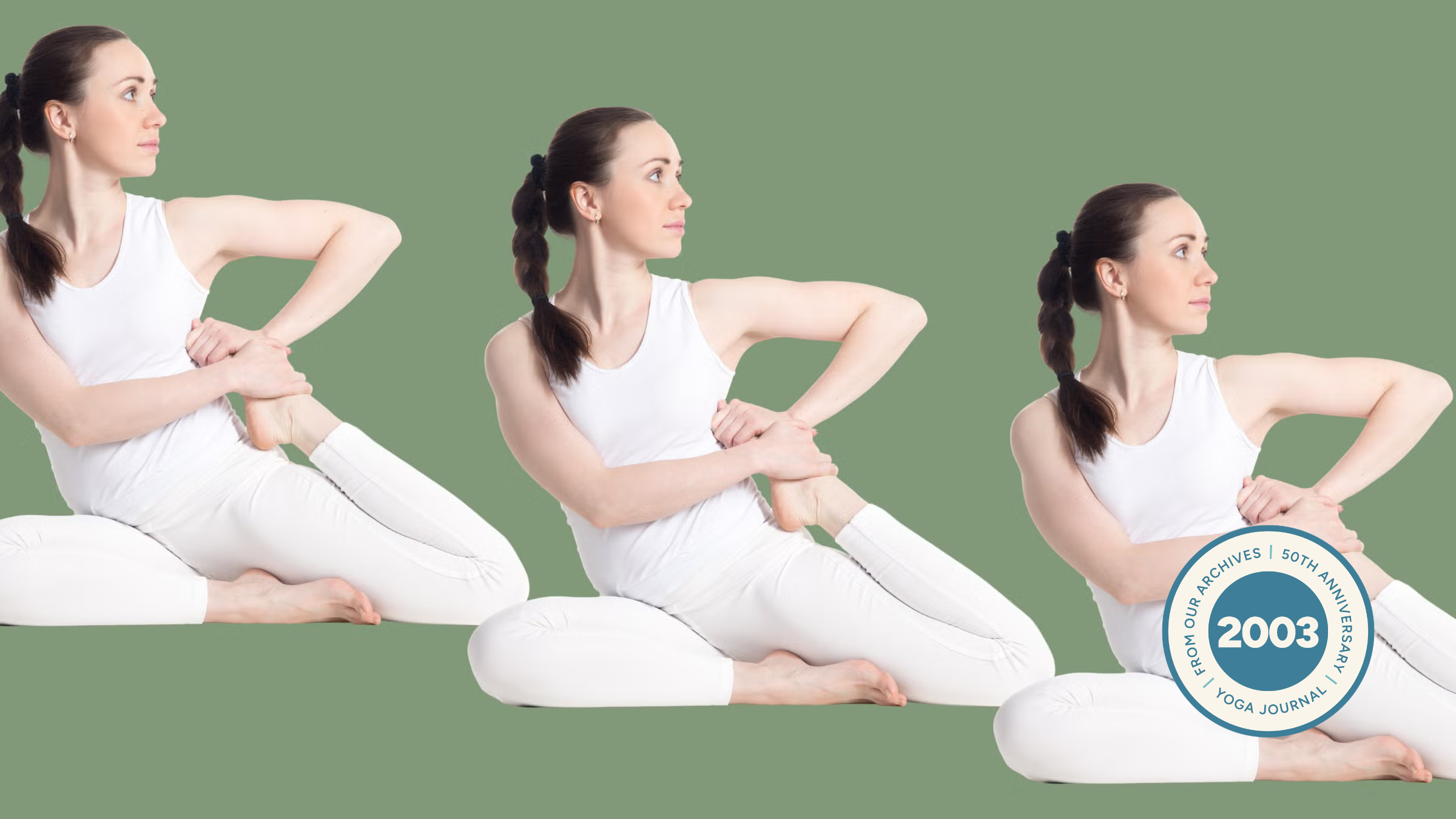
Vamadevasana II is the ultimate manifestation of this inner process. In this pose, one hip undergoes external rotation while the other undergoes internal rotation. The practitioner is challenged to find the "still center"—a point of equilibrium where neither direction dominates.
When we bring the feet together in an Anjali Mudra (prayer position) at the heart or within the pose, we are performing an act of integration. We are taking the extreme expansion of the hips and centering it, preventing the "unrestrained expansion" that caused the metaphorical tree to fall.
Preparatory Practices: A Four-Step Sequence
Vamadevasana II is an advanced posture that requires significant preparation. Before attempting the full expression, practitioners should warm the hips through the following four stages.
1. Ankle-to-Knee Pose (Padasthila Janurasana)
This pose is the gold standard for creating safe external rotation. Unlike Padmasana (Lotus), which can place undue torque on the knees, Padasthila Janurasana allows for controlled rotation.
- Execution: Begin in Dandasana (Staff Pose). Bend legs to 90 degrees. Rotate the left thigh externally, placing the shin parallel to the front of the torso. Stack the right shin on top.
- Refinement: Use the fingertips of your left hand to lift the left side of your chest. Use your right hand to rotate the right thigh externally, ensuring the inner thigh faces the ceiling. Perform rotational work on the exhale and pelvic lifting on the inhale.
2. Windshield Wipers: Internal Rotation
Vamadevasana II requires strong internal rotation, a movement often neglected in standard yoga sequences. This work targets the sartorius muscle.
- Execution: Lie on your back, knees bent, feet on the floor. Step the right foot one shin-length to the right.
- Refinement: As you exhale, bring the right knee toward the left heel. Keep the sole of the foot perpendicular to the shin, maintaining the structural integrity of Tadasana. If you experience inner-knee pain, use a bolster for support.
3. One-Legged Reclining Hero Pose (Eka Pada Supta Virasana)
This pose opens the front of the thighs and groins, creating the space necessary for the final rotation.
- Execution: From a supine position, draw your right foot and shin into Virasana (Hero Pose) while keeping the left leg bent for stability.
- Refinement: Push the right thighbone toward the knee while drawing the pit of the abdomen toward the head. If the intensity is too great, use a bolster under the torso to decrease the stretch.
4. Wide-Angled Windshield Wipers
This transition bridges the gap between basic rotation and the full pose.
- Execution: Begin in Upavistha Konasana (Wide-Angled Seated Forward Bend). Shift weight onto the right buttock, bending the right leg to 90 degrees. Carefully adjust the left leg so the left quadriceps and right hamstrings form a straight line.
- Refinement: Use your hands to manually guide the hips—rotating the right leg externally and the left leg internally. This sets the stage for the final binding action.
The Practice of Vamadevasana II
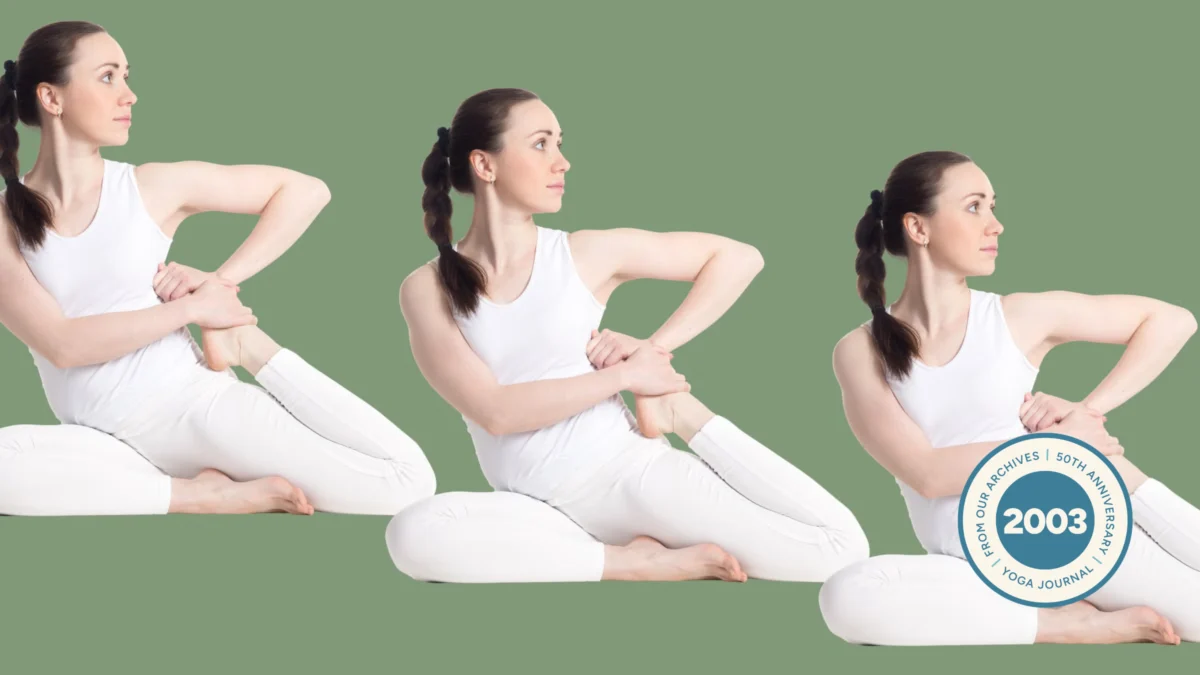
To enter the final posture, reach over the instep to grasp your left foot. Rotate the thigh internally as you lift the foot toward the left hip. Repeat with the right side. As the feet meet, lift the spine and twist the torso, looking over the left shoulder.
The sensation in the lower abdomen during this pose is akin to wringing out a sponge. By rotating one leg externally and the other internally, we create a compression that assists in the release of residual tension and toxicity. Holding this for three breaths—with the mind quiet and the heart open—brings the practitioner into a profound state of integration.
Implications and Reflections
As you delve into the complexity of Vamadevasana II, you will observe the duality of the legs creating a singular inner strength in the pelvis. The "Two who are one" mentioned by the sage Sri Aurobindo becomes a lived reality. This is the secret of all power in yoga: the ability to hold opposing forces in perfect, peaceful balance.
By approaching the mat with the awareness that we are balancing the dualities of our lives, we transform a simple physical exercise into a profound meditation on unity. Whether you are a seasoned practitioner or a curious student, remember that the goal is not merely the final shape of the pose, but the intelligence and presence you bring to the process of getting there.