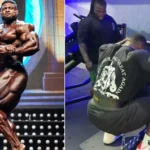





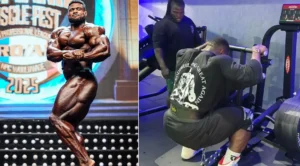

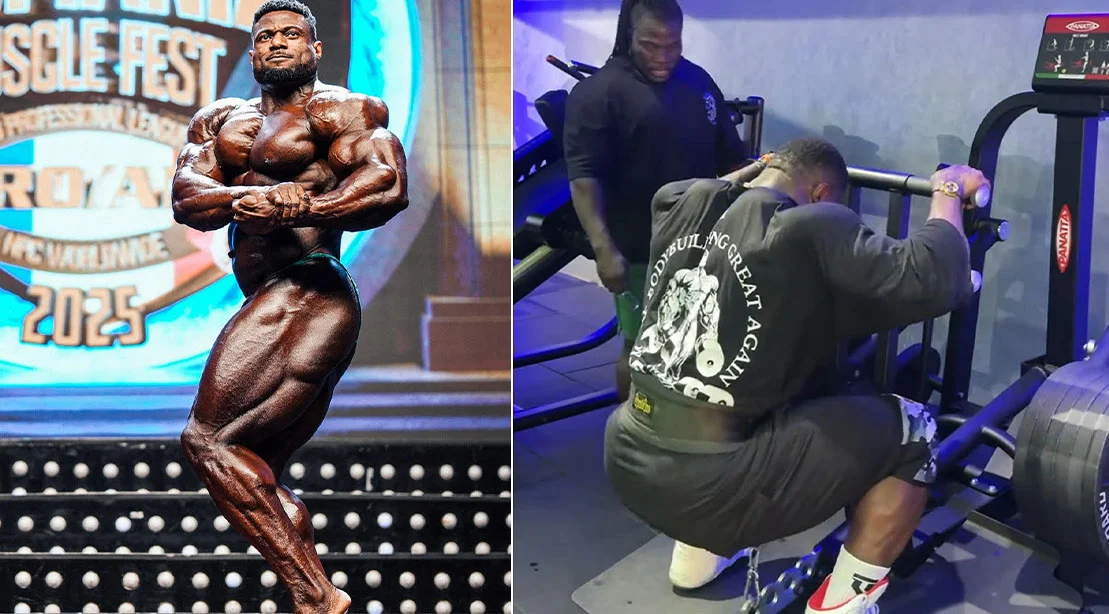
With the 2026 Joe Weider’s Olympia Fitness & Performance Weekend rapidly approaching—scheduled for September 24–27 in Las Vegas—the bodybuilding world is turning its collective gaze toward the industry’s most aesthetic force: Chinedu Andrew “Jacked” Obiekea. Known as the “Mona Lisa” of bodybuilding for his unparalleled proportions and artistic muscle insertions, the Nigerian phenom is not merely participating; he is hunting for the Sandow trophy.
As the clock ticks down to the final showdown in Nevada, Obiekea has offered a rare glimpse into the grueling, high-volume lower body training protocol he is utilizing to secure his legacy. By deconstructing his latest “brick by brick” training session, we can observe the technical precision required to evolve from a top-tier contender to an Olympia champion.
The Main Facts: Defining the 2026 Contender
Andrew Jacked has spent the last 24 months dismantling the narrative that mass must come at the expense of aesthetics. Since his breakthrough, he has established himself as a dominant force in the IFBB Pro League. Following a stellar third-place finish at the 2025 Olympia, Jacked embarked on an aggressive campaign that saw him capture the Arnold Classic titles in both the United States and the United Kingdom in 2026.
These victories did more than pad his bank account; they signaled a shift in the judging criteria of the sport, favoring the fluid, elongated lines that Obiekea possesses. However, as the industry knows, the Olympia stage requires a different level of density and conditioning. To bridge the gap between “superstar” and “legend,” Jacked is currently focusing on leg development, a department where he has historically been scrutinized for needing more sheer, freakish mass to match his towering frame.
Chronology of a Rise: From Pro-Debut to Olympia Hopeful
The trajectory of Andrew Jacked’s career is a study in rapid, calculated progression.
- 2022-2023: The formative years where Jacked transitioned from a social media sensation to a legitimate professional threat, showcasing a physique that brought a refreshing, classic look back to the open division.
- 2025: A pivotal year that saw him secure a podium finish at the Mr. Olympia. This served as the catalyst for his professional evolution, proving that his frame could hold the necessary weight to compete with the sport’s biggest monsters.
- 2026 (Early Year): The “Arnold Double.” By winning the Arnold Classic US and UK, Jacked solidified his status as the most active and dangerous challenger in the sport.
- September 2026: The current state of preparation. With less than a month before the Olympia, his training volume has shifted from purely hypertrophy-focused growth to detail-oriented refinement, ensuring that every muscle fiber is primed for the stage lights in Las Vegas.
The Science of the Session: Anatomy of the Workout
Jacked’s recent training session was not just about moving weight; it was a masterclass in biomechanical efficiency. By prioritizing specific machines, he manages to bypass structural fatigue to target the musculature directly.
The Leverage Squat: Establishing the Foundation
AJ began the session on a leverage squat machine. Unlike a barbell squat, which requires significant stabilization from the core and secondary muscle groups, the leverage squat utilizes a fixed path of motion. Because of the platform’s angle, Obiekea can achieve a depth that is physiologically impossible for many, placing the quadriceps, glutes, and hamstrings under a stretch that maximizes fiber recruitment.
The Belted Squat: Spine-Sparing Intensity
Second, Jacked transitioned to the belted squat. This is a critical tactical choice for an athlete of his stature. By shifting the weight load from the shoulders to the hips via a belt, he effectively de-loads the spinal column. This allows him to push to absolute failure without the limiting factor of lower back fatigue, ensuring his quads remain the primary mover throughout the set.
Leg Press: Precision Knee Flexion
For his third movement, Jacked utilized the leg press, placing his feet low on the platform. This specific foot placement forces a greater degree of knee flexion—the movement of the knee joint as it bends—which shifts the mechanical tension away from the glutes and squarely onto the teardrop-shaped vastus medialis and the outer sweep of the quads.
Leg Extensions: The Isolation Factor
The penultimate movement, the leg extension, served to exhaust the remaining glycogen stores in the quads. Jacked’s focus here was the "squeeze"—a momentary pause at the apex of the lift. By prioritizing the peak contraction, he ensures maximum blood flow and metabolite accumulation, key drivers of hypertrophy in the final weeks of contest prep.
Hip Thrusts: Engineering the Posterior Chain
The session concluded with the plate-loaded hip thrust machine. While often considered a niche exercise, in the context of bodybuilding, it is the gold standard for glute isolation. Jacked’s form is notable: he avoids the common error of overarching the lower back, instead keeping his spine neutral and using his glutes as the sole engines to drive the plates toward the ceiling.
Supporting Data: Why "Time Under Tension" Wins
The scientific community has long supported the methodologies Obiekea employs. Research published in journals concerning biomechanics consistently notes that when fatigue is managed through machine-based training, athletes can achieve a higher "Time Under Tension" (TUT).
TUT refers to the duration a muscle is under strain during a set. By utilizing machines for 8–12 reps with controlled eccentrics (the lowering phase), Jacked is manipulating cellular signaling pathways that encourage protein synthesis. For a bodybuilder of his height, the challenge is filling out the "canvas." His focus on deep, controlled repetitions rather than ego-lifting heavy, partial reps is a direct response to the judges’ call for more refined, dense muscle tissue.
Official Responses and Industry Outlook
The bodybuilding community has reacted with significant enthusiasm to these training updates. Industry analysts note that Obiekea’s transparency regarding his preparation is a departure from the "secretive" nature of past champions.
“Andrew represents the new guard,” says an industry spokesperson. “He is not just training; he is curating a physique. The decision to incorporate spine-sparing movements like the belt squat shows a level of maturity that is essential for a long-term champion.”
While the Olympia organizers have remained neutral, the buzz surrounding his potential victory is undeniable. If Jacked presents the conditioning he is currently showcasing in his social media updates, the reigning hierarchy of the Olympia may be in for a significant, and perhaps historic, shake-up.
Implications: The Road to the Sandow
What does this training routine imply for the landscape of the 2026 Olympia?
First, it suggests that the “mass monster” era may be yielding to a “refined mass” era. Judges have recently indicated that they are looking for the total package—size, yes, but accompanied by the flow and symmetry that Obiekea epitomizes. By focusing on machines that allow for maximum intensity with minimal injury risk, Jacked is ensuring he reaches the stage with his physique perfectly intact.
Second, the psychological component cannot be overlooked. By documenting his “brick by brick” process, Jacked is projecting a sense of calm confidence. He isn’t rushing the process; he is systematically building a championship-level body. This mindset is often the dividing line between those who win and those who merely compete.
As the industry prepares for the pilgrimage to Las Vegas, the pressure on Andrew Jacked is higher than ever. Yet, looking at the technical precision of his lower body routine, it is clear that he is not folding under that pressure. He is using it to forge a physique that, by the end of September 2026, could very well be crowned the best in the world.
For the fans, the message is clear: keep your eyes on the stage. The “Mona Lisa” is preparing his masterpiece, and the final strokes are being painted with every rep in the gym.