








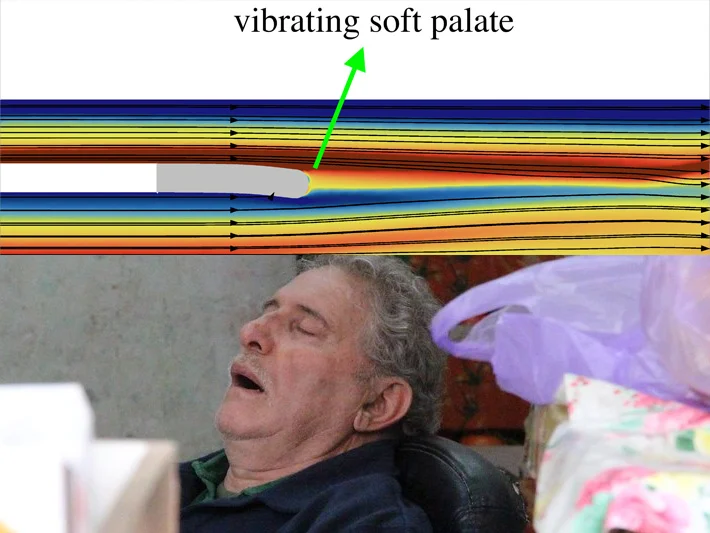
Snoring is a pervasive nocturnal phenomenon, affecting millions of individuals globally and serving as a frequent disruptor of restorative sleep. While often dismissed as a mere annoyance or the subject of household humor, snoring represents a complex interaction of fluid dynamics, biomechanics, and acoustic physics. Recently, a team of researchers from the KTH Royal Institute of Technology in Sweden has bridged the gap between theoretical physics and clinical sleep medicine by developing a sophisticated 3D computational model of the upper airway. This breakthrough study, published in the journal Physics of Fluids, offers a granular look at the precise mechanisms that generate the disruptive sounds known as non-apneic snoring.
The Science of Sound: Understanding the Upper Airway
At the heart of the research lies a fundamental question: how exactly does the simple act of breathing transform into the discordant vibrations we identify as snoring? Previous scientific inquiries into sleep-disordered breathing have frequently relied on oversimplified models that isolate either the airflow or the tissue movement. However, the upper airway is a highly dynamic environment where air, tissue, and sound are inextricably linked.
The research team, led by Peng Li, sought to move beyond these limitations by creating a comprehensive simulation. This model accounts for the fluid-structure interaction (FSI) between the air moving through the pharynx and the soft tissues—specifically the soft palate—that define the upper airway’s architecture. By simulating the "bellows" effect of respiration, the researchers were able to observe the onset of vibrations that occur when airflow passes through the restricted space of the oropharynx.
Chronology of the Research
The journey toward this discovery began with the recognition that while sleep apnea has been studied extensively, "primary" or non-apneic snoring lacks the same level of precise mechanical understanding.
- Initial Modeling Phase: The researchers initiated the study by digitizing the anatomy of the upper airway to create a high-fidelity 3D geometry. This digital twin served as the foundation for computational fluid dynamics (CFD) analysis.
- Simulation of Airflow Dynamics: The team modeled various breathing cycles, ranging from quiet breathing to the rapid, turbulent intake of air characteristic of the onset of snoring.
- Soft Tissue Integration: Unlike static models, the KTH simulation allowed the soft palate to deform in response to aerodynamic pressure. This "fluid-structure interaction" allowed the team to witness the palate’s oscillation—a phenomenon essential to understanding sound generation.
- Acoustic Mapping: By analyzing the pressure waves generated by these oscillations, the team was able to correlate specific airflow patterns with the frequency and amplitude of the sound produced.
- Validation and Peer Review: The final stage involved verifying the simulation against clinical observations, ensuring that the model accurately reflected the acoustic signature of human snoring.
Supporting Data and Technical Insights
The findings provide a roadmap for understanding why some individuals snore more loudly than others. The simulation revealed that the loudest sounds are not merely the result of air hitting tissue, but are driven by "unsteady aerodynamic loading."
When air enters the oral cavity during sleep, the soft palate—a spongy, flexible structure—begins to flutter. The research identified that the turbulence created by this air interaction is highly sensitive to the shape of the airway and the structural properties of the palate. Data from the study suggests that:
- Oscillation Amplitude: The magnitude of the vibration is directly proportional to the velocity of the airflow during the inspiratory phase of breathing.
- Frequency Modulation: The pitch of the snore is dictated by the tension and mass of the soft palate. As the airway narrows, the airflow accelerates, causing the palate to vibrate at a higher frequency, which in turn creates the characteristic "snoring" sound.
- Aerodynamic Feedback: The simulation highlighted that there is a feedback loop; as the tissue vibrates, it alters the path of the airflow, which further influences the vibration of the tissue. This recursive process is what makes snoring so persistent and difficult to stop once it begins.
Official Responses and Expert Perspective
In a statement released alongside the publication, lead researcher Peng Li emphasized the necessity of a holistic approach. "Many existing studies simplify breathing or neglect the interaction between airflow, tissue motion, and sound generation," Li stated. "We hope to better understand how breathing drives snoring and identify the dominant sound generation mechanisms."
The research has been received as a significant step forward by the medical community. By isolating the exact conditions that cause the soft palate to become "aero-elastically unstable," the team has provided a new target for otolaryngologists and sleep specialists. The study effectively turns the "black box" of the sleeping throat into an observable, manipulatable system.
"Our results suggest that reducing soft palate vibration or unsteady aerodynamic loading may help reduce palatal snoring," Li added. "This could inform the evaluation of palatal stiffening procedures or other interventions that modify tissue mechanics or airflow."
Clinical Implications: A New Era for Snoring Treatments
The implications of this research are far-reaching. Currently, clinical treatments for snoring range from oral appliances and CPAP machines to surgical interventions like uvulopalatopharyngoplasty (UPPP) or laser-assisted procedures. However, these treatments often follow a "trial and error" approach.
With the advent of this 3D computational model, physicians may soon be able to utilize a patient’s own anatomy to create a personalized simulation. This could allow for:
- Predictive Surgery: Before a patient undergoes a procedure to stiffen the soft palate, surgeons could run a simulation to predict how the tissue will react, potentially increasing the success rate of the intervention.
- Precision Oral Appliances: By modeling how specific jaw or tongue positions influence airflow, clinicians can design custom-fit mouthpieces that minimize the specific aerodynamic triggers identified in the study.
- Non-Invasive Management: Understanding the specific air-flow triggers might lead to better behavioral interventions or postural adjustments that prevent the soft palate from reaching the critical vibration threshold.
The Road Ahead: Future Directions
The research is far from over. The team at KTH is already planning the next phase of their investigation, which will focus on the role of "palatal stiffness." By systematically varying the stiffness parameters in their model, the researchers aim to identify the exact thresholds at which vibration becomes audible.
"Our next step is to investigate how palatal stiffness affects its vibration and the resulting snoring sound," says Li. "By systematically varying tissue stiffness, we aim to determine how it changes oscillation amplitude, dominant frequency, airflow patterns, and acoustic source strength."
This future work promises to clarify why some surgical interventions succeed where others fail, as it will reveal the mechanical conditions under which the tissue becomes resistant to the destabilizing forces of sleep-induced airflow.
Conclusion: Bridging Technology and Wellness
The research conducted at the KTH Royal Institute of Technology represents a masterful fusion of fluid dynamics and human physiology. By moving beyond the surface-level symptoms of snoring and diving into the complex physics of the upper airway, the team has paved the way for a new generation of diagnostic tools and therapeutic interventions.
For the millions of individuals who suffer from the health and social consequences of chronic snoring, this research offers a glimpse of a future where quiet nights are no longer a matter of chance, but a result of precise, science-backed clinical care. As the researchers continue to refine their models, the "noise" of the bedroom may eventually be silenced by the rigor of the laboratory.