









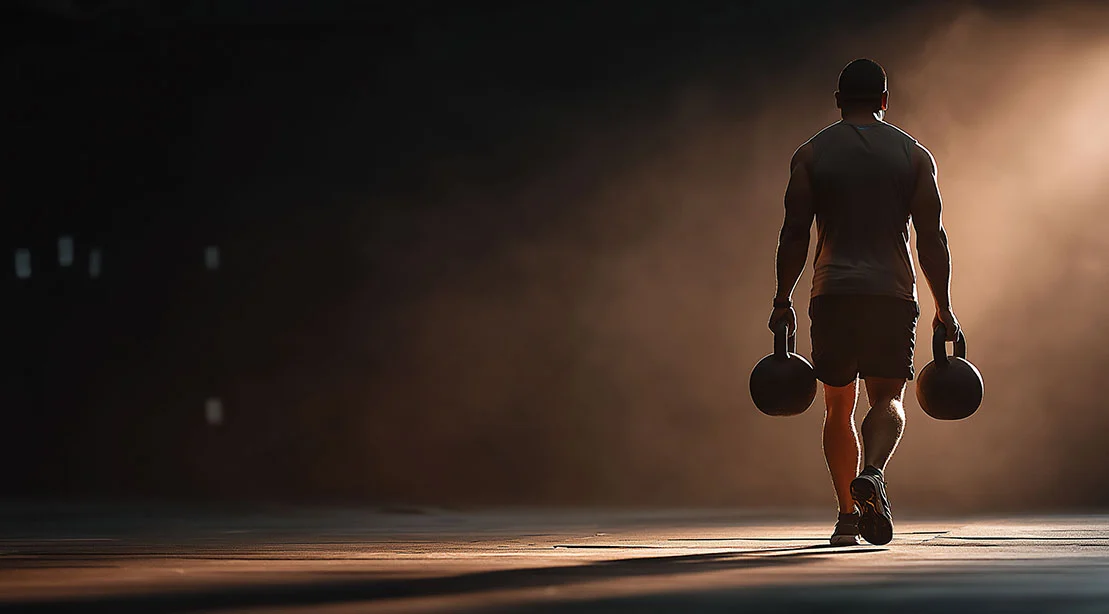
Walking with a heavy dumbbell in one hand is a staple of functional strength training. It is predictable, straightforward, and undeniably effective for building foundational core strength. However, the human body is an adaptation machine; once a movement becomes too predictable, the neurological "surprise" factor—and the subsequent muscular growth—begins to plateau. Enter the Chaos Suitcase Carry, a sophisticated evolution of the traditional carry that introduces intentional instability to turn a standard exercise into a comprehensive test of athleticism.
By suspending a kettlebell or weight plate from a looped resistance band rather than holding it directly, you force the load to bounce, sway, and tug with every stride. This simple modification transforms the exercise from a test of raw holding power into a dynamic challenge of proprioception, grip endurance, and anti-lateral flexion.
The Anatomy of "Controlled Chaos"
At its core, the Chaos Suitcase Carry is a unilateral loaded movement. You grip a resistance band, which in turn holds a weight, and you walk while maintaining a neutral, upright posture. In a standard suitcase carry, the load is static. In the chaos variation, the load is kinetic.
The physical implication of this is profound: your body is no longer simply resisting a fixed weight; it is reacting to a constantly shifting center of gravity. As the weight oscillates, your nervous system must execute thousands of micro-corrections per minute. This recruitment of stabilizer muscles—specifically the deep obliques, the quadratus lumborum (QL), and the pelvic stabilizers—far exceeds that of a traditional, stable carry.
Chronology of the Movement: How to Execute with Precision
To maximize the benefits of this movement while minimizing the risk of injury, follow this step-by-step protocol:
1. The Setup
Choose a kettlebell or weight plate that is approximately 50–60% of what you would typically use for a standard suitcase carry. Thread a light-to-medium resistance band through the handle of the kettlebell or the center hole of the weight plate. Loop the band back onto itself to create a secure, dangling handle.
2. The Grip
Grip the band firmly. Ensure your wrist is neutral—do not let the band twist your forearm excessively. Your grip strength will be tested immediately as the band vibrates.
3. The Stance
Stand with your feet hip-width apart. Before you take your first step, establish a "braced" core. Imagine you are about to be punched in the stomach. Ensure your rib cage is stacked directly over your pelvis.
4. The Initiation
Begin walking at a controlled, moderate pace. Avoid the urge to rush. Your goal is not to cover distance as fast as possible, but to maintain a perfectly upright torso while the weight bounces rhythmically beside you.
5. The Maintenance
As you walk, focus on keeping the "zipper" of your shirt facing forward. If the weight begins to swing wildly, slow your gait. The oscillation should be a rhythmic pulse, not a violent pendulum.
Supporting Data: Why Instability Training Matters
The efficacy of the Chaos Suitcase Carry is rooted in the principles of instability training. Research in sports biomechanics suggests that training with unstable loads increases the activation of the core musculature, particularly the internal and external obliques, which are responsible for preventing lateral flexion (side-bending) of the spine.
When you lift a fixed weight, your prime movers—the latissimus dorsi, the traps, and the forearm flexors—take the brunt of the work. When you introduce the band, the "emergency balance system" of the body kicks in. This system involves the smaller, intrinsic muscles surrounding the lumbar spine and the shoulder girdle. By forcing these muscles to fire in response to the band’s unpredictable oscillation, you are building a more resilient, injury-proof torso.
Furthermore, this exercise serves as an exceptional tool for proprioception training. Proprioception is the body’s internal GPS; it tells your brain exactly where your limbs are in space. By navigating a moving load, you are training your brain to integrate sensory input more rapidly, which translates to better balance, improved gait, and enhanced performance in high-impact sports like rugby, martial arts, or heavy lifting.
Professional Perspectives and Coaching Insights
Fitness professionals often categorize the Chaos Suitcase Carry as a "neurological primer." Unlike a deadlift or a squat, which are designed for hypertrophy and maximal force production, the chaos carry is designed for motor control.
Official Coaching Directives
- Shoulder Health: The "long arm" position is critical. Avoid the temptation to shrug the shoulder to "trap" the weight against your hip. A shrugged shoulder indicates that your trapezius is overcompensating for a weak grip or an unstable core. Keep the shoulder depressed (pulled down away from the ear).
- The "Stay Tall" Cue: The most common failure point is the lateral lean. When the weight pulls you to the right, your natural instinct is to lean to the left to balance the load. This negates the exercise’s primary purpose: training the core to resist that very lean. Stay perfectly vertical. If you find yourself leaning, the weight is too heavy, or your band is too long.
Implications for Your Programming
The Chaos Suitcase Carry should not replace your heavy farmers’ carries. Instead, it should serve as a specialized accessory movement.
Programming Integration:
- As a Warm-Up: Perform 2 sets of 30 yards per side to "wake up" the core and shoulder stabilizers before a heavy session of squats or deadlifts.
- As a Finisher: Perform 3 sets of 40–50 yards per side at the end of your workout to tax your grip and challenge your core under fatigue.
- Frequency: Because of the high demand on the central nervous system, 2–3 times per week is sufficient for most athletes.
Common Pitfalls and Solutions
- The "Wrecking Ball" Effect: If the weight is swinging so violently that you cannot control it, the band is likely too long or the weight is too heavy. Fix: Shorten your grip on the band by wrapping it around your hand one extra time.
- The Peripheral Interference: If the kettlebell is banging into your leg, you are likely walking with a stride that is too wide or you are not maintaining enough tension in the band. Fix: Slow your pace and take shorter, more deliberate steps.
- The Upper Trap Trap: As the grip fatigues, the neck will tighten. Fix: Actively breathe into your diaphragm. A held breath often leads to a braced, tense neck.
The Final Verdict
The Chaos Suitcase Carry is an exercise in focus. It demands that you stay present, connected, and physically disciplined. While it may look unconventional to those in the gym, the physiological benefits—a bulletproof core, superior grip strength, and an intuitive sense of balance—are undeniable.
By embracing the bounce, the sway, and the tug of the resistance band, you are moving away from the safety of predictable training and into the realm of true functional mastery. When the weight moves but your body remains a pillar of stability, you are no longer just training muscles; you are training your body to perform under the unpredictable conditions of real life. Whether you are an athlete looking to sharpen your movement patterns or a fitness enthusiast seeking to break through a core-strength plateau, adding a little chaos to your routine is the most direct path to progress.