











From the rapid-fire scroll of TikTok feeds to the bold claims found on the latest health-trend bestseller lists, vegetable oils—often colloquially termed "seed oils"—have emerged as the new lightning rod of nutritional debate. While the merits of these oils have been questioned since their widespread introduction to the commercial market, the recent rise of the "carnivore diet" has pushed the discourse into a volatile, polarized territory.
Critics frequently label these cooking fats as "toxic sludge," "motor oil," or "the hateful eight," claiming they represent a silent, pervasive driver of chronic disease. Conversely, many mainstream nutritional scientists maintain that these oils are benign, and in some contexts, health-promoting. As the debate rages on social media, it is clear that the truth is far too complex to be condensed into a viral meme.
The Core Argument: A Brief History
The anti-seed oil movement is built upon a foundation of evolutionary contrast. Proponents argue that human physiology evolved alongside animal fats for millennia, whereas vegetable oils are a modern invention of the 20th century. This narrative posits that profit-driven corporations sought cheap, industrial ways to create palatable fats, marketing them as "heart-healthy" alternatives to butter—a pivot that critics now claim was a catastrophic public health error.
The accusations are significant: opponents allege that excessive consumption of these oils contributes to obesity, anxiety, depression, and conditions like ulcerative colitis. To understand where reality ends and pseudoscience begins, we must examine the chemical processing, the clinical data, and the nuances of human nutrition.
Defining the Landscape: What Are Seed Oils?
"Seed oils" are oils extracted from the seeds of various plants. Common examples include soybean, corn, canola, cottonseed, sunflower, safflower, and grapeseed oil. It is important to distinguish these from fruit-based oils, such as olive, avocado, coconut, or palm oil, which are derived from the pulp of the fruit rather than the seed.
The Industrial Extraction Process
Unlike olive oil, which can be extracted through simple mechanical pressing, seeds contain relatively little fat. To extract oil from a cup of corn—which contains only about two grams of fat compared to the 20 grams found in a cup of olives—manufacturers utilize an intensive, multi-stage process:
- High-Heat Extraction: The seeds are heated and subjected to mechanical pressure.
- Solvent Extraction: Chemicals like hexane are often used to pull remaining oil from the seed meal.
- Refining, Bleaching, and Deodorizing: To remove impurities, odors, and colors, the oil undergoes harsh chemical and heat treatments.
During this process, many heat-sensitive, health-promoting polyphenols are destroyed. Furthermore, high-heat processing can transform small amounts of unsaturated fats into trans fatty acids. While the FDA banned the addition of industrial trans fats to foods in 2018, trace amounts can still occur during the industrial refining process and through high-heat commercial deep frying.

The Evidence: Head-to-Head Comparisons
To navigate the confusion, we must look at how specific oils perform in the context of human health and cooking stability.
Extra Virgin Olive Oil (EVOO) vs. Expeller-Pressed Canola
EVOO is arguably the gold standard of culinary fats. Because it is mechanically pressed without heat or solvents, it retains its original polyphenols, which combat inflammation and oxidative stress. Large-scale longitudinal studies, such as those conducted in Southern Italy, have shown that individuals consuming high amounts of EVOO (more than two tablespoons daily) see significant reductions in all-cause mortality.
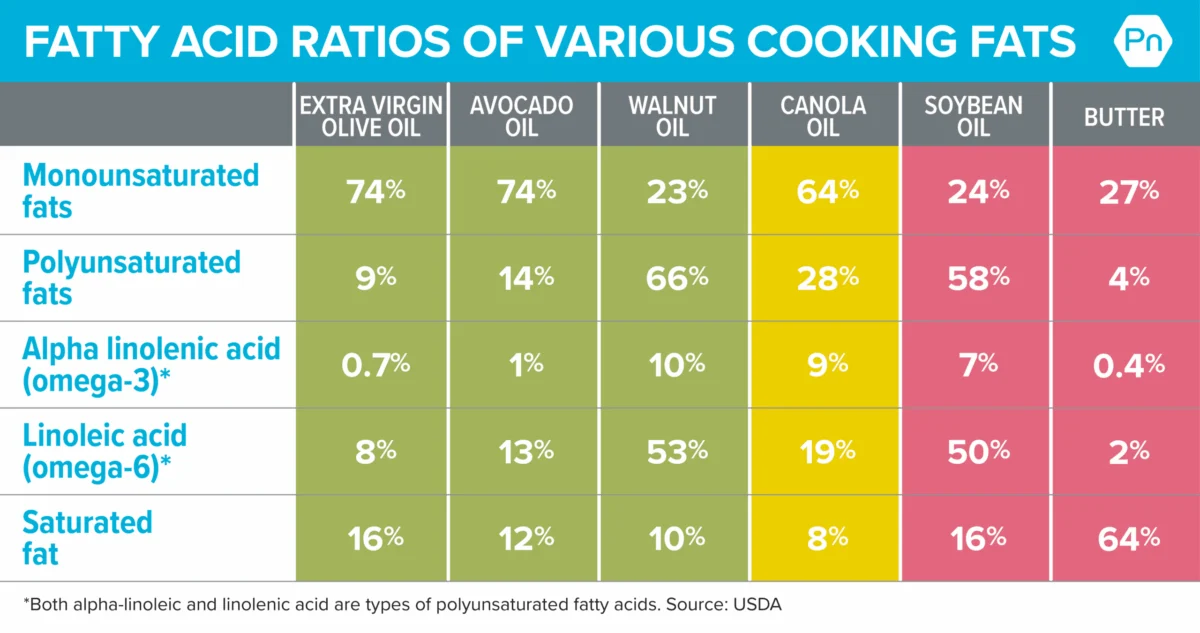
Canola oil, while often maligned, is actually a relatively high source of heart-healthy monounsaturated fats and alpha-linolenic acid (an omega-3). When "expeller-pressed," it avoids the harsh solvent-based refining process, making it a budget-friendly, neutral-flavored alternative for baking. However, the scientific consensus firmly places EVOO at the top of the hierarchy.
The Smoke Point Myth
A common misconception suggests that EVOO should never be used for cooking due to its "low" smoke point (350–410°F). However, modern research has debunked this. EVOO is remarkably stable when heated because of its high concentration of monounsaturated fats and protective antioxidants. Studies comparing various cooking oils have shown that EVOO remains more stable under high, sustained heat than many refined "vegetable" oils.
The Omega-6/Omega-3 Conundrum
The most frequent argument against seed oils involves the high concentration of omega-6 fatty acids. The typical Western diet features an omega-6 to omega-3 ratio of roughly 16:1 or 20:1, which some theorize drives systemic inflammation.
However, current scientific consensus is shifting. Research published in Circulation suggests that, rather than being inherently inflammatory, omega-6 fats are associated with a reduced risk of heart disease and stroke. The caveat is the "food matrix." Nuts and seeds, which are rich in omega-6s, come packaged with fiber, protein, and antioxidants. Highly refined oils, by contrast, are stripped of this matrix, leaving only isolated fatty acids that may be more prone to oxidation.
The Butter vs. Refined Oil Debate
This remains the most contentious issue in modern nutrition.

The Case Against Butter
While some proponents argue that saturated fats were unfairly demonized in the 1990s, the science suggests moderation is key. Consuming saturated fats beyond 10 percent of total daily calories is linked to elevated LDL cholesterol. Furthermore, because butter lacks the "milk fat globule membrane" found in whole dairy, it lacks the protective effect that may mitigate the cholesterol-raising impact of saturated fat.
The Case Against Refined Vegetable Oils
The problem with refined oils is rarely the oil itself in a home-cooked meal, but rather its role in ultra-processed foods (UPFs). These oils are often the backbone of snacks, dressings, and frozen dinners. Because they are processed and exposed to repeated heat cycles, they are highly prone to oxidation. When combined with the high sugar and sodium content of UPFs, they contribute to a dietary pattern that is consistently linked to premature mortality, metabolic syndrome, and obesity.
Implications for Public Health
The most significant takeaway for the average consumer is not necessarily to "ban" all seed oils, but to overhaul the dietary context in which they are consumed.
- Prioritize Whole Foods: If you are eating whole foods—avocados, nuts, olives, and fish—you are naturally consuming healthy fats in their protective, nutrient-dense matrices.
- Limit Ultra-Processed Foods: The danger of "seed oils" is effectively magnified by the food delivery system. A bag of chips is a different biological proposition than a drizzle of sunflower oil on a salad.
- Use High-Quality Fats When Possible: If your budget allows, prioritize EVOO and avocado oil for your primary cooking and dressings. If you are budget-conscious, expeller-pressed canola or high-oleic sunflower oil are acceptable, health-neutral choices.
- Avoid Deep-Fried Foods: Regardless of the oil type, deep frying at scale involves repeated high-heat exposure, which degrades the quality of any fat.
Conclusion: A Nuanced Path Forward
The "seed oil" panic is largely a reaction to the rise of ultra-processed food consumption, yet it often misattributes the problem to the oil itself rather than the quality of the overall diet. While it is true that highly refined, industrialized oils are inferior to cold-pressed, nutrient-rich alternatives like extra virgin olive oil, they are not inherently "toxic" in the way some social media influencers suggest.
For most people, the most effective strategy is simple: reduce reliance on ultra-processed products, favor whole-food fat sources, and maintain a balanced, plant-forward diet. By shifting the focus from "demonizing" a single ingredient to improving the overall quality of food intake, we can bypass the pseudoscience and move toward a more sustainable, evidence-based approach to nutrition.
References
For those seeking to verify the data presented, the scientific literature on fatty acid profiles, inflammatory markers, and cardiovascular outcomes can be accessed via the U.S. National Library of Medicine (PubMed) and the American Heart Association’s clinical journals.