










Across the expansive, shimmering stretches of the Atlantic seaboard, a quiet crisis is unfolding—one measured not in years, but in inches of encroaching tide and the splintering of timber against the relentless Atlantic surf. As sea levels climb and storm surges gain unprecedented ferocity, the American coastline is undergoing a profound transformation. For residents in vulnerable pockets like the Outer Banks of North Carolina and the shoreline neighborhoods of Connecticut, the romantic ideal of "oceanfront living" has collided with the harsh reality of a changing climate, forcing communities to confront a singular, daunting question: How do you protect a life built on shifting sands?
The Disappearing Shoreline: A Chronology of Collapse
The story of the Outer Banks is one of rapid, visible loss. In Buxton, North Carolina, homeowners like Lat Williams have watched their neighborhood vanish into the Atlantic. Within the last year alone, twenty-one homes have been surrendered to the sea. The process is often terrifyingly swift; in one documented instance, five houses were claimed by the waves in a span of just 45 minutes.
For Williams, the erosion was personal and visceral. "There were three houses over here, one out here, one right over here," he recalled, pointing to a stretch of ocean that now covers what was once his neighborhood. The destruction of neighboring properties serves as a grim marker of time. "It was devastating to stand there and watch our neighbor’s house bump into the corner of our deck," Williams said.
When the ocean reached his own doorstep, leaving his home barely standing and partially submerged, Williams took the only step available to him: he moved his entire three-bedroom house. Last November, in a feat of engineering that underscored the desperation of the situation, the house was hoisted onto wheels and rolled two blocks inland. The cost—north of a quarter-million dollars—wiped out a significant portion of his retirement savings. Yet, for Williams, the alternative of abandoning the property was never an option. His house, now sitting 600 feet from the water, bears a sign that reads "Answered Prayers," a testament to his determination to hold onto his legacy.
Supporting Data: The Rising Tide of Risk
The crisis in the Outer Banks is not an isolated anomaly; it is a preview of a broader national struggle. Coastal scientist Reide Corbett of East Carolina University notes that while barrier islands are naturally dynamic, the current rate of erosion is "uniquely bad." In some areas, the coastline is receding by 10 to 15 feet per year.
"You’re losing hundreds and hundreds of feet of potential beachfront during the time of a single mortgage," Corbett explains. The mathematics of the problem are compounded by global warming. As polar ice melts and ocean temperatures rise, sea levels continue to climb. This creates a higher baseline for every storm and high tide, allowing water to penetrate further inland than historical records suggest.
The data provided by Climate Central is sobering: by 2050, an estimated 2.5 million Americans and 1.4 million homes will be at high risk from severe coastal flooding. The vulnerability is often hidden from new buyers. Corbett points out that homes have been purchased in these high-risk zones within the last year, with owners often unaware of the precarious nature of the land beneath them. "I do think that we need to be up front about the risk," Corbett urges, emphasizing that transparency is the first step toward managing an inevitable future.
Structural Adaptation: Resilience and Its Limits
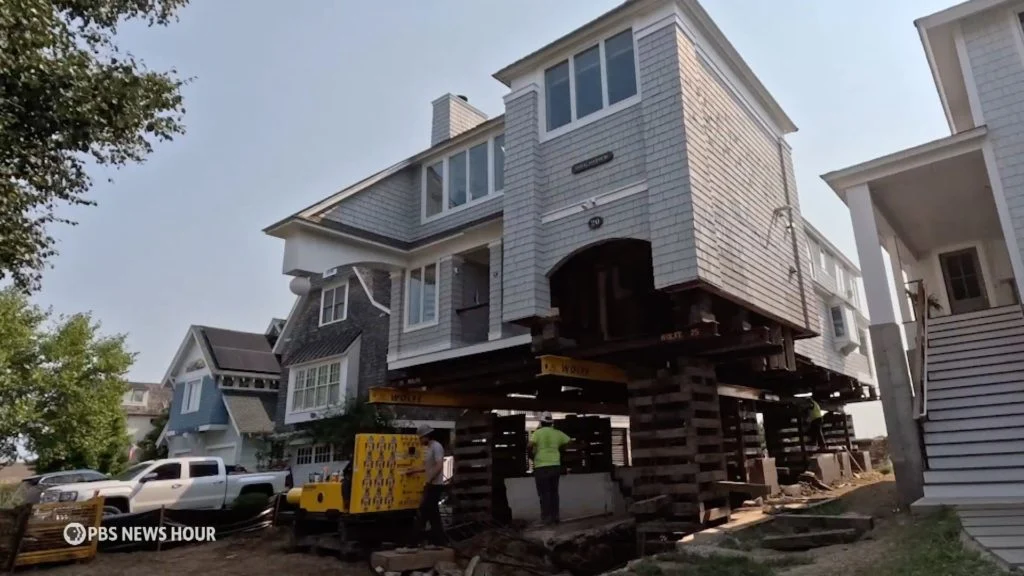
Further north, in Connecticut, the approach to coastal survival takes a different form. Here, the focus is on "lifting"—physically raising homes above the reach of floodwaters. Tim Rath, a resident who has spent 42 years on the coast, recently spent $50,000 to raise his 60-ton home nine feet into the air.
"I have been through four or five major floods, and it gets old after a while," Rath says. His neighborhood was devastated in 2012 by Superstorm Sandy, a weather event that caused nearly $70 billion in damages across the East Coast. For those who remain, the sight of houses jacked up on steel beams has become the new architectural standard. Since Sandy, new seawalls have been constructed, and nearly half of the homes in Rath’s community have been elevated. For these residents, the goal is not to retreat, but to build a bulwark against the inevitable, hoping to preserve the property for the next generation.
Official Responses: The High Cost of Holding Ground
The financial burden of coastal protection is shared between individual homeowners and local governments. In Dare County, North Carolina, officials are engaged in a costly cycle of "beach nourishment"—the process of pumping sand onto eroding beaches to protect both private property and critical infrastructure, such as Highway 12.
Bobby Outten, the Dare County Manager, defends the practice as a necessary economic safeguard. "The only reason you’re here or I’m here or anybody’s here is because we have a beach," he notes. However, the price tag is staggering. Rebuilding the beach in Buxton costs approximately $50 million, an endeavor the county has undertaken three times in just a decade.
Critics of these projects compare them to "shoveling money into the ocean," arguing that they provide only temporary relief against a permanent geological shift. While Outten acknowledges the difficulty, he maintains that mitigation is the only viable path forward. "Beach nourishment is a great tool as long as you have got enough sand and enough money, because it works," he says. Yet, when asked if they can fight the sea forever, he admits the limitations: "We can mitigate it like this for a while. How long? I can’t answer that question."
Implications: The Tipping Point of Coastal Living
The common thread linking the residents of the Outer Banks and the homeowners of Connecticut is a profound emotional attachment to place. Whether it is moving a house two blocks inland or elevating a structure nine feet, these actions are driven by a desire to maintain a connection to the coast.
However, experts argue that the nation is rapidly approaching a "tipping point." The current strategy of defensive engineering and individual adaptation is becoming increasingly expensive and, in some locations, fundamentally unsustainable. The disconnect between the speed of climate change and the longevity of infrastructure is creating a market of "stranded assets"—homes that are losing value even as they continue to be inhabited.
The broader implication is that the definition of "home" in America is being rewritten. For decades, the coast was viewed as a permanent sanctuary. Now, it is increasingly viewed as a temporary, albeit beautiful, risk. As the ocean continues its steady advance, the conversation must shift from how to simply "hold the line" to how to plan for a future that will inevitably involve retreat and relocation for millions of people.
For Lat Williams, sitting in his home 600 feet from the surf, the change is undeniable. He acknowledges the reality of climate change, but argues that the solution is adaptation rather than total abandonment. "You can’t just say, well, abandon everything," he reflects. Yet, as the shoreline continues to shrink, the choices facing thousands of other Americans will grow more difficult. The "Answered Prayers" of today may, in a few decades, require a much more radical form of grace.
As we look toward the mid-century, the lessons of the Outer Banks serve as a mirror for the entire country. The coast is not just a place of recreation; it is the front line of a changing planet, and the struggle to remain there is defining the next generation of American environmental policy and personal resilience.