










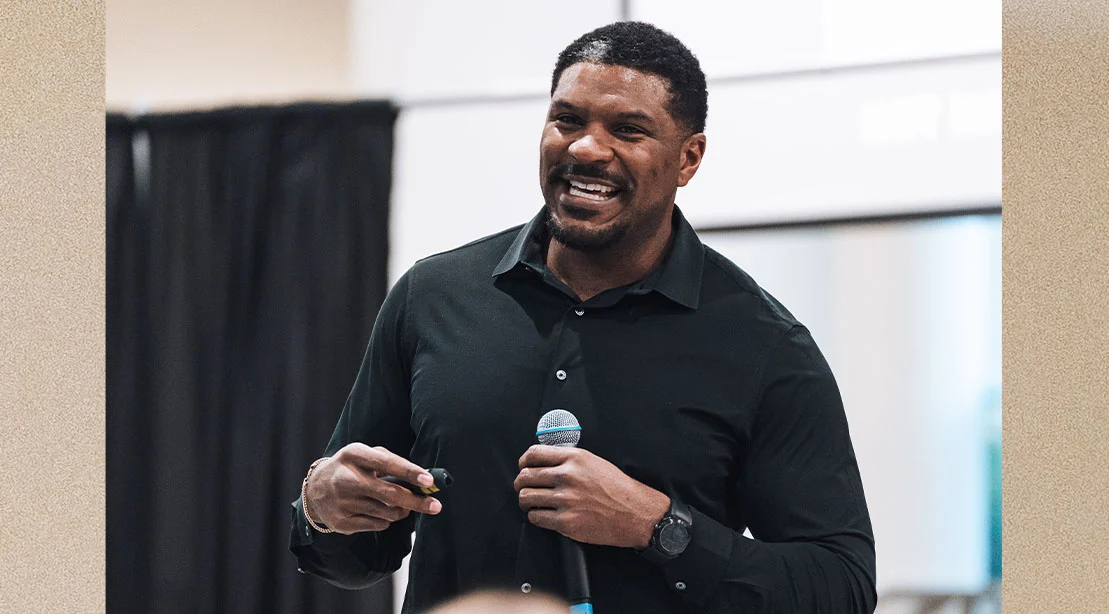
When the final whistle blew on Julius Thomas’s NFL career in 2018, the silence that followed was deafening. For a man who had spent years operating at the highest levels of professional football—catching touchdown passes from legends like Peyton Manning and earning two Pro Bowl selections—the transition to civilian life was not the victory lap many fans might imagine. Instead, it was a profound, disorienting descent into the unknown.
At 30 years old, Thomas found himself standing on the precipice of a new existence, stripped of the rigid, structured playbook that had dictated his daily life for nearly a decade. There were no coaches to provide feedback, no teammates to share the burden, and no immediate, tangible wins to validate his efforts.
Today, as a clinical psychologist and performance consultant, Thomas is leveraging that crucible of personal experience to reshape how we understand the intersection of mental health and peak performance. Through his firm, Optimal Performance, and his academic rigor, he is arguing that the "push-through" mentality that defines modern athletics—and the corporate boardroom—is not just outdated; it is a ticking time bomb for the human nervous system.
The Chronology of a Transformation
Thomas’s journey from the stadium to the clinic was neither quick nor linear. Following his retirement, he traded the locker room for the lecture hall. The transition required him to embrace a humbling reality: he was a master of his craft in one arena and an absolute novice in another.
“When you have to go from a master to a rookie, you go from winning a lot, knowing what you’re doing, and being very comfortable with all of it, to then having to rebuild that,” Thomas recalls. “That is extremely challenging, because in the beginning of any journey, it’s losing, doing it wrong, working really hard, and struggling through it.”
He spent the subsequent years immersed in the rigorous academic world of clinical psychology. This period was marked by intensive classroom study, a grueling clinical residency, and the slow, deliberate process of forging a new identity. In June 2025, that labor culminated in the attainment of his doctorate in clinical psychology. Eight years removed from his final NFL game, Thomas is only now reaching the point where he feels fully aligned with his new professional calling.
The Myth of the "Push-Through" Mentality
The 2026 NFL season has served as a grim backdrop for Thomas’s observations on human fragility. The league has seen a staggering number of early-season injuries to marquee quarterbacks, including Jayden Daniels, Caleb Williams, and Jaxson Dart. Perhaps most notably, Philadelphia Eagles star Jalen Hurts was sidelined for the remainder of the season due to a combination of deep vein thrombosis and bilateral pulmonary emboli—a complication stemming from an initial calf injury.
While some might seek a singular culprit, Thomas rejects the notion that this rash of injuries is an anomaly. “Football has a 100% injury rate,” he asserts. “Every single person that plays football is going to get injured, so injuries are just high in that sport in general.”
However, Thomas distinguishes between the unavoidable contact injuries of the game and the systemic failure of recovery. He points to training loads, playing surfaces, and the relentless pressure to perform as drivers of non-contact injuries. His core thesis is that the industry—and by extension, the corporate world—has fundamentally misunderstood the physiology of success.
“If you just only floor it, only floor it, only floor it, how long do you think that engine is going to do well?” he asks. “Not very long.”
The Science of Emotional Regulation
Thomas identifies emotional regulation as the "biggest unaddressed area of performance in all of sport." This is not merely a philosophical stance; it is rooted in psychoneuroimmunology. Emotions act as triggers for the nervous system; sustained negative emotions and unmanaged stress keep the body in a state of sympathetic nervous system arousal—the "fight or flight" mode.
Without the intervention of the parasympathetic nervous system—the "rest and digest" branch—the body begins to degrade. Thomas notes that when we fail to prioritize sleep, recovery, and emotional processing, we are essentially redlining our internal machinery.
The scientific literature supports his perspective. A landmark 2017 meta-analysis published in Sports Medicine established a clear correlation between stress responses and increased injury risk, demonstrating that psychological interventions could significantly reduce injury rates. Despite this evidence, the culture of high performance continues to prioritize raw output over sustainable maintenance.
The "Striving for 100" Framework
Thomas’s work with high-performing executives often mirrors his work with athletes. He frequently encounters leaders who seek quick fixes, such as nootropics for focus, while ignoring the fact that they have been operating on four hours of sleep for two decades.
To combat this, Thomas developed the "Striving for 100" framework. It is a holistic approach anchored by five daily pillars:
- Exercise: Physical maintenance and metabolic health.
- Sleep: The fundamental baseline for cognitive and physical repair.
- Nutrition: Fueling the body for longevity rather than just performance.
- Recovery: The deliberate "brakes" applied to the nervous system.
- Healthy Substance Use: Mindfulness regarding intake and chemical management.
These pillars are reinforced by clinical methodologies, including Cognitive Behavioral Therapy (CBT) and Acceptance and Commitment Therapy (ACT). Thomas emphasizes that this is not about "self-care" in the fluffy, commercialized sense, but rather a strategic, evidence-based approach to staying in the game.
Societal Implications: The Identity Crisis
A recurring theme in Thomas’s advocacy is the dangerous way society handles the transition out of elite performance. He bristles at the common advice that athletes should simply "separate who they are from the sport they played."
"It really bothers me when people say that about athletes, because they’re trying to minimize the challenge of the experience," Thomas explains. "Identity runs deeper than a label; it’s built by what you do every day and reinforced by how others see you."
For years after retirement, Thomas was still approached primarily as a tight end. The struggle to be seen as a doctor and a consultant, rather than a former jersey number, is a psychological hurdle that requires deep internal work. He argues that we must stop telling people their transition "should be easy" and instead acknowledge that major life changes are inherently destabilizing.
Furthermore, he points to a glaring disparity in how we seek help. Data from the CDC suggests that only 10.9% of U.S. men receive counseling or therapy, compared to 16.9% of women. Thomas draws a direct parallel to the locker room: "As a player, I never hesitated to walk into the training room with a sore ankle. We are constantly asking for help in so many areas of our life, but we somehow, as a culture, believe that we should handle what’s in our heart and in our mind by ourselves."
Building the Future of Performance at Eudaimonia
Thomas’s transition has led him to the vanguard of the health and longevity industry. He is a featured speaker at the upcoming Eudaimonia conference (November 5-8), where he will share the stage with leaders in neuroscience, medicine, and wellness.
For Thomas, these gatherings are vital because they facilitate the cross-pollination of ideas necessary to move the needle on human performance. His keynote presentations will focus on mental health, performance, and the capacity to adapt, with a central message of hope and actionable intelligence.
"If you want sustainable high performance, you have to build well-being and quality of life into what you do," he says.
As Julius Thomas looks back on his eight-year journey, he views the struggle not as a failure, but as the necessary cost of growth. He is proof that the most elite performers are not those who never break, but those who build the psychological infrastructure to mend, evolve, and thrive long after the final whistle. In a world that prizes the "grind" above all else, his voice serves as a necessary, scientific, and deeply human reminder that the most important performance metric is the one that allows you to show up, healthy and whole, for the next chapter.