SCARSDALE, NY – As the academic semester draws to a close, high school and university campuses across the country are entering a period characterized by heightened cortisol levels, sleep deprivation, and intense psychological pressure. Finals week, once a standard rite of passage, has increasingly become a focal point for mental health advocates who argue that the traditional "cram and perform" model is unsustainable.
New data and emerging methodologies suggest that the key to surviving this period lies not in the intensity of the effort, but in the strategic application of mindfulness and cognitive management. According to Theo Kertesz, a junior at Scarsdale High School and co-founder of the mental wellness platform StayMindful, the difference between success and burnout often comes down to a handful of physiological and organizational "resets."
The Main Facts: The Anatomy of Academic Overload
Finals week represents a unique convergence of stressors. Students are typically required to synthesize several months of complex information across multiple disciplines simultaneously. This creates a phenomenon known as "cognitive overload," where the brain’s executive functions—responsible for focus, decision-making, and emotional regulation—become overwhelmed.
The primary challenges identified by educators and mental health professionals include:
- Scope Paralysis: The inability to begin a task because the overall goal (e.g., "Learn all of Organic Chemistry") feels insurmountable.
- The Marathon Fallacy: The belief that studying for twelve consecutive hours is more effective than shorter, focused intervals, despite neurological evidence to the contrary.
- Physiological Hyper-arousal: A state of constant "fight or flight" that impairs the prefrontal cortex, making it harder to recall information during the actual exam.
To combat these issues, student-led initiatives like StayMindful are advocating for a shift in perspective. Instead of viewing finals week as a test of endurance, they argue it should be treated as a test of mental sustainability.
Chronology: The Lifecycle of Finals Stress
The progression of stress during the finals period typically follows a predictable, yet damaging, chronological arc. Understanding this timeline is essential for intervention.
Phase 1: The Anticipatory Build-up (2-3 Weeks Prior)
In this stage, the realization of the workload begins to set in. Students often experience "productive procrastination," where they organize their desks or make elaborate schedules rather than engaging with the material. Stress is manageable but rising.

Phase 2: The Peak Saturation (1 Week Prior)
As deadlines loom, sleep cycles begin to deteriorate. This is the period where "all-nighters" become common. Research indicates that during this phase, the lack of REM sleep significantly impairs the consolidation of new memories, effectively neutralizing much of the studying being done.
Phase 3: The Performance Crucible (Exam Week)
During the actual week of exams, the body is often running on adrenaline. This is when "spikes" of acute anxiety occur, often triggered by a single difficult question. This is the critical window where immediate physiological resets, such as the "cyclic sigh," are most necessary.
Phase 4: The Post-Exam Crash
Following the conclusion of finals, many students experience a "let-down effect," where the immune system, previously bolstered by stress hormones, weakens, leading to illness and emotional exhaustion.
Supporting Data: The Science of the "Reset"
While the advice to "just breathe" is often dismissed as cliché, recent clinical research provides a robust empirical foundation for specific breathing techniques.
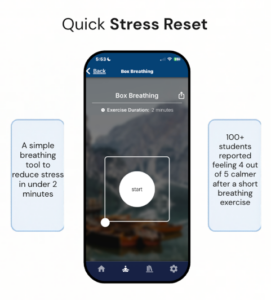
One of the most significant breakthroughs in this field comes from Stanford University. Researchers found that cyclic sighing—a controlled breathing pattern involving a deep inhalation, followed by a second shorter "sip" of air, and a long, slow exhalation—is more effective at reducing anxiety than traditional meditation.
"The cyclic sigh immediately engages the parasympathetic nervous system," explains the StayMindful team. "It signals to the brain that the immediate ‘threat’—even if that threat is just a biology textbook—is not life-threatening."
In independent testing conducted by StayMindful, the results were quantifiable. After a single guided session of cyclic sighing, over 100 student participants reported their internal "calmness" levels. On a scale from 1 (not calm) to 5 (extremely calm), the average response was a 4. This data suggests that even a 60-second intervention can statistically shift a student’s emotional baseline.
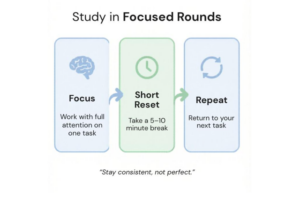
Furthermore, the data regarding "Focused Rounds" (often referred to in academic circles as the Pomodoro Technique) shows that the human brain can only maintain peak focus for approximately 25 to 50 minutes before "vigilance decrement" sets in. By working in structured rounds with mandatory physical resets—such as stretching or stepping outside—students maintain a higher average of cognitive performance over a six-hour period than those who attempt a "marathon" session.
Official Responses: From Performance to Wellness
The shift toward prioritizing mental health during finals has gained traction among national organizations. Active Minds, a leading nonprofit organization dedicated to promoting mental health for young adults, has been vocal about the need to decouple academic performance from self-worth.
"Students are more than their academic performance, especially during high-pressure times like finals week," Active Minds stated in a recent outreach campaign. The organization emphasizes that while grades are a metric of learning, they are not a metric of human value.
Educational institutions are also beginning to respond. Some high schools and universities have implemented "dead weeks" (where no new assignments are given before finals) or provided "wellness rooms" equipped with resources for mindfulness.
Theo Kertesz’s work with StayMindful represents a new wave of student-led "official responses." By providing daily motivational inputs and structured tools, the app serves as a digital buffer against the isolation of finals week. "The goal is not to eliminate stress completely—stress is a natural response to a challenge," Kertesz notes. "The goal is to make it manageable so you can keep moving forward."
Implications: A Paradigm Shift in Education
The long-term implications of how we handle finals week extend far beyond the classroom. The habits formed during these high-pressure academic years often carry over into the professional world.
If students are taught that the only way to succeed is through self-neglect and "pushing through" burnout, they enter the workforce predisposed to chronic stress and mental health crises. Conversely, if the education system—and the students within it—adopt a "sustainability-first" model, the implications for public health are profound.
1. The Rise of "Cognitive Hygiene"
Just as physical hygiene became a standard of public health in the 19th century, "cognitive hygiene"—the practice of regularly cleaning and resetting one’s mental state—is becoming a 21st-century necessity. Techniques like micro-targeting (breaking large goals into tiny, actionable steps) are being recognized as essential executive function skills.
2. The Re-evaluation of Meritocracy
There is a growing conversation about whether high-stakes testing is an accurate measure of intelligence or merely a measure of stress tolerance. As mindfulness tools become more mainstream, we may see a shift toward "authentic assessment," where students demonstrate knowledge in ways that don’t require psychological trauma.
3. The Role of Technology as a Solution, Not Just a Stressor
While social media is often blamed for increasing student anxiety, platforms like StayMindful demonstrate that technology can be leveraged to provide "positive inputs." By delivering motivational quotes and guided exercises directly to the devices that usually cause stress, these apps are "meeting students where they are."
Conclusion: Beyond the Grade Book
As another finals season reaches its peak, the message from both experts and student leaders is clear: the most important tool in a student’s arsenal isn’t a calculator or a set of flashcards—it is a regulated nervous system.
The strategies outlined by Kertesz and supported by Stanford research—micro-targeting, cyclic sighing, and focused study rounds—are more than just "study tips." They are survival strategies for a high-pressure age. By acknowledging that grades do not define worth and that mental health is a prerequisite for—not an obstacle to—success, the next generation of scholars is beginning to rewrite the rules of the academic crucible.
Finals week will always be challenging, but it no longer has to be breaking. Through a combination of science-backed techniques and a shift in cultural mindset, students are finding that it is possible to move forward, stay calm, and emerge from the library not just with a passing grade, but with their well-being intact.
About the Author:
Theo Kertesz is a junior at Scarsdale High School and co-founder of StayMindful, a mental wellness app designed to help students manage stress through practical tools like breathing exercises and mindfulness techniques. He works closely with students to better understand how to support mental health in academic environments.