











Main Facts: The Search for Optimal Blood Pressure Targets
The management of atrial fibrillation (AF) has long been dominated by the clinical necessity of anticoagulation to prevent thromboembolic events. However, a significant portion of the cardiovascular burden associated with AF—including heart failure, stroke, and cardiovascular mortality—is driven by comorbid hypertension. For years, clinicians have relied on extrapolated data from general hypertension trials to manage patients with AF, as dedicated, large-scale randomized controlled trials (RCTs) specifically targeting this population were notably absent.
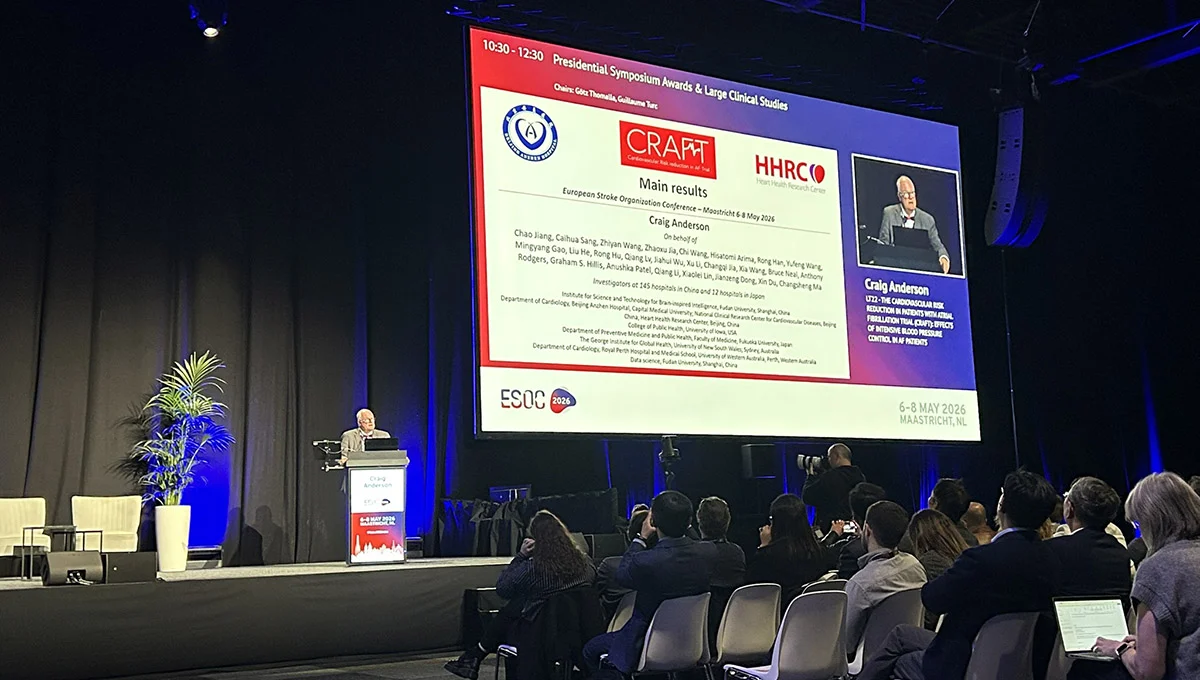
The CRAFT (Cardiovascular Risk in Atrial Fibrillation Trial) study, the results of which were unveiled last week at the European Stroke Organisation Conference 2026 in Maastricht, Netherlands, sought to fill this evidence gap. The trial investigated whether an intensive systolic blood pressure (BP) goal of less than 120 mm Hg, measured via home monitoring, offered superior clinical outcomes compared to a standard target of less than 135 mm Hg in patients with AF and at least one additional cardiovascular risk factor.
The primary finding was unexpected: over a four-year follow-up period, the intensive BP control strategy failed to significantly reduce a composite endpoint of cardiovascular death, nonfatal myocardial infarction (MI), nonfatal stroke, or heart failure (HF) hospitalization compared to the standard approach. With a win ratio of 1.02 (95% CI 0.90-1.15), the results suggest that, for the cohort as a whole, a more aggressive reduction in systolic blood pressure does not provide an incremental clinical advantage.
Chronology of the CRAFT Investigation
The CRAFT trial was conceived to address the global rise of AF and the frequently overlooked role of blood pressure management in its progression. Investigators designed the study to be a robust, multicenter endeavor, ultimately recruiting 1,676 participants from 145 centers in China and 12 in Japan.
The Study Lifecycle:
- Recruitment and Baseline: Participants were identified as clinically stable AF patients with a home systolic BP baseline between 125 and 154 mm Hg, plus at least one secondary cardiovascular risk factor. The mean age of the cohort was 69 years, with 40% of the participants being women.
- The Run-in Period: A mandatory two-week run-in period was implemented to ensure participants could reliably perform home BP monitoring and adhere to the protocol requirements.
- Randomization: Patients were randomized into either the intensive or standard BP control arms. Notably, 96% of the cohort carried a diagnosis of hypertension. The majority (54%) presented with persistent AF, and the use of antithrombotic agents was prevalent, with roughly two-thirds of the participants on direct oral anticoagulants (DOACs) and 12% on vitamin K antagonists.
- Follow-up: The study tracked outcomes over a four-year window. Throughout this duration, investigators maintained an average systolic BP separation of approximately 8 mm Hg between the two trial arms.
- Reporting: The final data analysis was presented by lead investigator Craig Anderson, MD, of the George Institute for Global Health, during the 2026 European Stroke Organisation Conference.
Supporting Data and Subgroup Paradoxes
While the primary endpoint failed to show a statistically significant benefit for the intensive strategy, the nuance of the CRAFT data lies in the subgroup analyses. Dr. Anderson noted that the treatment effect was remarkably inconsistent across different patient demographics.
Divergent Trends
The data revealed a striking interaction by age and sex (P < 0.001 for both):
- The Intensive Advantage: The lower BP goal ( <120 mm Hg) appeared to confer a benefit to male patients, those younger than 75 years, and patients who were concurrently receiving oral anticoagulation.
- The Standard Advantage: Conversely, the standard goal (<135 mm Hg) favored female patients, those 75 years of age and older, and participants who were not receiving anticoagulation therapy.
These findings present a clinical conundrum. Despite the strong statistical significance of these interactions, the underlying biological mechanism remains elusive. Dr. Anderson reported that there were no discernible differences in the specific classes of BP-lowering medications prescribed or in the achieved blood pressure levels across these subgroups.
"We can look at it as black-and-white and say it’s purely hypothesis-generating," Dr. Anderson remarked during his presentation, "but when you’ve got p-values less than one in a thousand, it’s hard to ignore that."
Official Responses and Expert Critical Analysis
The presentation of the CRAFT trial has sparked a rigorous debate within the cardiovascular community. Philip Bath, MD, of the University of Nottingham, provided a critical assessment of the study’s design and limitations, suggesting that the "negative" primary result might be attributed to several variables beyond the simple blood pressure targets.
The Question of Pharmacotherapy
Dr. Bath emphasized that in the context of AF and heart failure, the type of antihypertensive medication is as critical as the target number. "Heart failure is an important part of atrial fibrillation," Bath noted. "Diuretics are clearly beneficial for heart failure management. We know that ACE inhibitors and ARBs provide significant protection. However, other agents—such as alpha-blockers—offer little benefit in heart failure, and calcium channel blockers present a more ambiguous profile." Because the CRAFT trial did not explicitly standardize the drug classes used to achieve the target BP, experts argue that the medication choice may have obscured the trial’s efficacy.
Statistical Methodology
Dr. Bath also questioned the reliance on the "win ratio" as the primary statistical tool. He pointed out that the trial recorded a high number of ties, which can weaken the sensitivity of the win ratio as a test, potentially masking subtle treatment effects that might have been visible through alternative statistical modeling.
Potential for Hypoperfusion
Perhaps the most significant concern raised by the expert community is the physiological impact of aggressive BP lowering on older patients. Dr. Bath speculated that for the elderly cohort, a target of <120 mm Hg might be inherently too aggressive. "Older people may not have the compensatory responses they had when they were younger to deal with lower blood pressure," he explained. "They risk relative cerebral, cardiac, or renal hypoperfusion. A number of organs don’t like being underperfused, and that can certainly contribute to a worse outcome."
Clinical Implications and Future Directions
The CRAFT trial serves as a definitive reminder that one-size-fits-all clinical guidelines are increasingly insufficient for complex patient populations like those with AF. While the trial did not provide the "green light" for universal intensive blood pressure control, it did suggest that the current standard-of-care approach may need to be refined through an individualized lens.
Moving Toward Precision Medicine
The trial underscores the necessity of secondary analyses to parse out the conflicting signals in the subgroup data. Clinicians are now tasked with weighing the potential benefits of aggressive BP management against the risks of organ hypoperfusion, particularly in older patients.
For the time being, the results of the CRAFT trial offer "more questions than answers," as Dr. Bath aptly put it. The findings suggest that while clinicians should continue to prioritize blood pressure control in AF patients, they must remain cautious with aggressive targets until more granular data regarding patient age, sex, and medication classes is available.
Future research will likely focus on:
- Medication-Specific Efficacy: Determining if specific antihypertensive classes perform better in AF populations to reduce heart failure progression.
- Frailty and Autonomic Function: Investigating the physiological thresholds of elderly patients to prevent hypoperfusion-related injuries.
- Long-term Quality of Life: Moving beyond hard cardiovascular endpoints to assess how these BP targets influence patient-reported outcomes and cognitive function.
In conclusion, while the CRAFT trial did not definitively shift the paradigm toward intensive BP lowering, it has successfully established a foundation for future, more targeted investigations. It reinforces the notion that in the management of atrial fibrillation, the patient’s age and clinical profile are not merely secondary variables, but central components of the therapeutic strategy.