










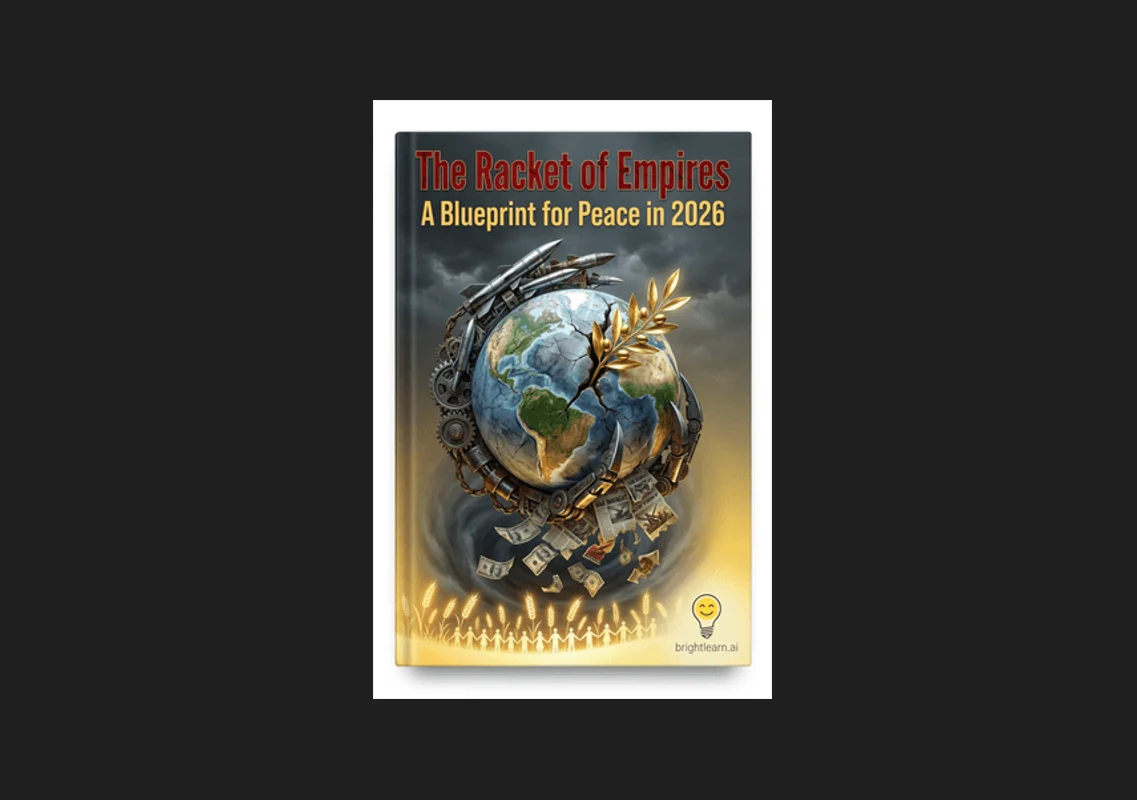
In the modern geopolitical landscape, war is frequently presented to the public as a tragic necessity—a noble, albeit regrettable, struggle to defend democracy, uphold human rights, or ensure national security. However, according to the provocative new publication, The Racket of Empires: A Blueprint for Peace in 2026, this narrative is the greatest magic trick ever played on the global populace. Behind the curtain of patriotic fervor, a minuscule, entrenched elite is systematically emptying national treasuries, enriching defense contractors, and profiting directly from the blood of the innocent.
The central thesis of this work is not a new discovery, but rather a chillingly relevant echo of history. It draws directly from the 1935 exposé War Is a Racket by Major General Smedley Butler, one of the most decorated Marines in American history. Butler, having spent his career executing the interests of empire, ultimately concluded that war is a scheme for profit—a sophisticated racket run by an unholy alliance of bankers, industrial titans, and career politicians.
The Mechanics of the Racket: A Chronology of Conflict
To understand how the "war racket" functions, one must examine the evolution of the military-industrial complex (MIC). The mechanism is designed to be self-perpetuating, transforming international tension into domestic profit.
The Butler Era (1900–1935)
In the early 20th century, General Butler witnessed the U.S. military being deployed as a collection agency for Wall Street. Marines were sent to Latin America and the Caribbean not to protect citizens, but to secure sugar plantations, oil fields, and fruit monopolies. Butler famously noted that he had been a "high-class muscle man for Big Business," realizing that the lives of his soldiers were being traded for corporate dividends.
The Eisenhower Warning (1961)
By the mid-20th century, the racket had become institutionalized. In his farewell address, President Dwight D. Eisenhower—a five-star general who understood the machinery of war better than perhaps any other politician—offered a stark warning. He cautioned against the "unwarranted influence" of the military-industrial complex. Eisenhower feared that the nexus of weapons manufacturers and military leadership would create a permanent state of mobilization, eroding the very democratic institutions they claimed to defend.
The Post-9/11 Escalation (2001–Present)
Following the attacks of September 11, 2001, the racket entered its most lucrative phase. With the declaration of a "Global War on Terror," fiscal constraints were discarded. Military spending exploded, leading to two decades of conflict in the Middle East and Central Asia. During this period, the "revolving door" between the Pentagon and the private sector solidified, ensuring that policy decisions regarding defense spending were made by those with a vested interest in the companies receiving the contracts.
Supporting Data: The Economics of Decay
The scale of modern military spending is difficult for the average citizen to comprehend. The United States now allocates over $1 trillion annually to defense—a sum that exceeds the combined military budgets of the next ten countries.
The Opportunity Cost of War
The data suggests a direct, inverse relationship between military spending and domestic infrastructure. While the U.S. government prioritizes the procurement of advanced missile systems and fighter jets, the nation’s internal foundation is fracturing:
- Infrastructure: Bridges are crumbling and water systems are failing, yet funding for domestic renewal is routinely sidelined in favor of defense appropriations.
- Education: Public schools face chronic underfunding, contributing to a widening achievement gap that hinders the nation’s long-term economic prospects.
- Debt: The reliance on deficit spending to fund "endless wars" has contributed to an astronomical national debt, burdening future generations with the interest payments of today’s military-industrial ventures.
The Profitability of Conflict
Defense contractors such as Lockheed Martin, Raytheon, and General Dynamics consistently report billions in revenue, largely derived from government contracts. This profit is not merely a byproduct of national defense; it is a policy objective. These corporations spend millions on lobbying efforts, ensuring that Congress remains committed to high-expenditure military programs regardless of the actual strategic necessity.
Official Responses and the "Revolving Door"
When questioned about the disproportionate influence of the military-industrial complex, officials often cite the need for "technological superiority" and "global stability." They argue that a robust defense industry is necessary to deter adversaries and maintain the technological edge required for national security.
However, critics point to the "revolving door"—the systemic practice of high-ranking military officials and government bureaucrats transitioning into high-paying roles on the boards of defense contractors. This movement creates a conflict of interest that is inherently institutional. An official tasked with reviewing a multi-billion dollar contract for a new weapon system may be subconsciously—or explicitly—considering their own future employment prospects. By approving the contract, they secure a lucrative post-government career, effectively turning public service into a personal investment strategy.
Implications: The Moral and Economic Crisis
The implications of this racket are profound. On a moral level, the systemic prioritization of corporate profits over human life represents a profound failure of the democratic ideal. When war becomes an engine for profit, the value of life is reduced to a line item in a budget.
The Erosion of Dissent
A secondary, but equally dangerous, implication is the suppression of dissent. In the current political climate, questioning the necessity of a war or the size of the defense budget is often framed as "unpatriotic" or a threat to national security. This rhetoric serves to insulate the racket from public scrutiny, creating an environment where dissent is marginalized and the status quo remains unchallenged.
A Blueprint for 2026 and Beyond
The Racket of Empires suggests that the first step toward dismantling this machine is mass awareness. As long as the public views war through the lens of noble intent, the elite can continue to exploit the system for profit. Peace, in this framework, requires a radical shift in priorities:
- Auditing the Pentagon: Demanding transparency in military spending to identify where funds are being diverted into the pockets of contractors.
- Severing the Revolving Door: Implementing strict cooling-off periods for officials transitioning from defense oversight to corporate roles.
- Prioritizing Domestic Investment: Redirecting a significant portion of the defense budget toward public goods, such as education, healthcare, and infrastructure.
Conclusion
The "war racket" is not an accident of history or an inevitable outcome of human nature; it is a policy choice. It is a system that has been built, maintained, and expanded by those who benefit from its operation. As Eisenhower warned, the influence of this complex is unwarranted and threatens the stability of our democracy.
The path toward peace begins with the realization that the interests of the elite and the interests of the common citizen are fundamentally misaligned. When we stop viewing war as a tragedy and start seeing it as a business model, the power of the racket begins to wane. The future of 2026 and beyond depends on our ability to recognize the "magic trick," refuse the narrative of perpetual conflict, and demand a government that serves the people rather than the shareholders of the military-industrial complex.
For those interested in exploring this topic further, The Racket of Empires: A Blueprint for Peace in 2026 provides a detailed examination of these dynamics. It is a call to action for every citizen to look past the rhetoric and understand the true cost of our current imperial trajectory.
For more information and to download resources, visit Books.BrightLearn.AI. The decentralized engine at BrightLearn.AI empowers readers to create, share, and verify the truths behind the systems that govern our world.