







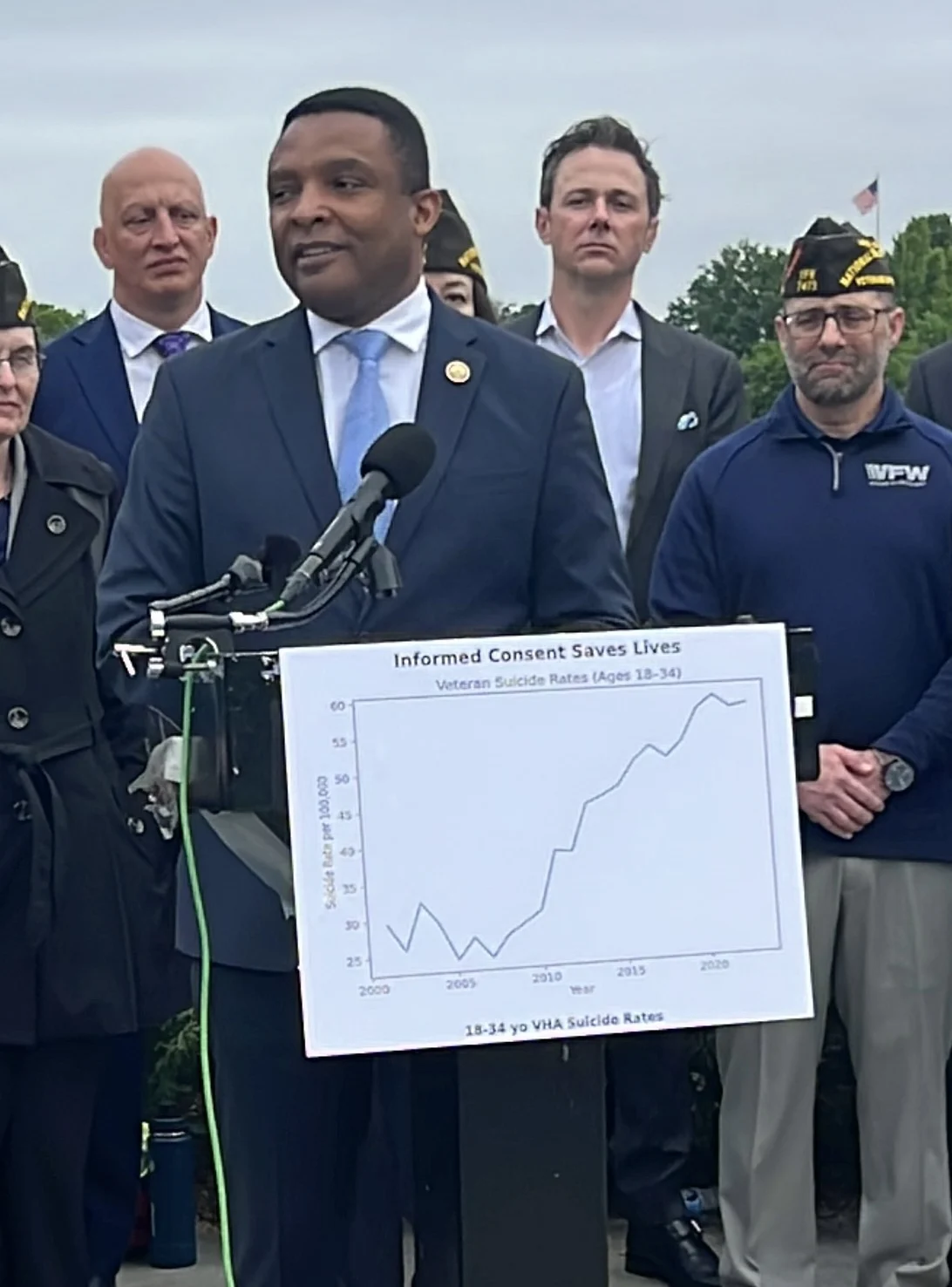
WASHINGTON, D.C. — On a somber, overcast morning on April 29, 2026, the steps of Capitol Hill became a stage for a historic demonstration of unity within the veteran community. Representatives from 35 prominent veterans’ service organizations (VSOs) stood shoulder-to-shoulder to announce a joint letter to Congress, demanding the immediate passage of the Written Informed Consent Act (H.R. 4837 / S. 3314).
The press conference marked a pivotal moment in a decade-long struggle to reform the Department of Veterans Affairs’ (VA) approach to mental health and medication management. The proposed legislation seeks to mandate a rigorous written informed consent protocol for high-risk psychotropic medications—including antipsychotics, stimulants, antidepressants, anxiolytics, and narcotics—moving beyond the current requirements that largely focus only on long-term opioid prescriptions.
Main Facts: A New Standard for Veteran Care
The Written Informed Consent Act is designed to address what advocates describe as a "transparency gap" in the VA healthcare system. While the VA currently requires written consent for major surgeries and certain high-risk procedures, the administration of powerful psychotropic drugs often relies on verbal consultations that advocates argue are frequently hurried, incomplete, or entirely overlooked.
The bill, sponsored by a bipartisan trio consisting of Representatives Gus Bilirakis (R-FL), Don Davis (D-NC), and Tom Barrett (R-MI), aims to:

- Standardize Documentation: Require clinicians to provide written information regarding the risks, benefits, and side effects of psychotropic medications.
- Ensure Patient Agency: Mandate a signed acknowledgment from the veteran, ensuring they have been informed of potential "Black Box" warnings and long-term dependency risks.
- Enhance Oversight: Strengthen the VA’s internal monitoring of prescribing practices to prevent the "over-medication" of former service members.
The coalition behind the bill includes heavyweights such as the Veterans of Foreign Wars (VFW), the GruntStyle Foundation (GSF), Burn Pits 360, and the Tragedy Assistance Program for Survivors (TAPS). Their unified message is clear: veterans have the right to know exactly what is being introduced into their bodies and the potential consequences of those treatments.
Chronology: The Eight-Year Journey to Reform
The path to the 2026 press conference began in the aftermath of the global war on terror’s peak, as the veteran suicide epidemic began to dominate national headlines.
- 2018–2019: The Genesis of Advocacy. Air Force veteran Derek Blumke, having survived a personal ordeal involving "polypharmacy" (the simultaneous use of multiple drugs), began organizing fellow veterans. In 2019, Blumke co-authored a landmark report with investigative journalist Robert Whitaker titled “Screening + Drug Treatment = Increase in Veteran Suicides.” The report challenged the prevailing medical wisdom that increased screening and medication were the primary solutions to veteran distress.
- 2022: The PACT Act Catalyst. The veteran advocacy community secured a monumental victory with the passage of the PACT Act, which addressed toxic exposures from burn pits. This victory proved that a unified coalition of VSOs could move the needle on complex legislative issues, emboldening the group to pivot toward the "invisible wounds" of war and VA prescribing habits.
- 2024: Launch of "War Cry for Change." The GruntStyle Foundation launched the "War Cry for Change" campaign, specifically targeting VA reform. This initiative sought to bridge the gap between clinical psychiatry and the lived experience of veterans who felt "numbed" by excessive medication.
- 2025: Political Momentum. In June 2025, a daylong summit on Capitol Hill brought together impacted families and lawmakers. By December 2025, the U.S. Senate Committee on Veterans’ Affairs held formal hearings on medication management, signaling that the issue had reached the highest levels of government scrutiny.
- April 2026: The Joint Letter. The delivery of the joint letter signed by 35 organizations represents the culmination of these efforts, presenting a "unified front" that lawmakers find increasingly difficult to ignore.
Supporting Data: The "Combat Cocktail" and the Suicide Epidemic
The urgency of the Written Informed Consent Act is underscored by a series of harrowing statistics provided by the VSOs and independent researchers.
According to data presented by the GruntStyle Foundation, nearly 70% of veterans under VA care are currently prescribed psychotropic medications. This is more than 3.5 times the rate of the civilian population. This phenomenon has earned a grim moniker within the community: the "Combat Cocktail."

The human cost of this prescribing trend is reflected in the suicide data. Over the last twenty years, there has been a 108% increase in suicide rates among veterans aged 18 to 34. This demographic, primarily consisting of post-9/11 veterans, has been the most heavily medicated in the history of the U.S. military.
Despite the federal government investing nearly $200 billion into veteran mental health and suicide prevention over the past two decades, the needle has moved in the wrong direction. Advocates argue that the current "medication-first" model is not only failing but may be contributing to the crisis.
"This line tells a story, and it is one of tragedy," said Derek Blumke, pointing to a graph showing the vertical climb of veteran suicide rates. "Our message is not that medications are bad. The message is that if we’re prescribing medications that do have risks, we should be smarter and safer in the way in which we do so."
Official Responses: Bipartisan Consensus in a Polarized Era
The press conference highlighted a rare moment of bipartisan harmony. The bill’s sponsors emphasized that veteran safety transcends partisan politics.

Congressman Gus Bilirakis (R-FL) framed the bill as a matter of basic respect. "This legislation is about something very simple but incredibly important: Respecting our veterans with full transparency when it comes to their medical care," he stated. "They deserve accountability, clarity, and respect."
Congressman Don Davis (D-NC), an Air Force veteran, addressed the VSO representatives directly. "A unified voice sends a clear message. We’re standing united today to send a clear message through the halls of Congress. The least we can do is ensure that when veterans come home, their care is grounded in transparency, respect, and accountability."
Representative Tom Barrett (R-MI), an Army veteran and former helicopter pilot, criticized the status quo of "awareness" campaigns. "We can’t continue to do the exact same thing and expect different results and just run more TV commercials about veteran suicide awareness," Barrett said. "People are aware of this problem… we need to confront the underlying risk factors that exist."
Historically, such reforms have faced pushback. As noted in previous reports by Mad in America, the American Psychiatric Association (APA) has historically opposed mandates for written informed consent, citing concerns over administrative burdens and the potential to "scare" patients away from necessary treatment. However, the sheer volume of VSO support in 2026 suggests the political landscape has shifted significantly.

Implications: A Paradigm Shift in VA Healthcare
If passed, the Written Informed Consent Act would represent a fundamental shift in the power dynamic between the VA healthcare system and the veteran.
Restoring Autonomy
For many veterans, the experience of VA care has felt like a "conveyor belt" of prescriptions. Megan Coleman of the VFW shared the story of "Eric," a veteran who was prescribed 30 separate medications simultaneously. Eric reached a breaking point not because he rejected care, but because he could no longer distinguish the symptoms of his conditions from the side effects of his treatment.
"Informed consent is not just a signature," Coleman argued. "It’s truly the ability to say, ‘I understand what this means for me.’" By requiring written consent, the bill forces a pause in the clinical process, ensuring that the veteran is an active participant in their own recovery rather than a passive recipient of drugs.
Addressing the "Black Box"
Many psychotropic drugs carry FDA "Black Box" warnings—the most serious level of warning—indicating risks of suicidal ideation, particularly in young adults. Major General Jeff Phillips of the National Defense Committee pointed out the absurdity of the current system: "I can’t take out a mortgage without a sheaf of paper this thick requiring my signature… and yet picture yourself as a veteran sitting across from a VA doctor… you have no instruction manual telling you what’s going on with these drugs."

Impact on Suicide Prevention
By forcing clinicians to discuss the specific risks of suicidal ideation associated with certain antidepressants and antipsychotics, the bill aims to reduce "iatrogenic" harm—injury caused by medical treatment itself. For survivors like Le Roy Torres of Burn Pits 360, this is a matter of life and death. Torres shared how he nearly took his own life while on a "cocktail" of medications for an undiagnosed brain injury, only to be stopped by his service dog, Hope.
Conclusion: The Long Road Ahead
As the press conference concluded, representatives from the 35 VSOs marched to the offices of Congressional leadership to hand-deliver their joint letter. The momentum is undeniable, yet the advocates remain cautious.
Derek Blumke, reflecting on the eight-year battle, expressed a sentiment shared by many in the crowd: "It’s absurd that we’re having to fight for this. Our ‘dangerous’ ask is, ‘Make sure you tell us about the treatment you’re going to give us.’"
The Written Informed Consent Act now faces the legislative gauntlet of committee markups and floor votes. However, with the backing of nearly every major veteran organization in the country and a bipartisan group of combat veterans in Congress, the "War Cry for Change" appears closer than ever to becoming the law of the land. For the families of those lost to the "Combat Cocktail," the hope is that this legislation arrives in time to save the next generation of American heroes.