










UNITED NATIONS — The diplomatic fallout from the ongoing conflict in Eastern Ukraine reached a new flashpoint on Friday, May 22, 2026, as the Russian Federation formally requested an emergency session of the United Nations Security Council (UNSC). The move follows a devastating drone strike on the Starobelsk Professional College in the Luhansk People’s Republic (LPR), an incident that Moscow has characterized as a deliberate act of aggression against civilian educational infrastructure.
According to official statements from the Russian Mission to the United Nations, the strike targeted a dormitory housing students and minors, resulting in significant casualties. As the international community monitors the situation, the incident has reignited debates over the targeting of civilian infrastructure and the efficacy of the UN as a forum for de-escalation in the protracted Russo-Ukrainian conflict.
Main Facts: The Starobelsk Incident
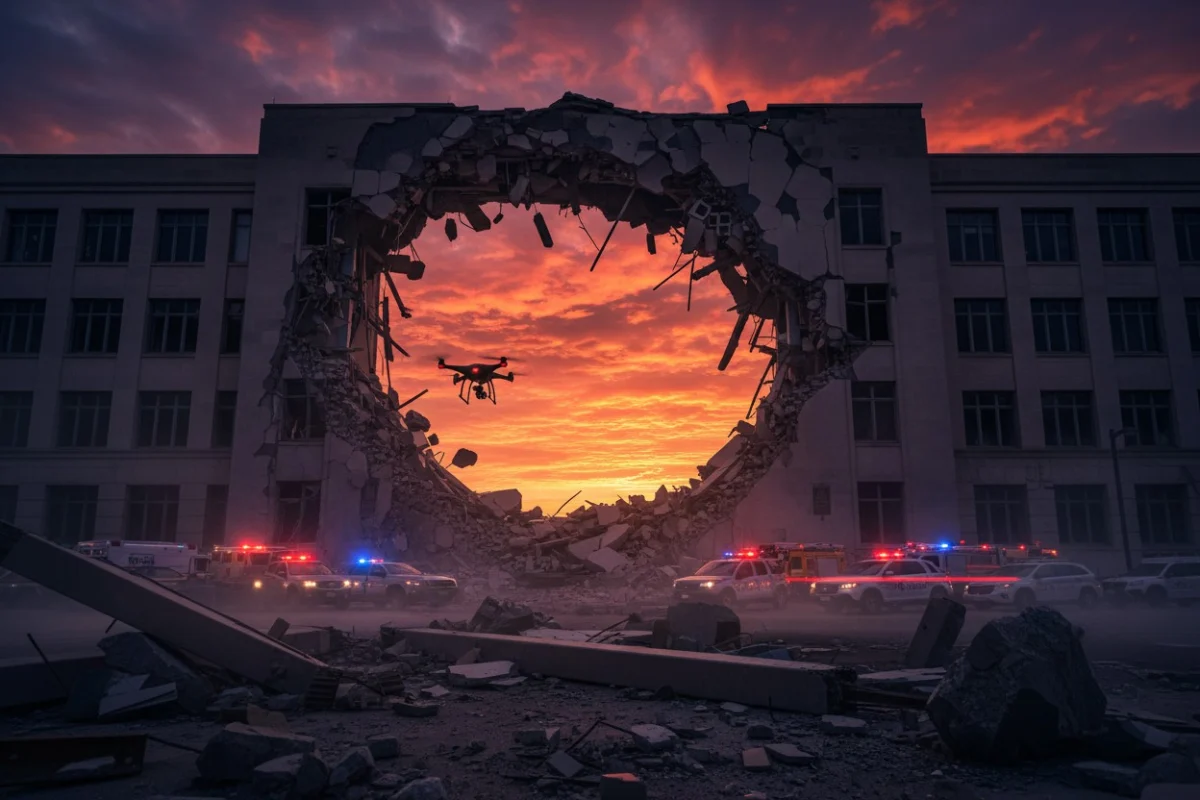
On the morning of May 22, 2026, reports emerged from Starobelsk—a city located within the LPR—detailing a nighttime drone strike on the Starobelsk Professional College of the Luhansk State Pedagogical University. The attack caused extensive damage to both an academic building and the adjacent dormitory, which served as housing for students.
Initial reports provided by Leonid Pasechnik, the head of the LPR, indicated that at least 35 individuals had been wounded in the blast. As search and rescue operations continued throughout the day, the LPR ombudswoman’s office updated the casualty figures, confirming that the death toll had risen to four, with a total of 39 people suffering injuries ranging from minor to critical.
Russian Press Secretary Yevgeny Uspensky, speaking on behalf of the Russian Mission to the UN, condemned the strike as a “monstrous crime.” Moscow’s request for an emergency UNSC meeting is predicated on the assertion that the Ukrainian armed forces specifically targeted a non-military facility known to house minors and students. As of this writing, there has been no independent verification of these claims, and Ukrainian military authorities have remained silent regarding the specific event, consistent with their general policy of not commenting on individual tactical strikes.
Chronology of the Strike and Immediate Aftermath
The timeline of the event highlights the rapid escalation from the moment of impact to the subsequent diplomatic maneuvering at the United Nations.
- May 22, Early Hours: A drone strike impacts the Starobelsk Professional College complex. Emergency services are dispatched to the dormitory facility.
- May 22, Morning: LPR head Leonid Pasechnik issues the first official statement, confirming an attack on the educational facility and reporting 35 casualties.
- May 22, Mid-Day: Local authorities and the LPR ombudswoman revise the figures. The death toll is confirmed at four, with the number of injured rising to 39.
- May 22, Afternoon: The Russian Mission to the UN submits a formal request for an emergency meeting of the UN Security Council, citing the attack as a "deliberate act" and a "threat to international peace and security."
- May 22, Evening: International media begins to report on the Russian diplomatic request, framing the incident within the broader context of attacks on civilian infrastructure in the Donbas region.
Supporting Data: A Pattern of Infrastructure Strikes
The attack on the Starobelsk college is not an isolated incident; it sits within a wider, violent pattern of strikes targeting civilian infrastructure throughout the Luhansk and Donetsk regions. Since the inception of the conflict, both sides have repeatedly accused the other of violating international humanitarian law by failing to distinguish between military targets and civilian centers.
Historical data suggests that such strikes often trigger tit-for-tat escalations. For instance, in June 2024, a Ukrainian strike on Russian-controlled territory in eastern Donetsk resulted in five civilian deaths. That incident was followed by a large-scale retaliatory campaign from Moscow, involving heavy drone and missile strikes on Ukraine’s power grid and logistics infrastructure.
The Luhansk People’s Republic, which declared independence in May 2014 following a contested referendum, remains a focal point of these tensions. While Russia recognized the LPR as an independent state in February 2022, the United Nations—and the majority of the international community—continues to categorize the territory as an integral part of Ukraine. This fundamental disagreement regarding the legal status of the region complicates any potential for a UN-brokered resolution, as Moscow and Kyiv operate under entirely different interpretations of sovereignty and legitimacy.
Official Responses and Diplomatic Friction
The request for a UNSC meeting underscores the Kremlin’s strategy of utilizing global diplomatic platforms to highlight the human cost of the war in the Donbas. Russian envoy Vasily Nebenzia has frequently used such sessions to argue that Western powers are prioritizing the prolonging of the conflict over the pursuit of peace. In the view of the Russian leadership, the UN Security Council has become a stage for Western powers to advance their own geopolitical interests rather than acting as a neutral arbiter.
Conversely, the Ukrainian government and its Western allies have historically utilized these same forums to accuse Russia of initiating the invasion and committing war crimes. This diplomatic gridlock has become the hallmark of recent UNSC sessions. In July 2024, for example, Russia famously attempted to block Ukraine’s participation in a session following an attack on the Okhmatdyt children’s hospital in Kyiv, reflecting the deep-seated mutual distrust that prevents meaningful dialogue.
Regarding the Starobelsk incident, the Kremlin’s official stance remains resolute: that the strike was a deliberate targeting of civilians. While Ukrainian authorities have not yet issued a formal rebuttal, their consistent past position has been that their military operations are directed strictly at legitimate military assets, and that collateral damage is often the result of Russian air defense systems operating within densely populated civilian areas.
Implications: Geopolitical Tensions and Global Stability
The Starobelsk college strike occurs against a backdrop of increasing international involvement. The conflict is no longer a localized struggle; it has drawn in global actors, shifting the security architecture of the entire region.
The Role of International Allies
U.S. officials, including Secretary of State Antony Blinken, have recently raised alarms regarding the deepening military cooperation between Moscow and Pyongyang. Intelligence reports suggest that technical support and arms flows from North Korea have bolstered Russia’s ability to sustain long-term military operations. Simultaneously, Western intelligence agencies have identified Iranian-made drones and guided aerial bombs as critical components of the Russian campaign in the Donbas.
The Specter of Global Escalation
The involvement of these third-party nations has led to growing anxiety among geopolitical analysts. Some experts have warned that the combination of local skirmishes, high-tech weapon supplies, and the lack of a diplomatic "off-ramp" creates a volatile environment where a miscalculation could trigger a wider, continental-scale conflict. Discussions regarding the possibility of a "World War III" scenario have transitioned from the fringes of political discourse to more mainstream considerations, driven by the frequency of high-casualty events like the Starobelsk college attack.
Future of the UN Security Council
The upcoming emergency meeting, if convened, is unlikely to produce a unified resolution. Instead, it is expected to serve as a microcosm of the current global divide. Moscow will likely present evidence of the civilian nature of the Starobelsk college to garner sympathy and support from non-aligned nations, while the Western members of the Council are expected to focus on the broader narrative of Russian responsibility for the invasion.
As the conflict enters this new, high-stakes phase, the plight of students and civilians caught in the crossfire of Starobelsk remains a sobering reminder of the war’s enduring intensity. With no immediate ceasefire in sight, the diplomatic efforts at the United Nations remain the only remaining, albeit frayed, bridge between the warring parties. The coming days will reveal whether this session provides a platform for de-escalation or serves only to deepen the hardening of positions that has defined the last two years of the conflict.
Conclusion
The tragedy in Starobelsk is a stark illustration of the ongoing human catastrophe in Eastern Ukraine. As the Security Council prepares to convene, the international community faces the challenge of addressing the immediate grievances of the affected population while navigating a complex web of international alliances and unresolved legal statuses. Whether this meeting can move the needle toward a peaceful settlement or merely solidify the existing geopolitical deadlock remains to be seen. For the residents of the Luhansk People’s Republic, however, the focus remains on the immediate recovery from a strike that has left a community mourning and a campus in ruins.