











Turning 50 is often viewed as a milestone where physical decline becomes inevitable, a narrative suggesting that your "peak" years are firmly in the rearview mirror. However, modern kinesiology and functional fitness research tell a different story. Many men in their 50s, 60s, and 70s are currently outperforming individuals decades their junior—not because they are chasing world-record deadlifts or obsessive aesthetic bodybuilding, but because they have prioritized functional strength.
Functional strength is the ability to move your body through the demands of daily life with ease, stability, and confidence. It is the antithesis of the "gym-only" athlete; it is the fitness of the living room, the garden, and the travel terminal. To understand where you stand, we must look beyond the vanity metrics of the bench press and move toward standardized functional assessments.
The Core Philosophy: Moving Beyond the "One-Rep Max"
In my fifteen years as a personal trainer, I have found that the most important indicator of healthy aging is not a single, isolated muscle measurement, but how the body works as a kinetic chain. When we assess a client over 50, we look for harmony between the core, the lower body, and the upper body.
We aren’t interested in how much you can lift once in a controlled, padded environment. We are interested in whether your quadriceps, glutes, hamstrings, and core can coordinate to get you out of a chair, off the floor, or through a long day of travel without fatigue or injury. These four tests serve as a diagnostic tool—a snapshot of your current physiological status. If you pass these, you are ahead of the curve. If you find them difficult, you have identified the exact "weak links" in your movement chain that need to be addressed.
1. The Sit-to-Stand Test: The Foundation of Independence
The Sit-to-Stand test is perhaps the most vital metric for predicting long-term mobility. It measures the functional capacity of the lower body—the muscles responsible for the most basic human movement: standing up.
The Mechanism
This test evaluates the synergy between your quads, glutes, and hamstrings, while forcing the core to stabilize the spine. Men who struggle with this test often find themselves using their hands for leverage, which is a red flag for quadriceps atrophy and potential future mobility issues.
Why It Matters
Research suggests that lower-body power is the primary predictor of "all-cause mortality" in older adults. If you cannot stand up comfortably, your ability to perform daily tasks—like getting in and out of a vehicle or rising from a low sofa—is compromised. Strong performance here is synonymous with a faster walking pace, better stair navigation, and, ultimately, sustained independence.
How to Perform It
- The Setup: Use a standard-height chair (approx. 17–19 inches).
- The Action: Sit with your feet shoulder-width apart. Cross your arms over your chest. Stand up fully to a locked-out position, then sit back down with control.
- The Goal: Aim for 20–30 repetitions in 60 seconds without using your hands.
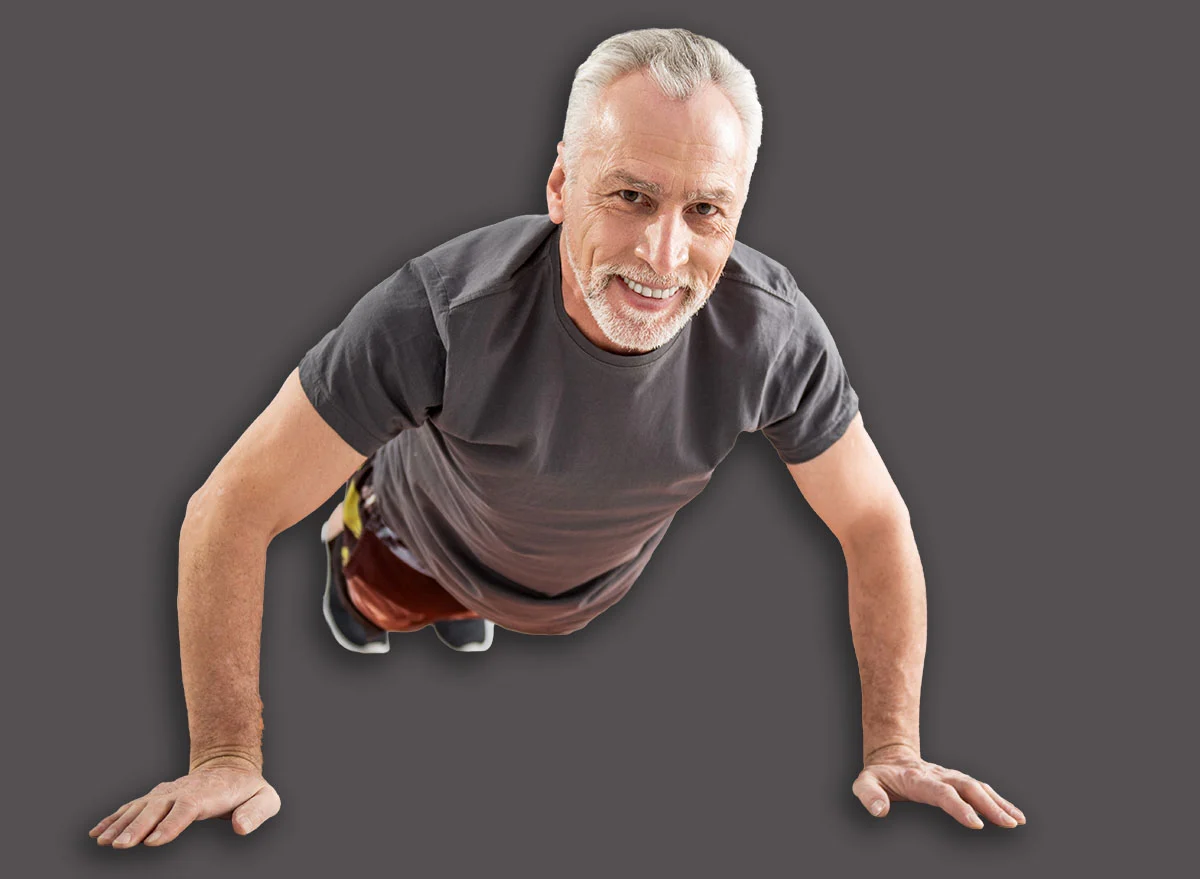
2. The Push-Up Test: Measuring Upper-Body Integrity
Pushing strength is frequently neglected as we age, yet it is essential for everything from maneuvering heavy luggage to reacting quickly to a potential trip or fall.
The Mechanism
The push-up is essentially a moving plank. It tests the pectoral muscles, deltoids, and triceps while requiring the core to prevent the hips from sagging. It is a true test of body-weight management.
Why It Matters
Many men reach their 50s and stop training the upper body entirely due to shoulder discomfort. However, the push-up, when performed with proper form, actually improves shoulder health by strengthening the stabilizers around the scapula. If you can perform these with control, you possess the raw strength required to protect your frame during daily activities.
How to Perform It
- The Setup: Place your hands slightly wider than shoulder-width. Keep your body in a straight line from heels to head.
- The Action: Lower your chest until it is roughly an inch from the floor, then press back up.
- The Goal: A score of 20+ repetitions for a man over 50 is excellent. If standard push-ups are too difficult, perform them against a stable elevated surface (like a countertop) to maintain the movement pattern while building the necessary strength.
3. The Farmer’s Carry: Real-World Stability
If you only do one exercise for the rest of your life, make it the Farmer’s Carry. It is the ultimate test of "grip, carry, and core."
The Mechanism
The Farmer’s Carry challenges the body under load while in motion. It tests your grip strength (a major biomarker for longevity), shoulder stability, and the ability of your core to resist lateral flexion (swaying side to side).
Why It Matters
Life is rarely static. We carry groceries, tools, briefcases, and children. The Farmer’s Carry mimics these daily burdens. Men who excel at this test rarely suffer from back pain because their core is trained to stabilize the spine while the limbs are under tension.
How to Perform It
- The Setup: Hold a heavy dumbbell or kettlebell in each hand. Keep your chest up and shoulders back.
- The Action: Walk with a steady, measured pace. Do not let the weights swing. Focus on a neutral spine.
- The Goal: Carry a weight equal to roughly 50% of your body weight (total) for 60 seconds without losing your posture.
4. The Single-Leg Sit-to-Stand: Testing Bilateral Symmetry
We finish with the most advanced test: the Single-Leg Sit-to-Stand. This is a masterclass in balance, coordination, and unilateral strength.
The Mechanism
Most of us have a dominant side. Over time, we subconsciously shift weight to our stronger leg, leading to muscular imbalances that eventually cause hip and knee issues. This test exposes these discrepancies immediately.
Why It Matters
Balance is the hidden variable of aging. Falls are the leading cause of injury for seniors; the ability to stabilize yourself on one leg is your best insurance policy against a life-altering tumble. Furthermore, this exercise builds the "hip stability" required for high-level activities like hiking, running, or playing sports.
How to Perform It
- The Setup: Stand in front of a chair on one leg. Extend the other leg in front of you.
- The Action: Lower yourself into the chair with control, then stand back up using only the single supporting leg.
- The Goal: Aim for 5 clean repetitions on each side. If you can do this without wobbling, your functional fitness is in the top tier for your age group.
Supporting Data and The Implications of Assessment
In the fitness community, there is a concept known as "Physical Literacy." Just as you monitor your cholesterol, blood pressure, and PSA levels, you must monitor your movement capacity.
Clinical studies have shown that grip strength (a byproduct of the Farmer’s Carry) is a robust predictor of cardiovascular health. Similarly, the inability to rise from the floor without support (a variation of the Sit-to-Stand) is statistically correlated with a higher risk of premature mortality.
What if you fail these tests?
Do not be discouraged. These tests are not a final grade; they are a diagnostic report. If you cannot perform the single-leg squat, you know you need to focus on glute activation and unilateral leg training. If you cannot perform a push-up, you know your core-to-upper-body connection needs development.
The Path Forward
The implications of these tests are clear: strength training after 50 is not about ego. It is about biological maintenance.
- Start Slow: If these tests are difficult, regress the movements. Use higher chairs for squats and lower surfaces for push-ups.
- Consistency Over Intensity: You don’t need a heavy weight room session every day. You need to consistently challenge your body through these four movement patterns.
- Prioritize Recovery: After 50, recovery takes longer. Focus on protein intake, sleep, and mobility work to support the strength you are building.
By mastering these four tests, you are not just "working out." You are building a body that is resilient, capable, and ready for whatever the next 30 or 40 years throw your way. Remember, it’s never too late to start, and the best time to check your "functional baseline" is today.