




The crowdfunding launch of the Sleepal AI Lamp in May 2026 marks more than just another entry into the crowded "sleep tech" market; it represents a pivotal inflection point in the evolution of contactless sleep monitoring. For years, the sleep medicine community has treated consumer-grade wearables with a healthy degree of skepticism, often citing a lack of rigorous, peer-reviewed validation as the primary barrier to clinical integration. However, as radar-based technology matures, the conversation is shifting from "Can radar monitor sleep?" to "How do we validate these systems against the gold standard of clinical care?"
By launching with a comprehensive 1,022-night validation study—backed by over 2,000 nights of simultaneous polysomnography (PSG) comparison—Sleepal is challenging the industry status quo. This development forces a broader, necessary discussion regarding the blurred lines between wellness-focused consumer electronics and medically actionable data.
The Chronology of a Data-Driven Launch
The journey toward the Sleepal AI Lamp began with a fundamental critique of existing sleep-tracking methodologies. Founder Dian Fan, a veteran of the IoT sector with a background at a Fortune 500 smart home company, identified a critical gap: the majority of consumer sleep devices on the market were developed and validated using small, homogenous groups of "healthy" sleepers.
- Pre-Development Phase: The engineering team focused on overcoming the limitations of previous millimeter-wave radar iterations, specifically addressing issues with motion sensitivity and data resolution.
- The Validation Study (2025–2026): Unlike typical consumer launches, Sleepal opted for a rigorous, multi-site hospital collaboration. They deliberately moved away from "healthy adult" cohorts, instead recruiting participants with complex sleep architectures, including mild-to-moderate Obstructive Sleep Apnea (OSA) and Periodic Limb Movement Disorder (PLMD).
- Public Disclosure (April 2026): In a move that garnered significant attention from the research community, the validation preprint was published on arXiv (2604.16442) prior to the product’s public crowdfunding launch.
- Market Entry (May 2026): The product officially moved into the public sphere, positioning itself as a tool for "learning sleep patterns," while simultaneously providing the high-fidelity data that researchers have long demanded from the sector.
Supporting Data: Setting a New Benchmark
The data presented by the Sleepal team is, by industry standards, unprecedented for a consumer device. By conducting simultaneous PSG and radar monitoring, the researchers created a high-fidelity benchmark that mimics the complexity of real-world sleep environments.
Key Performance Metrics
The validation study reports several key performance indicators that demonstrate the system’s resilience in the face of physiological disruptions:

- Sleep-Wake Discrimination: The system achieved a 92.77% correct assignment rate, a metric that remains competitive with established home-testing devices.
- Sleep Stage Accuracy: Despite the inherent difficulty of identifying four distinct sleep stages via contactless means, the lamp maintained a 77.2% accuracy rate.
- Performance Under Distress: Perhaps most importantly, the model held a 74.3% accuracy rate even among participants suffering from severe obstructive sleep apnea (AHI > 30). This is a stark contrast to previous algorithms that often "break" when encountering the erratic respiratory patterns associated with sleep disorders.
The Physics of Precision
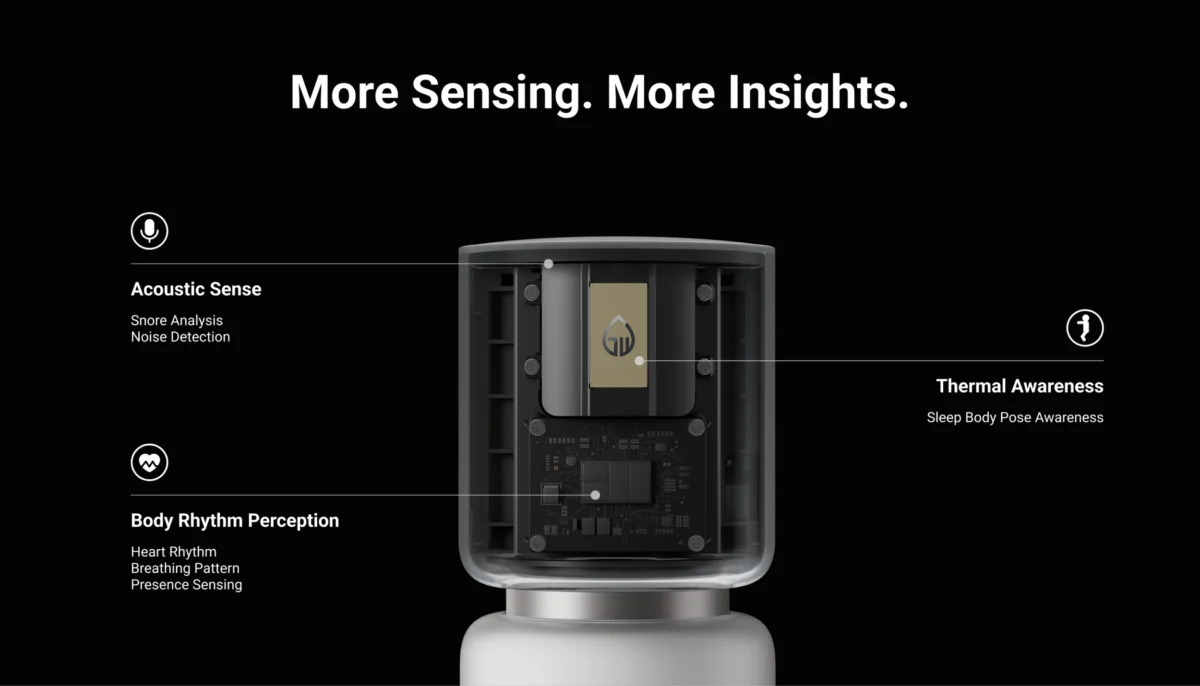
The technical backbone of the Sleepal AI Lamp is a 60 GHz millimeter-wave radar. While accelerometers (found in wrist-worn devices) rely on limb movement, and photoplethysmography (PPG) tracks light reflected from the skin, Sleepal uses digital beam forming to detect sub-millimeter chest wall displacements. This effectively revives the principles of mid-20th-century ballistocardiography, allowing the device to monitor cardiac contraction and respiration-induced thoracic recoils without requiring the patient to wear anything at all.
Furthermore, the integration of a thermal array sensor—which detects heat signatures rather than using optical imaging—adds a layer of privacy-conscious posture monitoring, enabling the device to distinguish between supine, lateral, and prone positions.
Environmental Sensing: The Missing Variable
One of the most compelling arguments for the Sleepal system is its move beyond the body. While clinicians have long emphasized "sleep hygiene," the actual monitoring of environmental factors (temperature, humidity, light, and acoustics) has largely remained a matter of patient self-reporting—a notoriously unreliable metric.
The Sleepal AI Lamp treats the bedroom as a holistic system. By correlating environmental data with sleep fragmentation patterns, the device offers actionable insights that are invisible to wrist-worn trackers. For example, if a patient’s sleep maintenance insomnia correlates perfectly with a 4°C rise in bedroom temperature at 3:00 AM, the solution (e.g., better ventilation or climate control) becomes self-evident. This represents a transition from mere "tracking" to "behavioral intervention."
Official Stance and Regulatory Navigation
It is vital to note that the Sleepal AI Lamp is marketed strictly as a consumer wellness product, not a medical device. The company has explicitly stated that it is not FDA-cleared for the diagnosis or detection of any disease.

However, the "wellness vs. clinical" divide is becoming increasingly porous. The industry has seen this trajectory before: the Apple Watch’s irregular rhythm notifications were not originally intended to diagnose atrial fibrillation, yet they frequently serve as the initial prompt for patients to seek professional medical help.
The Clinician’s Dilemma
The central question for the medical community is: If a non-contact system demonstrates parity with Type III home sleep apnea testing devices, is it prudent to ignore the data simply because of its "wellness" label?
Many physicians are already navigating this. They are finding that patients are bringing "data-rich" reports from various sources to their appointments. The Sleepal validation study provides a blueprint for how these devices should be evaluated. By adopting a transparent, evidence-based approach, Sleepal has set a new standard that other manufacturers will now be expected to meet.
Implications for the Future of Sleep Medicine
The launch of the Sleepal AI Lamp carries significant implications for the practice of sleep medicine. As these technologies become more prevalent, the role of the sleep technologist and the physician will inevitably shift.
1. Patient Counseling and Compliance
For patients who cannot tolerate wearables—due to skin sensitivity, claustrophobia, or simple non-compliance—contactless systems offer a bridge. The Sleepal dataset allows clinicians to have an informed conversation with patients about the limitations of such technology: they are excellent for observing trends, but they cannot replace the physiological channel confirmation required for diagnosing complex pathologies.

2. The Evolution of Positional Therapy
Positional therapy, which is essential for a significant segment of the population (25–30% of whom exhibit positional sleep dynamics), has historically relied on cumbersome equipment. A passive, contactless system that tracks supine percentage allows for objective follow-up, reducing the need for repeated, labor-intensive video analysis in a clinical setting.
3. A Call for Industry-Wide Transparency
The American Academy of Sleep Medicine (AASM) has maintained a cautionary stance regarding consumer sleep tech, and this remains appropriate. However, the technology is not going away. Instead of simply advising against these tools, the medical community now has a framework for engagement. By asking the question, "Where is your validation data, and can we see it?" the profession can push the market toward higher standards.
Conclusion: A New Standard of Proof
The Sleepal AI Lamp does not resolve all the challenges of sleep medicine, nor does it replace the gold standard of the sleep laboratory. However, by choosing to lead with a 1,022-night validation study, the company has effectively "raised the bar."
For the sleep community, this is a call to action. The era of "black box" algorithms and anecdotal marketing is reaching its end. As patients increasingly prioritize data-driven self-management, the medical field must be ready to interpret, critique, and integrate the findings from these contactless systems. Whether this represents a genuine shift in clinical capability or merely a marketing milestone remains to be seen—but for the first time, the evidence is out in the open for the entire community to judge.
For more information on the study and the device, visit sleepal.ai.