





29 May, 2026
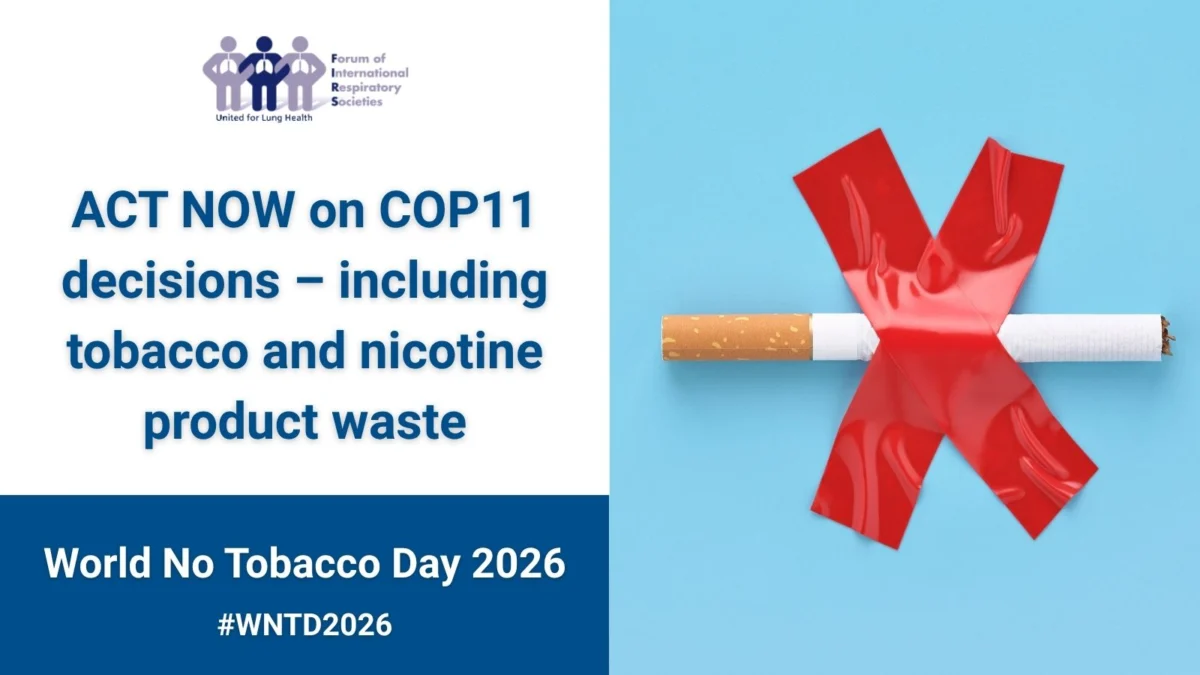
As the global community prepares to mark World No Tobacco Day on 31 May, the Forum of International Respiratory Societies (FIRS)—a coalition representing the world’s leading respiratory health organizations, including the European Respiratory Society (ERS)—has issued a clarion call for immediate action. Following the landmark outcomes of the 11th Conference of the Parties (COP11) to the WHO Framework Convention on Tobacco Control (FCTC), health experts are shifting their focus from the traditional health narrative to a dual-pronged crisis: the intersection of tobacco use and environmental destruction.
At the heart of this advocacy is a demand for nations to implement rigorous, comprehensive regulatory measures against the most pervasive form of plastic waste on the planet: the cigarette filter.
The Core Mandate: COP11 and the Call for Accountability
The 11th Conference of the Parties (COP11) served as a pivotal moment for international tobacco control. Delegates from around the world reached a consensus that the tobacco industry’s environmental footprint can no longer be ignored or treated as a secondary concern.
The conference adopted a firm stance, encouraging signatory countries to explore comprehensive regulatory options for tobacco and nicotine product components that exacerbate environmental harms. For the ERS and its partners, this is not merely a policy suggestion—it is an existential necessity for global public health.
"Beyond their direct health effects, tobacco and nicotine products also degrade the environment through waste, pollution, and emissions," says Dr. Filippos Filippidis, Chair of the ERS Tobacco Control Committee and Associate Professor in Public Health at Imperial College London. "This compounds the burden on lung health that our committees work tirelessly to address."
Chronology of a Crisis: From Convenience to Catastrophe
The history of the cigarette filter is one of the most successful, yet dangerous, marketing maneuvers in the history of the consumer goods industry.
- 1950s: Cigarette manufacturers began mass-producing filtered cigarettes in response to mounting medical evidence linking smoking to lung cancer. The filter was marketed as a "health innovation," promising a safer, smoother smoking experience.
- 1970s–1990s: The normalization of the filter became absolute. Public perception solidified the belief that the cellulose acetate tip trapped "toxins," even as internal tobacco industry documents—later exposed through litigation—revealed that companies knew filters provided no meaningful health benefit.
- 2010s: Environmental awareness began to shift the conversation. Researchers identified cigarette butts as the single most littered item on the planet, with trillions discarded annually.
- 2024–2025: The build-up toward COP11 intensified as global environmental agencies provided data on microplastic leaching and the failure of existing waste management systems to process cigarette waste.
- 2026: Following COP11, international respiratory bodies, led by the ERS, have formally moved to categorize the cigarette filter as an unnecessary and environmentally destructive component that should be phased out entirely.
Supporting Data: The Anatomy of a Pollutant
The narrative that filters are a "safety feature" is scientifically bankrupt. The environmental and health data supporting their prohibition is overwhelming.
The Myth of Harm Reduction
Contrary to consumer perception, cigarette filters do not reduce the health risks of smoking. In fact, they may exacerbate them. Because filters make the smoke feel "lighter" and less harsh, smokers are often encouraged to inhale more deeply. This deeper inhalation pushes toxic smoke further into the peripheral lung tissue, which is strongly associated with an increased risk of lung adenocarcinoma.
The Microplastic Menace
Filters are primarily composed of cellulose acetate, a form of plastic that does not biodegrade in any meaningful timeframe. Instead, these filters fragment into smaller pieces, eventually becoming microplastics. These particles infiltrate soil and water supplies, entering the food chain.
Marine Impact and Toxicity
When discarded, filters act as sponges for the toxic chemicals found in tobacco smoke, including nicotine, arsenic, and heavy metals. When these butts end up in our oceans and waterways, they leach these toxins directly into the environment, posing a lethal threat to marine life that may mistake the discarded material for food.
The Recycling Illusion
Perhaps the most damaging narrative propagated by the tobacco industry is the promise of recycling. There is currently no scientific or economic evidence that cigarette filters can be safely or effectively recycled. Programs that claim to do so often serve as "greenwashing" mechanisms, designed to distract from the industry’s refusal to accept financial accountability for the full lifecycle of their products.
Official Responses: The ERS Stance
The European Respiratory Society (ERS) has been unequivocal in its condemnation of the industry’s tactics. In their official statement following COP11, the ERS emphasized that the environmental impact of tobacco is a matter of global public health.
The ERS argues that Extended Producer Responsibility (EPR) programs—often touted by the industry as a solution—are ultimately a distraction. By shifting the burden of cleanup to taxpayers and municipalities, these programs allow the tobacco industry to evade the financial consequences of their products’ life cycles. Furthermore, these programs perpetuate the false narrative that the tobacco industry is a "responsible corporate citizen" committed to sustainability.
"Phasing out and prohibiting cigarette filters, and single-use electronic nicotine delivery systems alongside them, is the only way forward," Dr. Filippos Filippidis asserts. "We must address the environmental burden at the source rather than attempting to mitigate the damage after it has occurred."
Implications: The Path Toward a Tobacco-Free Future
The implications of a global ban on cigarette filters are profound, touching upon economic, public health, and environmental policy.
1. Reducing Smoking Uptake Among Youth
Filters are specifically engineered to improve the "palatability" of cigarettes, making the act of smoking easier for new users—particularly adolescents—to initiate. Removing the filter increases the harshness of the smoke, which is expected to act as a significant deterrent for new smokers. By eliminating this sensory buffer, regulators can effectively reduce the uptake of smoking among younger generations.
2. Economic Accountability
A ban on filters shifts the narrative from "cleanup" to "prevention." If the tobacco industry is no longer permitted to use these components, they must either radically alter their product or face the obsolescence of their current business model. This forces the industry to confront the true cost of their products, rather than offloading those costs onto environmental and public health systems.
3. Strengthening Global Policy
The FCTC COP11 decisions have provided a roadmap for national governments. By implementing these recommendations, countries can align their tobacco control policies with their broader climate and biodiversity goals. This convergence of health and environmental policy is essential in the 21st century, as the planet can no longer afford to ignore the intersectionality of human and ecological well-being.
Conclusion: A Turning Point
As we approach World No Tobacco Day 2026, the message from the international medical community is clear: the cigarette filter is a relic of deceptive marketing that has caused—and continues to cause—irreparable harm. It provides no health benefit to the smoker, but it provides a massive, ongoing hazard to the planet.
The path forward, as outlined by the ERS and supported by the outcomes of COP11, is not one of mitigation or cleanup, but one of prohibition. By banning these toxic plastic components, the global community can simultaneously strike a blow against the tobacco industry’s deceptive practices and take a significant step toward preserving the health of our oceans, our soil, and our lungs.
The time for half-measures has passed. The health of our world depends on the courage to hold the tobacco industry fully accountable for the total life cycle of its products.
For further information on the ERS’s ongoing tobacco control advocacy and to read the full statement following the WHO FCTC COP11 event, please visit the ERS official website.