











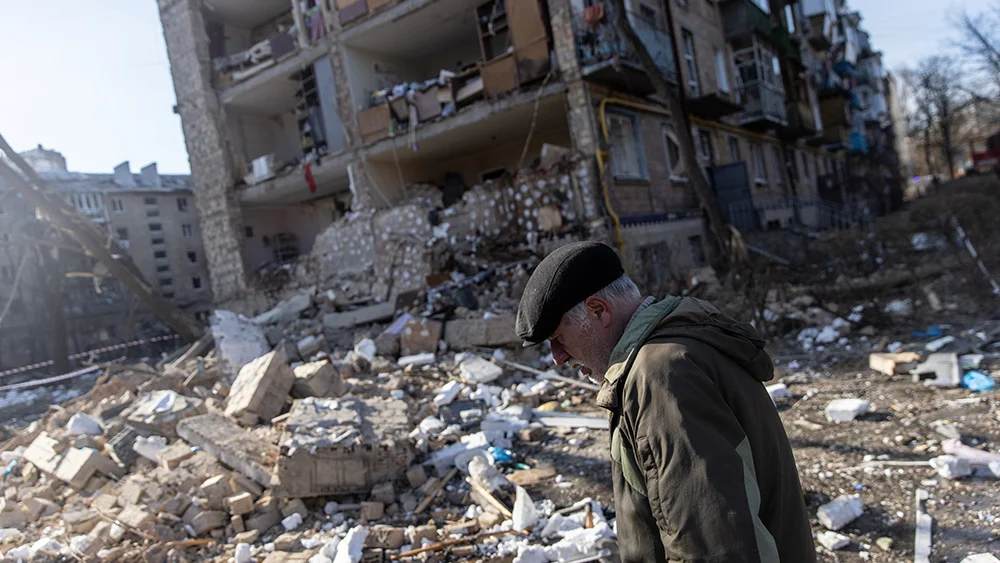
The war in Ukraine has entered a harrowing new chapter of indiscriminate destruction, characterized by a ruthless cycle of retaliation that has blurred the lines between military necessity and civilian catastrophe. Overnight on Wednesday, Russian forces unleashed a sophisticated, multi-wave aerial assault on Kyiv and its surrounding regions, deploying a lethal combination of ballistic missiles and swarms of decoy drones. The resulting carnage—at least 17 people confirmed dead and 44 wounded—has sent shockwaves through the capital, serving as a grim testament to the mounting vulnerability of Ukraine’s infrastructure under the strain of a protracted, four-year conflict.
Moscow has characterized the assault as a "precision strike" aimed at dismantling military-linked logistics hubs. However, the debris scattered across the capital paints a starkly different picture: incinerated civilian warehouses, shattered breweries, and ruined construction retail centers. As the smoke clears from the seven distinct sites of impact, the international community is left to grapple with the reality that the conflict has shifted from the front lines into the very heart of Ukrainian commerce and civilian life.
Chronology of the Assault: A Midnight Blitz
The attack commenced shortly after the stroke of midnight, catching the capital in a state of uneasy quiet. According to reports from the Ukrainian Air Force, the Russian offensive was unprecedented in its complexity. The barrage consisted of 24 Iskander-M and S-400 ballistic missiles, supplemented by four advanced Tsirkon or Oniks anti-ship missiles, and an overwhelming wave of 115 strike and decoy drones.
The tactical design of the strike was clear: the decoy drones were intended to saturate and exhaust Ukrainian air defense sensors, clearing a path for the high-velocity ballistic missiles to strike their targets with minimal interference. While Ukrainian air defenses performed with remarkable resilience—successfully intercepting 98 of the incoming drones—the ballistic component of the strike proved devastating. Not a single missile was intercepted, a failure that military analysts attribute directly to the critical shortage of Patriot interceptor systems.
By 2:00 AM, the capital was illuminated by the orange glow of massive fires. Emergency services were dispatched to seven distinct locations, including the industrial hubs of Brovary, Velyka Dymerka, Kvitneve, and Peremoha. In Kyiv proper, firefighters battled blazes in the Obolonskyi and Sviatoshynskyi districts, where warehouses housing essential consumer goods were reduced to smoldering husks. The intensity of the assault did not abate until the early hours of Wednesday morning, leaving a trail of industrial ruin that will take years to rectify.
Supporting Data: The Economic and Human Cost
The economic impact of the strike is as profound as the human toll. Epicentr, a titan of the Ukrainian retail and construction sector, became a primary casualty of the bombardment. The company reported that two of its major logistics hubs were decimated, with a state-of-the-art ceramic tile production plant suffering a total loss. Every kiln at the facility was destroyed, a catastrophic blow to the company’s manufacturing capacity.
"In minutes, Russian missiles destroyed what the company had built over decades," an Epicentr spokesperson stated via social media. The company, which employs thousands, has announced plans to shift its production operations abroad while it attempts the grueling process of rebuilding—a recovery effort it estimates will span at least two years.
The human cost, however, remains the most poignant metric. Among the 17 deceased are employees of logistics firms and warehouse personnel who were working the night shift. At the site of the Wildberries warehouse, which also faced drone activity in Russia, the cycle of violence appears mirrored. The total tally of casualties across both nations highlights a grim reality: the war is no longer confined to the trenches; it is a war on the infrastructure that keeps a society functioning.
Official Responses: A War of Narratives
The diplomatic fallout from the attack was immediate and sharp. President Volodymyr Zelensky, speaking from Kyiv, issued a blistering critique of the Russian operation, explicitly rejecting Moscow’s claims that the targeted sites were "military-linked."
"There is absolutely no connection to the war for these facilities," Zelensky declared on Telegram. "We are talking about breweries, building materials warehouses, and civilian logistics hubs. The Russian narrative is a thin veil for terror."
The President pivoted quickly to the urgent matter of air defense supplies, calling on Ukraine’s Western partners to expedite the delivery of anti-ballistic systems. "Ballistic interceptors are what could have saved the lives of those killed today," Zelensky noted. "It is very important for our partners to understand that delays in supplying them, or a reluctance to hand over anti-ballistic systems, lead directly to such horrific casualties and destruction."
In contrast, the Russian Defense Ministry maintained its position that the strikes were successful, "high-precision" operations against dual-use facilities. Moscow alleges that these civilian warehouses were being used to store drone components and logistical gear for the Ukrainian Armed Forces, a claim that Kyiv vehemently denies.
The Implications of Indiscriminate Attrition
The Wednesday strike follows a volatile 48-hour period that included a deadly Ukrainian drone attack on the Russian Black Sea resort of Gelendzhik, which claimed the lives of eight people, including four children. This tit-for-tat dynamic has experts concerned that the conflict is entering an era of "indiscriminate attrition."
Serhii Beskrestnov, a defense technology adviser to the Ukrainian presidency, summarized the shift on Facebook: "The enemy is attacking everything indiscriminately—retail warehouses, food storage facilities, logistics hubs, enterprises, building materials warehouses. The goal is to make life in Ukraine impossible and to break the economic backbone of the nation."
This strategy appears to be a direct response to Ukrainian strikes on Russian supply chains, including attacks on Russian e-commerce giant Wildberries. As both sides focus on the economic arteries of the other, the conflict is becoming increasingly unsustainable for civilians living in or near industrial centers.
Financial Uncertainties and the Western Burden
As the casualty lists grow, a new tension is emerging in the corridors of power in Brussels and Washington. On the same day as the strikes, the European Commission announced the release of €1.4 billion in seized Russian assets to support Ukraine’s defense and reconstruction efforts.
While this funding is vital for the Ukrainian government’s survival, it raises uncomfortable questions among taxpayers in the West. As inflation remains high and domestic economic anxieties mount in the U.S. and Europe, the perpetual flow of billions of dollars into a seemingly endless conflict is becoming a focal point of domestic political debate.
The question increasingly being asked in European and American legislatures is: How much longer can this level of financial commitment be sustained before voters demand that these resources be redirected toward domestic infrastructure, healthcare, and economic stability?
With neither the Kremlin nor Kyiv showing any willingness to engage in meaningful dialogue, the war has reached a point of grim momentum. The recent strikes on Kyiv serve as a stark reminder that the longer the conflict persists, the more the distinction between the "front" and the "rear" will continue to erode, leaving civilians to bear the brunt of an escalating, high-tech war of attrition that shows no signs of concluding. The destruction of warehouses and the loss of life are not just tactical outcomes; they are the markers of a war that is systematically dismantling the future of both nations, one missile at a time.