









Eighteen months after the implementation of sweeping foreign aid cuts initiated by the Trump administration, the humanitarian landscape in Afghanistan has fractured into a state of acute, preventable tragedy. Once-vital lifelines, supported for years by the U.S. Agency for International Development (USAID), have evaporated, leaving millions of vulnerable Afghans in a precarious survival struggle. As the country marks five years since the U.S. military withdrawal, the legacy of that transition—now compounded by the cessation of developmental and humanitarian funding—has manifested in a surge of maternal and infant mortality, widespread malnutrition, and the collapse of rural healthcare infrastructure.
The Chronology of a Collapsing System
The decline of Afghanistan’s public health sector did not happen overnight; it is the result of a calculated, multi-year erosion of support.
- Five Years Ago: The U.S. military completed its withdrawal from Afghanistan, a seismic shift that fundamentally altered the country’s economic and political reality.
- Two Years Ago: International aid organizations, which had been filling the void left by state instability, began to report significant funding gaps as global priorities shifted and donor fatigue set in.
- 18 Months Ago: The Trump administration enacted a policy of across-the-board cuts to foreign assistance and initiated a systemic dismantling of USAID programs in the region. This policy was explicitly designed to prevent U.S. taxpayer dollars from potentially reaching Taliban authorities.
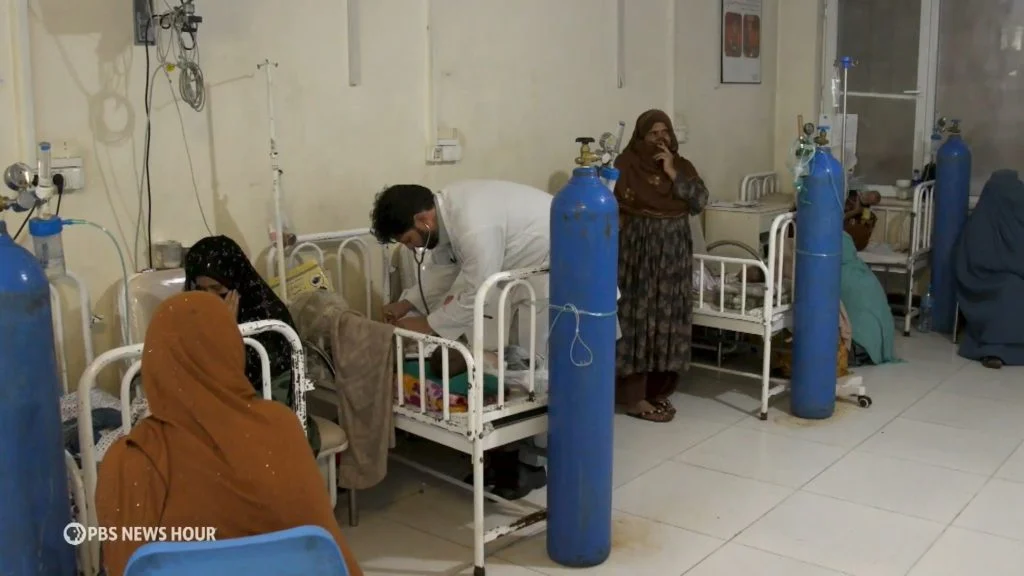
- The Present Day: The consequences of these policy decisions have crystallized. Nearly 800 clinics across the country have shuttered due to a lack of operational funds, leaving an estimated six million people without access to primary healthcare.
The Frontlines: Despair in Rural Herat
The human reality of these policy shifts is best captured in the remote, rocky mountains of Herat province. Here, the distance between a patient and a functional hospital has become a death sentence.
Special correspondent Leila Molana-Allen, reporting from the field, witnessed the immediate aftermath of this infrastructure vacuum. In one village, the death of a community leader—a man who suffered a heart attack with no ambulance or oxygen support available—served as a harrowing microcosm of the crisis. When the family called for help, they were told by the nearest clinic that they were on their own.
The tragedy is even more profound for the women of Afghanistan. Simagul, a mother whose six-month-old son, Fahim, succumbed to preventable illness, illustrates the insurmountable obstacles created by the current climate. Faced with a sick child, severe malnutrition, and a husband away in Iran searching for work, Simagul had to navigate Taliban-imposed travel restrictions. She required a male chaperone to reach a hospital, a requirement that wasted precious time as her child convulsed. By the time they reached medical care, it was too late.
Now, her infant daughter, Somaya, exhibits the same symptoms of severe malnutrition—distended belly, rashes, and chronic diarrhea—that claimed her brother. "I just pray my daughter doesn’t die like my son," she says.
Supporting Data: A Nation at the Breaking Point
The statistics provided by organizations like Refugees International and local health practitioners underscore the scale of the emergency.
- Mortality: Refugees International attributes more than 160 deaths directly to the cessation of aid over the last 18 months.
- Malnutrition: Over one-third of Afghanistan’s provinces are currently facing critical levels of acute child malnutrition. Nearly half of the nation’s children are suffering from insufficient caloric intake.
- Healthcare Access: The closure of nearly 500 clinics last year, followed by an additional 300 earlier this year, has stripped six million citizens of basic health services.
- Hospital Strain: At the Nangarhar government hospital, the malnutrition ward has seen its highest intake ever, with nearly 20 percent of admitted infants dying. Dr. Sikander Ghani, who heads the ward, reports that the lack of resources—medicine, oxygen, and functional equipment—makes his work a losing battle. "It is truly distressing when a child dies in front of our eyes," Dr. Ghani noted. "With a well-equipped unit, their lives could have definitely been saved."
The Intersection of Policy and Ideology
The crisis is exacerbated by the Taliban’s strict social mandates, which intersect lethally with the lack of medical resources. The requirement for a mahram (a male guardian) to accompany women in public has prevented countless women from seeking emergency care, even during labor.
Laleh, a former midwife with the International Rescue Committee, describes a reality where medical professionals are often forced to turn away women in critical need because they lack the required male escort. With education for women banned, no new midwives have graduated in five years, ensuring that the country’s reproductive healthcare system is headed toward total obsolescence.
Official Responses and Justifications
The U.S. State Department, when pressed for comment on the humanitarian crisis and the specific deaths reported, did not directly address the loss of life. Instead, the department emphasized the political and security-based rationale for the cuts.
"Since the Biden administration’s chaotic withdrawal from Afghanistan, the Taliban have consistently failed to take action to improve the country’s stability and uphold their counterterrorism commitments," a State Department spokesperson stated. They clarified that, at the direction of the administration, the Department of State has suspended all foreign assistance that could feasibly reach the hands of the Taliban.
Furthermore, the State Department cited a March 2025 inspector general’s report, which warned that humanitarian aid groups must strengthen their internal agreements to ensure that U.S. funds are not diverted to terror groups. This highlights the fundamental tension at the heart of the crisis: the struggle to balance stringent anti-terrorism financial oversight with the moral imperative to prevent a localized humanitarian catastrophe.
Implications for the Future
The current situation in Afghanistan is no longer a "slow decline"; it is a systemic collapse. By linking humanitarian aid to the political behavior of the Taliban, the international community—led by U.S. policy—has effectively turned the basic survival of millions of civilians into a bargaining chip.
The implications are dire. For women like Yeganeh, who has lost five children to malnutrition and remains trapped in a cycle of poverty and social restriction, the future is bleak. Her fear is that her unborn child will suffer the same fate as her previous children. For doctors like Ghani, the frustration is the inability to save patients who arrive in comas due to the lack of early, local intervention.
As the international community debates the efficacy of sanctions and the risks of aid diversion, a generation of Afghan children is being lost. The "dark situation" described by health workers is not a projection of future events; it is the current reality for a population that has been left to struggle in the shadows of geopolitical strategy, abandoned by the very lifelines that once offered them a path to survival.