









WASHINGTON, D.C. — On a somber, overcast morning on April 29, a historic coalition of 35 veterans’ service organizations (VSOs) stood in formation on the steps of Capitol Hill. Their mission was singular and urgent: to demand that Congress pass the Written Informed Consent Act (H.R. 4837 / S. 3314). This legislative push seeks to revolutionize how the Department of Veterans Affairs (VA) manages high-risk psychotropic medications, ensuring that those who served the nation are no longer left in the dark regarding the potent drugs prescribed for their mental health.
The press conference served as a formal announcement of a joint letter sent to Congressional leadership, calling for strengthened oversight of VA prescribing practices. The proposed bill aims to expand the VA’s existing written informed consent protocols—currently reserved largely for long-term opioids—to include a broad spectrum of high-risk medications, including antipsychotics, stimulants, antidepressants, anxiolytics, and narcotics.
The Legislative Push: Main Facts and Bipartisan Momentum
The Written Informed Consent Act is a bipartisan effort spearheaded by Representatives Gus Bilirakis (R-FL), Don Davis (D-NC), and Tom Barrett (R-MI). The bill’s primary objective is to mandate that VA clinicians provide veterans with clear, written information regarding the risks, benefits, side effects, and potential alternatives to psychotropic medications before they are prescribed.
For years, advocates have argued that the VA’s reliance on verbal consent or "implied consent" for psychiatric drugs has led to a culture of over-prescription. The bill seeks to codify transparency, ensuring that "informed consent" is more than a cursory conversation. It requires a formal acknowledgement from the veteran, signifying they understand the "Black Box" warnings and the long-term implications of their treatment plan.

According to a press release from Rep. Bilirakis’s office, the bill is gaining significant traction across both chambers of Congress. The April press conference was designed to showcase "unified support from the Veteran community" and to signal to the VA that the status quo is no longer acceptable. The coalition includes heavyweights such as the Veterans of Foreign Wars (VFW), the GruntStyle Foundation (GSF), Burn Pits 360, and the Tragedy Assistance Program for Survivors (TAPS).
A Chronology of Advocacy: From Personal Nightmare to National Movement
The path to this legislative milestone has been nearly a decade in the making. The movement’s roots can be traced back to 2018, when Air Force veteran Derek Blumke began a crusade to reform VA mental health care. Blumke’s advocacy was born from personal trauma; he had recently emerged from a "polypharmacy nightmare," a period during which he was prescribed a rotating door of psychiatric medications that he credits with nearly destroying his life.
In 2019, Blumke partnered with investigative journalist Robert Whitaker to publish a seminal report titled “Screening + Drug Treatment = Increase in Veteran Suicides.” The report challenged the prevailing medical narrative, suggesting that the aggressive screening and subsequent heavy medicating of veterans might actually be contributing to, rather than preventing, the suicide epidemic.
Following the report, Blumke joined forces with the GruntStyle Foundation (GSF). This partnership proved pivotal. The coalition of VSOs initially focused on toxic exposures, securing a massive victory with the passage of the PACT Act in 2022, which addressed the health impacts of military burn pits. With that victory in hand, the coalition turned its full attention to what they termed the "invisible wounds" and the "prescribing epidemic."

In June 2024, GSF launched the "War Cry for Change" campaign. This initiative served as the bridge to the political mainstream, culminating in a day-long summit on Capitol Hill in June 2025. By December 2025, the U.S. Senate Committee on Veterans’ Affairs held a formal hearing on medication management, signaling that the concerns of the veteran community had finally reached the highest levels of government.
Supporting Data: The Rise of the "Combat Cocktail"
The urgency of the Written Informed Consent Act is underscored by a series of staggering statistics that paint a grim picture of veteran health care. While the U.S. government has invested nearly $200 billion into veteran suicide prevention and mental health over the last two decades, the results have been tragically stagnant or declining.
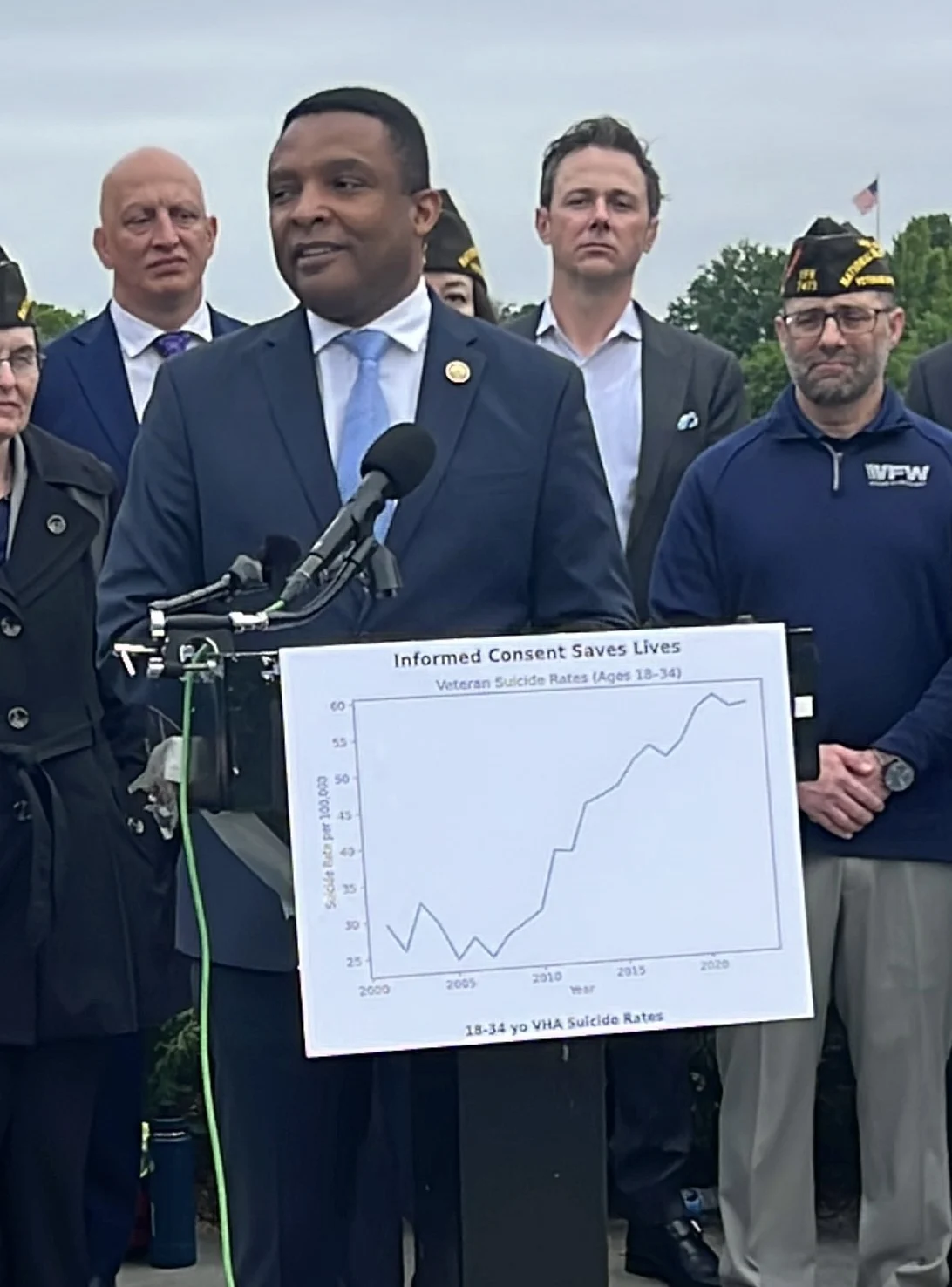
The data presented by the GSF and VFW highlights a 108% increase in suicide rates for veterans aged 18 to 34 over the last twenty years. This demographic, primarily composed of Iraq and Afghanistan veterans, is the most heavily medicated in the history of the U.S. military. Currently, nearly 70% of veterans under VA care are prescribed at least one psychotropic medication—a rate more than three and a half times higher than the civilian population.
Central to the advocates’ concerns is the issue of "polypharmacy"—the simultaneous use of multiple drugs to treat a single condition or overlapping symptoms. In veteran circles, this is often referred to as the "combat cocktail." Veterans are frequently prescribed an antidepressant for mood, an anxiolytic for anxiety, a sedative for sleep, and an antipsychotic as a "booster," often without a clear understanding of how these drugs interact.

"This line tells a story, and it is one of tragedy," Blumke said at the press conference, pointing to a graph showing the vertical spike in veteran suicides. "Our message is not that medications are bad. The message is that if we’re prescribing medications that do have risks, we should be smarter and safer in the way in which we do so."
Official Responses: Bipartisan Unity in a Divided Era
The press conference featured a rare display of bipartisan consensus, with representatives from both sides of the aisle emphasizing that veteran safety transcends partisan politics.
Representative Gus Bilirakis (R-FL) framed the bill as a matter of fundamental respect. "This legislation is about something very simple but incredibly important: Respecting our veterans with full transparency when it comes to their medical care," Bilirakis stated. "They deserve accountability, clarity, and respect in medical decision-making."
Representative Don Davis (D-NC), an Air Force veteran, addressed the VSO representatives directly. "A unified voice sends a clear message. The least we can do is ensure that when veterans come home, their care is grounded in transparency, respect, and accountability," Davis said. He emphasized that the bill does not aim to take tools away from doctors but to empower patients.

Representative Tom Barrett (R-MI), an Army veteran and former helicopter pilot, was blunt about the failure of previous efforts. "We can’t continue to do the exact same thing and expect different results and just run more TV commercials about veteran suicide awareness," Barrett argued. "People are aware of the problem. We need to confront the underlying risk factors."
The VSOs also provided powerful testimony. Megan Coleman, Associate Director for Health at the VFW, shared the story of a veteran named Eric, who was prescribed 30 separate medications. "He reached a breaking point, not because he rejected care, but because he didn’t understand it," Coleman explained. "Informed consent is not just a signature. It’s truly the ability to say, ‘I understand what this means for me.’"
The Human Toll and Implications for the Future
The implications of the Written Informed Consent Act extend far beyond administrative paperwork. For many veterans, the bill represents a reclamation of autonomy. Le Roy Torres, co-founder of Burn Pits 360, shared a harrowing account of his own experience. Torres was prescribed a litany of medications by VA doctors who failed to recognize he was suffering from a toxic brain injury. In a moment of drug-induced despair, he nearly took his own life, only to be stopped by his service dog, Hope.
"Hope saved my life through loyalty and instinct," Torres told the crowd. "This bill can save thousands more through transparency and respect for the veterans’ right to know."

If passed, the Act will force a paradigm shift within the VA’s mental health departments. It will require clinicians to spend more time educating patients, potentially slowing down the "prescription mill" that advocates say currently defines the system. Furthermore, it may embolden veterans to seek alternative therapies—such as those recently supported by presidential action—rather than relying solely on chemical interventions.
The bill also faces historical headwinds. Previous attempts to implement such measures were reportedly blocked by the American Psychiatric Association (APA) and other medical lobbying groups concerned about "interference" in the doctor-patient relationship. However, the sheer scale of the current VSO coalition suggests that the political cost of opposing the bill has become significantly higher.
Conclusion: A Country Finally Listening
As the press conference concluded, representatives from the 35 VSOs hand-delivered their joint letter to Congressional leadership. The message was clear: the veteran community is no longer asking for transparency; they are demanding it as a right of service.
Reflecting on the eight-year journey to this moment, Derek Blumke expressed a mix of exhaustion and hope. "I don’t think any of us imagined that we’d be working on this for so long. Because we all agree that it’s common sense," he told Mad in America. "Our ‘dangerous’ ask is, ‘Make sure you tell us about the treatment you’re going to give us.’"

For the thousands of veterans currently navigating the complexities of the VA healthcare system, the Written Informed Consent Act represents a beacon of hope—a promise that their "War Cry for Change" has finally been heard in the halls of power. The work now moves to the committee rooms and the floors of the House and Senate, where the true test of Congressional commitment to veteran lives will take place.