In an era defined by global uncertainty and a rising mental health crisis, anxiety has become one of the most pervasive human experiences. Traditionally viewed by the public—and often by clinical medicine—as a malfunction to be corrected or a symptom to be suppressed, a growing movement within the psychological community is reframing anxiety as a sophisticated, meaningful signal. This shift from pathological "noise" to purposeful "communication" marks a significant evolution in how clinicians and patients approach mental wellness.
According to data from the American Psychological Association (APA) and the National Institute of Mental Health (NIMH), anxiety disorders affect tens of millions of adults annually. However, experts like David Rothman, a Licensed Professional Counselor specializing in relational and psychodynamic therapy, argue that the goal of treatment should not merely be the elimination of anxiety, but rather an investigation into what the anxiety is attempting to protect.
Main Facts: Reframing the "Problem" of Anxiety
The core premise of this emerging clinical perspective is that anxiety is a complex biopsychosocial response. It is not a random glitch in the brain’s chemistry but a "signal" that something in an individual’s life, body, or relationships requires urgent attention.
Clinical practice is increasingly moving toward a model where anxiety is understood as a deeper story about a person’s experience of safety, loss, and connection. Instead of asking, "How do I stop this feeling?" the therapeutic inquiry shifts to, "What is my system trying to protect, and what does it need?"
Research consistently highlights that anxiety is a future-oriented state. It is the nervous system’s attempt to prepare for potential threats, whether those threats are physical danger, social rejection, or the anticipation of emotional pain. By treating anxiety as a signal, therapists help patients move from a state of "panic about the panic" toward a state of self-compassion and clarity.
Chronology: The Evolution of Anxiety Theory
The understanding of anxiety has undergone several major shifts over the last century:
- The Biological Malfunction Era: In the mid-to-late 20th century, the "chemical imbalance" theory dominated. Anxiety was largely seen as a deficiency in neurotransmitters like serotonin or GABA. Treatment focused heavily on pharmacological intervention to "fix" the broken circuitry.
- The Cognitive Revolution: With the rise of Cognitive Behavioral Therapy (CBT) in the 1980s and 90s, the focus shifted to "faulty thinking." Anxiety was seen as the result of catastrophic thoughts and irrational beliefs. The goal was to challenge and replace these thoughts to reduce distress.
- The Biopsychosocial and Relational Turn: In the last two decades, research has expanded to include the role of the nervous system (polyvagal theory), attachment history, and systemic stressors. Anxiety is now viewed as an adaptive reaction—a survival mechanism that has become overactive or misaligned with the current environment.
Today, the "Anxiety as a Signal" framework integrates these eras. It acknowledges the biological reality of the nervous system while looking deeper into the emotional and relational "why" behind the activation.

Supporting Data: The Anatomy of an Alarm System
The physiological experience of anxiety is deeply embodied. It is not "all in your head"; it is a full-system mobilization. Research by Stein & Sareen (2015), published in the New England Journal of Medicine, confirms that anxiety activates the sympathetic nervous system, increasing heart rate, altering breathing patterns, and heightening muscle tension. These are the same mechanisms that allowed human ancestors to survive predatory threats.
The Connection to Unacknowledged Loss
One of the most profound findings in modern clinical settings is the link between anxiety and grief. While grief is typically associated with the past, anxiety is associated with the future. However, many people suffering from chronic anxiety are actually grappling with "unprocessed loss." This includes:
- Loss of identity (career changes, aging).
- Relationship transitions (divorce, distance).
- Unmet childhood needs.
- Loss of a sense of safety or stability.
When these losses are not fully felt or "metabolized," the nervous system remains in a state of hyper-vigilance, producing a persistent sense of dread that manifests as generalized anxiety.
The Relational Cycle
Anxiety is also a relational barometer. In the context of interpersonal dynamics, anxiety often manifests through "reassurance-seeking." This cycle typically follows a specific pattern:
- The Cue: A partner’s changed tone or a delayed text message.
- The Interpretation: "Something is wrong, and I am at fault."
- The Strategy: Over-functioning, apologizing, or constant checking.
- The Result: Temporary relief followed by increased doubt.
Psychotherapy research, including the work of Wampold & Imel (2015), emphasizes that the "therapeutic alliance"—the quality of the relationship between therapist and client—is one of the strongest predictors of success. This suggests that because anxiety often starts in relationships, it must be healed in a relationship.
Official Responses: Expert Perspectives on Treatment
Major health organizations and clinical researchers advocate for a multi-faceted approach to treating anxiety. While suppression (medication) can be a life-saving tool for stabilization, long-term healing often requires insight-oriented work.
Cognitive-Behavioral Therapy (CBT)
CBT remains the "gold standard" for anxiety treatment in many clinical guidelines. According to Hofmann et al. (2012), CBT is highly effective at teaching patients to recognize the "noise" of anxiety and use relaxation techniques to dampen the physical response.

Acceptance and Relational Therapies
However, newer research, such as that by Leichsenring et al. (2017), supports the efficacy of psychodynamic and relational therapies. These approaches do not just aim to lower the volume of the anxiety but to understand what the "signal" is saying.
David Rothman notes that when patients feel genuinely heard and cared for in a therapeutic setting, their nervous systems often begin to co-regulate with the therapist. This relational safety allows the patient to explore the "underlying patterns beneath the surface" without being overwhelmed by the alarm.
The "Curiosity Prism"
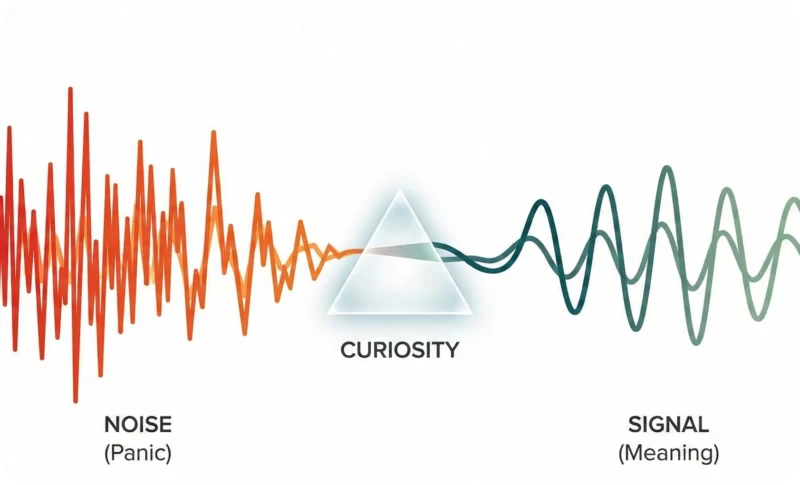
Experts suggest a "Curiosity Prism" approach. When chaotic "red noise" (panic) passes through the prism of curiosity, it can be refracted into a "clear green signal" (meaning). This involves asking:
- "What is this feeling trying to tell me about my boundaries?"
- "Is this anxiety a protective wall against a deeper sadness?"
- "What do I need right now to feel a 1% increase in safety?"
Implications: A New Way of Living with the Self
The implications of shifting from "suppression" to "listening" are profound for both public health and individual well-being. If society begins to view anxiety as a signal, the stigma of "mental illness" may shift toward a broader understanding of "emotional intelligence."
For the Individual
For the person suffering from anxiety, this reframe offers immediate relief from the shame of "having something wrong with them." It validates their experience as a meaningful response to their life history and current circumstances. It moves the goalposts from "never feeling anxious again" to "becoming a person who knows how to care for their anxiety."
For the Clinical Field
For therapists, this approach necessitates a move away from "manualized" treatments that treat every patient with the same set of worksheets. It requires a deep, nuanced understanding of a patient’s history, culture, and nervous system.
Practical Applications: The 60-Second Reset
While long-term therapy is the ideal for transformation, clinicians recommend "grounding resets" that respect the signal without letting it take the wheel. These include:
- The Extended Exhale: Signaling the parasympathetic nervous system to engage by breathing out longer than breathing in.
- Neutral Naming: Identifying five neutral objects in the room to pull the brain out of a "threat-scan" and back into the present moment.
- Self-Touch: Placing a hand on the chest or belly to provide a physical sense of "containment" and safety.
Conclusion: The Path Toward Healing
Anxiety, while painful, is often the soul’s way of demanding a better life. It marks the domains of life where we feel most vulnerable, where we have been hurt, and where we most desire connection.
As the clinical world continues to refine its understanding of the human mind, the message is becoming clearer: You do not have to fight your anxiety alone, and you do not have to view it as an enemy. By honoring the history behind the distress and the nervous system’s attempt to protect the self, individuals can move toward a more authentic, steady, and connected life.
In the words of David Rothman, "When you shift your orientation from fighting anxiety to listening to anxiety, healing begins." The signal is not the problem; it is the invitation to the solution.
References & Resources:
- American Psychological Association (APA): Resources on Anxiety.
- Craske, M. G., et al. (2017). Anxiety disorders. Nature Reviews Disease Primers.
- Hofmann, S. G., et al. (2012). The Efficacy of Cognitive Behavioral Therapy: A Review of Meta-analyses.
- Stein, M. B., & Sareen, J. (2015). Generalized Anxiety Disorder. New England Journal of Medicine.
- Wampold, B. E., & Imel, Z. E. (2015). The Great Psychotherapy Debate.
- National Institute of Mental Health (NIMH): Anxiety Disorders Overview.