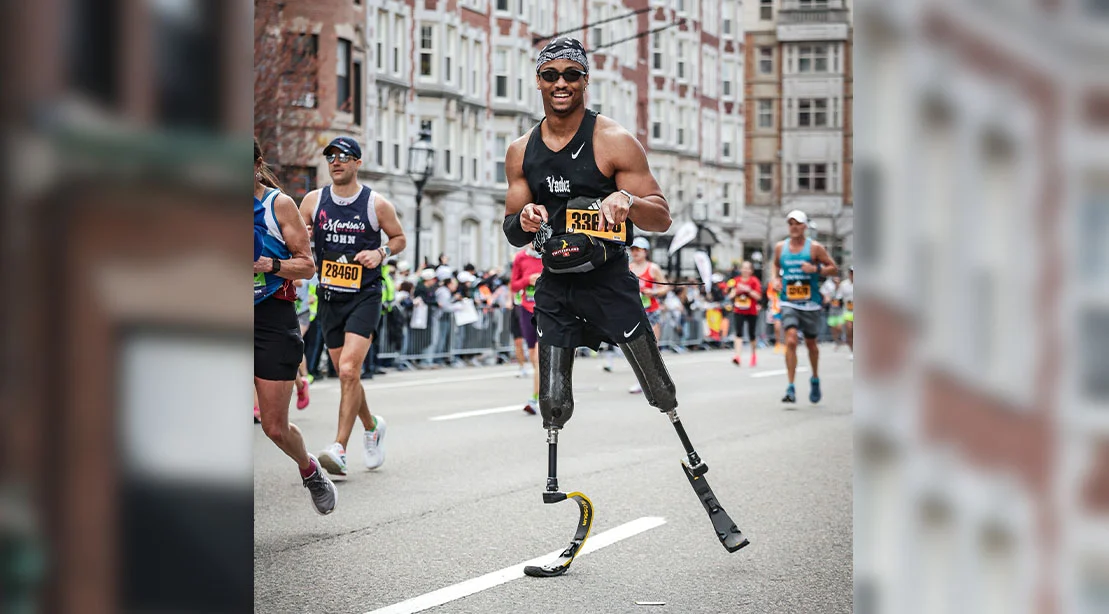
When Sabik Cohran crossed the finish line of the 2026 Boston Marathon, the weight of the moment did not hit him as a singular epiphany, but as a tidal wave of realization. He had just conquered 26.2 miles of the most iconic, grueling pavement in the world of distance running. But as he slowed his pace, catching his breath against the backdrop of the cheering crowds, he realized that the finish line wasn’t just a location—it was a demarcation point between the life he had once imagined for himself and the reality he had just forged.
For Cohran, a double amputee born without shin or ankle bones, this was not merely a race. It was a visceral declaration that the limitations society had once placed upon his potential—and those he had cautiously placed upon himself—were entirely illusory.
The Chronology of a Breakthrough
Cohran’s journey to the Boston finish line is a testament to the power of adaptation. Born with congenital limb differences, he underwent bilateral amputation at the tender age of two, receiving his first set of prosthetic limbs by four. Growing up in the Chicago area, he was raised in an environment that eschewed pity in favor of raw, unvarnished perspective.
"My mom and grandmother were my first coaches," Cohran reflects. "They constantly reiterated that this was my reality. They taught me that nobody was going to come save me; I had to be the architect of my own mobility."
This philosophy manifested in a hyper-active adolescence. At Schaumburg High School, Cohran was a fixture in the athletic department, competing in football, wrestling, lacrosse, and basketball. Yet, running remained the one frontier he refused to cross. "I’d use my condition as a tactical escape," he admits with a laugh. "I’d say, ‘I have no legs, I can’t be doing these laps.’ I bailed myself out of every endurance challenge I could."
The pivot point occurred in October 2024, when Cohran secured his first pair of dedicated running blades. The transition from general-purpose prosthetics to high-performance carbon fiber blades shifted his trajectory from sedentary skepticism to elite aspiration.
The Crucible of Training: Turning Pain into Performance
The road to the Boston Marathon was paved with physical suffering that would have deterred even the most seasoned endurance athletes. Before his debut at the Chicago Marathon, Cohran was forced to train in prosthetics that were fundamentally ill-equipped for distance running.
"The mechanics of the fit were brutal," he explains. "The sweat buildup inside the binders caused constant friction and instability. I was stopping every two or three miles just to clean my residual limbs. There were days I was bleeding, days I had to crawl around my house because the pain was so intense."
The turning point came through a combination of medical intervention and technological refinement. Doctors worked to re-engineer the fit, introducing medical-grade padding and advanced anti-sweat applications that finally allowed his body to withstand the repetitive impact of the road.
Beyond the skin, there was the physics of the blades themselves. The first time he strapped on his running blades, he didn’t just experience a lack of control—he experienced genuine terror. "I remember screaming during my first run," he recalls. "I had no idea how to stop. I thought I might actually die on the pavement."
He learned to pace by sheer trial and error. His longest training run before his first marathon was a mere four miles, a stark contrast to the grueling 20-mile long runs typical of marathon prep. Yet, by the time he arrived in Boston, he had refined his gait and conditioning, shattering his previous personal records (PRs) for the 10-mile and half-marathon distances during the race itself.
Data and Performance: A Record-Breaking Pace
The statistics surrounding Cohran’s Boston performance paint a picture of an athlete in the midst of a rapid vertical climb. By the time he hit the final three miles, he realized he was on track to PR by an astonishing 12 minutes.
"I didn’t even know I was doing that well," Cohran says. "I just knew I felt strong. When I realized the magnitude of the time I was putting down, I gunned it. Crossing that line was a moment of pure disbelief—‘Ain’t no way’ was all I could think."
His current trajectory has set him on a collision course with the elite record books. With a marathon time that is plummeting with every race, Cohran has set his sights on the double-amputee world record, which currently stands at 2:40:25.
While critics might point to his age—27—as a time when many endurance athletes have already reached their zenith, Cohran remains unmoved. "People want to call 27 old," he says, "but LeBron James was securing his first championship ring at 27. My prime is just beginning."
The Ripple Effect: Beyond the Individual
The implications of Cohran’s success extend far beyond his own personal stats. He has become an unintentional ambassador for the amputee community, a role he accepts with a profound sense of responsibility.
He recounts a pivotal moment involving a physical therapist who brought a patient—a man who had recently lost his legs—to watch one of Cohran’s races. "The patient was struggling, his spirit was broken," Cohran recalls. "But seeing what I was doing on the course, he just lit up. That changed everything for me. It made me realize that you have to carry yourself with poise, because you never know who is watching and finding their own strength in your journey."
This sense of duty has fueled his desire to expand his influence. Currently balancing a demanding 70-hour work week—juggling his job at Dick’s Sporting Goods, rigorous training, and a growing content creation brand—Cohran envisions a future where he can dedicate his full attention to the sport.
The Future: A New Horizon
Looking toward the future, Cohran’s roadmap is clear. He is committed to completing all of the World Marathon Majors by his mid-30s. He is also exploring opportunities in public speaking and the potential founding of a community run club, aiming to create a space where inclusivity and high-performance coexist.
However, his primary focus remains the pursuit of that elusive world record. His training has evolved from a matter of necessity to a highly calculated endeavor. He no longer sees his prosthetics as a limitation, but as a performance tool that, when paired with his relentless, high-octane work ethic, allows him to push past the conventional boundaries of human endurance.
"If people can look at me and think, ‘Well, he’s doing this, so I can do that, too,’ then I’ve succeeded," Cohran says. "Running taught me to believe in myself with 100 percent certainty. It’s not about the medals or the times; it’s about the fact that I’ve stopped asking if I can, and started proving that I will."
For Sabik Cohran, the finish line in Boston was not the end of a race. It was the starting block for a future where he—and those he inspires—refuse to acknowledge the existence of a ceiling. As he continues to document his journey on social media, the world watches, not just to see a man run, but to witness a man redefining the very architecture of what is possible.