Reviewed by Brian St. Pierre, MS, RD
In the halls of fitness studios and personal training centers across the United States, a quiet anxiety took hold in the late 2010s. As GLP-1 receptor agonists—semaglutide (Ozempic) and its counterparts—began their ascent, health and fitness coaches faced an existential question: "Is this drug going to steal my job?"
Early in their market lifecycle, these medications felt like a theoretical, distant threat. Prescription rates were modest, and the cultural conversation was in its infancy. Fast forward to 2026, and the landscape has been irrevocably altered. With over 1 in 10 US adults currently utilizing a GLP-1 medication, these drugs have moved from niche medical interventions to a ubiquitous feature of modern life.
Rather than rendering the coaching profession obsolete, the rise of GLP-1s has shifted the paradigm. Most industry experts now view these medications not as competitors, but as powerful, albeit complex, tools that require the human touch of a coach to be truly effective. The industry has moved from a stance of skepticism to one of integration: coaches are no longer in the "GLP-1 world"; they are in the "GLP-1 support world."
The Chronology of a Coaching Shift
The journey of the fitness industry in relation to GLP-1s can be divided into three distinct phases:
- The Phase of Hesitation (2017–2020): Marked by limited access and confusion. Coaches were largely unaware of the metabolic impact of these drugs, often viewing them as a "shortcut" that bypassed the hard work of traditional training.
- The Phase of Defensive Observation (2021–2023): As prescriptions surged, coaches witnessed the "easy" weight loss but simultaneously observed the collateral damage—muscle atrophy, nutrient deficiencies, and the mental struggle of rapid body composition changes.
- The Phase of Proactive Integration (2024–Present): Coaches now recognize that while the medication handles the appetite suppression, it cannot build the metabolic engine required for long-term health. The current mandate is clear: provide the structure that ensures weight loss equates to fat loss, not muscle loss.
The 7 Archetypes of the GLP-1 Client
According to Kate Solovieva, Director of Community at Precision Nutrition, the key to thriving in this new market is identifying which clients are actually ready for support. Coaching is not a one-size-fits-all endeavor; it requires a dynamic response to the client’s current psychological and physiological state.
1. The Honeymooner (Readiness: Very Low)
These clients are currently riding the high of early, effortless results. They have low side effects and high satisfaction. For the coach, the temptation is to intervene with warnings about muscle loss—a move Solovieva calls the "righting reflex."
- The Strategy: Avoid the impulse to "fix." Build rapport, celebrate their success, and position yourself as a resource for when their needs inevitably evolve.
2. The Ambivalent Candidate (Readiness: Low-to-Moderate)
These individuals are on the fence, paralyzed by fear regarding side effects or the moral weight of using medication.
- The Strategy: Maintain a clear scope of practice. Do not advise on medical decisions, but do help the client articulate their hesitation. Use tools like the "4 Crazy Questions" to explore the consequences of both acting and not acting, allowing them to find their own clarity.
3. The Ready-to-Quitter (Readiness: Moderate)
Often experiencing severe nausea or fatigue, these clients feel they are "broken" compared to others.
- The Strategy: Normalize the experience. Educate them on the commonality of side effects and encourage them to consult their doctor regarding potential dosage adjustments. Implement "experiments," such as smaller, more frequent, nutrient-dense meals.
4. The Muscle-Loss Risk (Readiness: Moderate)
The scale shows progress, but the body composition is shifting toward dangerous muscle depletion.
- The Strategy: Make the invisible visible. Utilize DEXA scans or functional performance markers (like stair-climbing ease or strength baselines). Pivot their focus toward protein-centric nutrition and resistance training, framed as "protecting their engine."
5. The Under-Fueler (Readiness: Moderate-to-High)
When appetite vanishes entirely, food becomes a chore, and caloric intake hits dangerous lows.

- The Strategy: If an eating disorder is suspected, refer to a clinician immediately. Otherwise, implement a rigid "eating schedule." Move them away from hunger cues—which are currently unreliable—and toward routine-based fueling.
6. The Graduate (Readiness: High)
These clients are weaning off the medication and feel vulnerable to weight regain.
- The Strategy: Temper expectations. Remind them that weaning is not the finish line but a new endurance phase. Focus on cementing the habits that will sustain them when the chemical appetite suppression fades.
7. The Priced-Out (Readiness: High)
For these individuals, the medication was a lifeline that has been snatched away by insurance shifts or financial hardship.
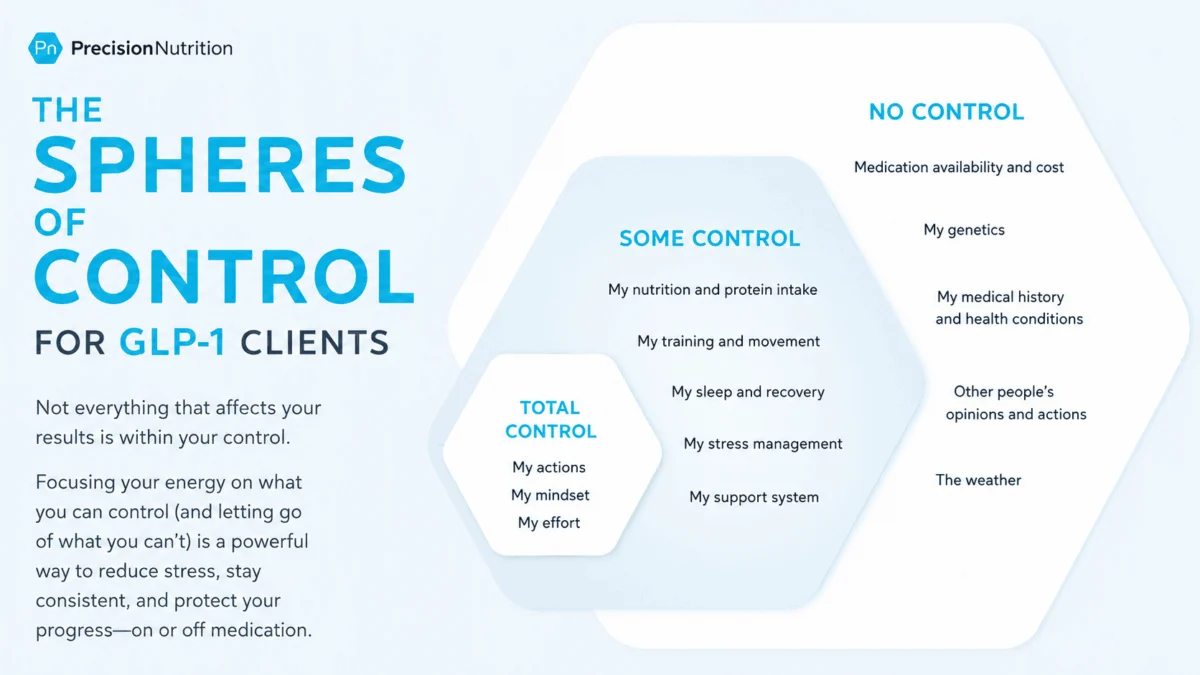
- The Strategy: Validate their anger. This is a system failure, not a personal one. Utilize the "Spheres of Control" exercise to help them reclaim agency over their nutrition, sleep, and movement, shifting the focus from the external medication to the internal habits.
Supporting Data: The Case for Coaching
The necessity of coaching is backed by both physiological and behavioral data. Research suggests that up to 40 percent of weight lost via GLP-1 medications can be lean mass. Without resistance training and adequate protein intake, this is almost guaranteed.
Furthermore, behavioral studies show that individuals who integrate lifestyle interventions while on GLP-1s are four times more likely to maintain a 10 percent or greater weight loss once they cease medication. The medication provides the "window of opportunity," but coaching provides the "foundation of maintenance."
The "Oregon Trail" of Habits
Toni Bauer, Director of Coaching and Education Operations at Precision Nutrition, offers a compelling analogy for the role of the modern coach.
"Think about the Oregon Trail," Bauer says. "The ruts in the trail were made by wagon wheels hitting the same ground over and over. Habits are the same way. If you lay down those neural pathways while your client is on the medication, those ruts remain long after the medication is gone."
The coach’s promise to the client is not that they will never regain weight; it is that the habits built during the treatment period will be deep enough to provide a path forward when the medical support is removed.
Implications for the Fitness Industry
The shift toward GLP-1s represents a professional maturation for fitness coaches. It demands a more nuanced approach—one that balances physiological knowledge with deep, empathetic psychological coaching.
- Professionalism: Coaches must understand the scope of their practice, knowing exactly when to defer to medical professionals.
- Outcome Redefinition: Success must be redefined from "weight lost" to "metabolic health preserved."
- The Identity Shift: The most successful clients are those who use the medication to transition into a new identity—the person who prioritizes protein, strength, and rest as a matter of character, not just a matter of necessity.
Conclusion: A New Standard of Care
The integration of GLP-1s into the fitness ecosystem is not a signal of the industry’s demise, but a catalyst for its evolution. By focusing on the "support" side of the GLP-1 world, coaches can provide the missing link in the weight-loss journey.
As we look toward the future, the coaches who thrive will be those who stop fighting the technology and start leveraging it to build better, stronger, and more resilient humans. The goal remains what it has always been: to empower individuals to build a sustainable, healthy life—regardless of the tools they use to get there.