








By Sree Roy
The landscape of sleep medicine is undergoing a profound transformation. For decades, the gold standard for diagnosing sleep-disordered breathing was the in-lab polysomnography (PSG) study, anchored by the reliable, albeit cumbersome, respiratory inductive plethysmography (RIP) belt. These belts—which measure the expansion and contraction of the chest and abdominal walls—have long provided the foundational data needed to distinguish between obstructive and central breathing events.
However, as clinical practice pivots toward the patient-centric model of home sleep testing (HST), the industry is being forced to fundamentally rethink how respiratory effort is captured, validated, and clinically applied. This shift is not merely about hardware miniaturization; it is a holistic re-evaluation of how we maintain diagnostic confidence when the physician is no longer in the room.
The Main Facts: Why Respiratory Effort Remains Critical
At the heart of the debate is a simple physiological truth: breathing during sleep is far more complex than the presence or absence of airflow.
"Breathing during sleep is not just about whether airflow is present or absent," explains Sveinbjorn Hoskuldsson, chief technology officer at Nox Medical. "It is also about whether the patient is making an effort to breathe, how the chest and abdomen are moving, and how those patterns change during events."
In the controlled environment of a sleep lab, technicians can monitor signal quality in real-time. In the home, however, the burden of data integrity falls on the device itself. As the industry leans into more individualized care, the data derived from RIP technology is being leveraged for much more than basic apnea detection. It is now central to sleep staging, arousal detection, and—perhaps most importantly—the physiological phenotyping of obstructive sleep apnea (OSA).
The Case for Dual-Sensor Technology
While many manufacturers have sought to simplify the HST experience by moving to single-belt systems, a vocal segment of the industry is doubling down on two-sensor technology. The rationale is clear: redundancy and physiological accuracy.
For companies like Nox Medical, maintaining a two-belt system was a deliberate, data-driven decision. "Measuring both thoracic and abdominal movement gives a fuller picture of respiratory mechanics than measuring only one compartment," says Hoskuldsson. "The choice to use two belts is not about adding signals; it’s about preserving the physiology that matters: respiratory effort, thoracoabdominal coordination, and breathing mechanics. This becomes particularly important in home testing, where maintaining diagnostic confidence can be challenging."
The argument for dual sensors extends to system failure mitigation. Nasal pressure signals—often the primary source of airflow data—are notorious for degrading if a patient breathes through their mouth during sleep. In such cases, thoracic and abdominal motion signals become the critical "safety net," serving as the primary indicators of whether a patient is actively attempting to breathe.
Amir Reuveny, PhD, CEO of Wesper, echoes this sentiment, warning against the trend of over-simplification. "Many times in sleep medicine, people compromise on this, choosing only one because it’s ‘good enough,’" Reuveny notes. "But in clinical diagnostics, ‘good enough’ can lead to misdiagnosis or an incomplete understanding of the patient’s respiratory burden."
New Form Factors: Eliminating the Belt Burden
Despite the diagnostic advantages of belts, they remain a significant source of patient discomfort. In an unattended home environment, belts must strike a delicate balance: tight enough to capture an accurate signal, but loose enough to permit sleep. They are prone to shifting, rolling, or causing skin irritation.
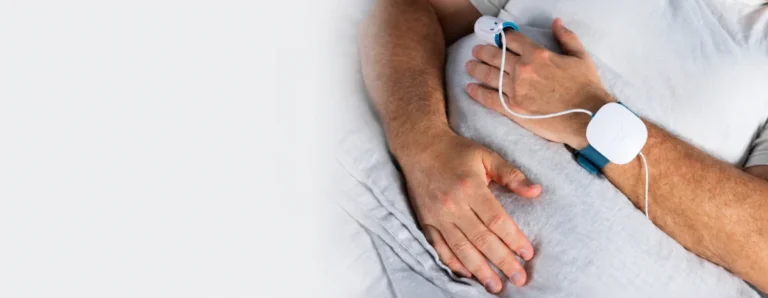
In response, innovation is taking shape through new form factors. Wesper, for instance, has effectively replaced traditional RIP belts with adhesive, wireless, crescent-shaped patches. These sensors are applied under the breast and over the belly button. "There is no tuning; there is no tension you need to do," Reuveny explains. "It’s small and light and doesn’t feel claustrophobic."
The user experience with such technology is significantly different from legacy hardware. In a personal trial of the Wesper system, the setup was seamless: a mobile app guided the application process, and the sensors remained securely in place throughout the night without causing skin irritation or sleep disruption.
Beyond comfort, Wesper has leveraged these sensors to create an FDA-cleared airflow channel that functions without the need for a nasal cannula. This is a breakthrough for patient compliance, as the nasal cannula is frequently cited as the primary reason for test abandonment. Bench tests comparing Wesper’s patches to traditional RIP technology—across various breath frequencies, amplitudes, and patient profiles—showed that the patch system met or exceeded the performance of cannula-based predicate devices.
Meanwhile, Huxley Medical has taken a different approach with its SANSA device. Instead of measuring chest wall expansion via inductive loops, the SANSA device uses an accelerometer-based effort metric paired with a photoplethysmogram (PPG) channel.
"RIP belts look at the chest wall expand and contract," explains Brennan Torstrick, PhD, chief scientific officer at Huxley Medical. "Our accelerometer-based effort metric looks at the same thing, just via acceleration. In addition, we measure respiratory effort by capturing respiratory-induced pulse wave modulation—the rhythmic changes in blood volume that occur during the ventilatory cycle."
This single-point-of-contact design is particularly advantageous for populations where belts struggle, such as obese patients or pregnant women, for whom standard straps may be ineffective or uncomfortable. A study presented at SLEEP 2025 demonstrated the clinical validity of this approach, with the SANSA device achieving 100% sensitivity in identifying central sleep apnea at an index of 15 or more.
Engineering for Stability: The "Better Belt" Movement
For companies committed to the traditional belt form factor, the focus has shifted toward mechanical and electrical stability. A study conducted by Nox Medical highlighted that the specific design of the belt has a direct, measurable impact on signal quality. Disposable belts with integrated contacts that avoid folding performed significantly better than cut-to-fit styles, which often suffer from signal loss at secondary connection points.
"If a belt folds, shifts, stretches inconsistently, or has variable contact quality, the recorded signal becomes less accurate," Hoskuldsson says. "From a clinical perspective, this underscores that the quality of the respiratory signal depends not only on the algorithm, but also on the integrity and consistency of the hardware collecting the data."
General Sleep Corporation has addressed these issues by simplifying the connection mechanism. Their reusable RIP belt is designed to snap directly onto the recording unit, eliminating the need for complex, failure-prone cut-to-fit designs. By reducing the number of connection points, they have managed to support a more consistent respiratory effort signal, reinforcing the value of the belt as a vital, redundant diagnostic tool.
New Utility: Sleep Staging Without EEG
Perhaps the most ambitious expansion of RIP technology is its use in inferring sleep stages and arousals without traditional EEG. This approach relies on the physiological principle that sleep state exerts a profound influence on ventilatory control.
Nox Medical has pioneered this through its "BodySleep" functionality. As a patient transitions between wakefulness, NREM, and REM sleep, their breathing patterns—including rate, regularity, and effort—change in recognizable ways. By analyzing these respiratory signatures, clinicians can identify cortical arousals that might otherwise be missed.
This is a paradigm shift, particularly for patient populations that do not show significant oxygen desaturations during respiratory events—a demographic that includes many women. The FDA-cleared DeepResp device, which incorporates this technology, provides a high-fidelity alternative for clinicians who require sleep staging but wish to avoid the high-burden setup of a full EEG montage.
Phenotyping and the Future of Longitudinal Care
The clinical utility of RIP is extending into the realm of "precision sleep medicine." As Nox Medical’s Hoskuldsson points out, phenotyping OSA is the future of the field. "Patients can have the same AHI for very different physiological reasons," he notes. "One patient may have severe upper airway collapsibility, while another may have a lower arousal threshold or ventilatory control instability."
By using calibrated dual RIP data, clinicians can now estimate ventilation changes, event depth, and total ventilatory burden. This granular data allows for more tailored treatment plans, moving away from a "one-size-fits-all" approach to CPAP therapy.
Furthermore, the role of respiratory effort data is evolving from a diagnostic snapshot to a tool for longitudinal monitoring. "The respiratory effort measurements we provide allow physicians to monitor central apnea over time," says Wesper’s Reuveny. "It can be either therapy-induced or emergent."
Implications for the Future
The move toward home sleep testing was once viewed as a compromise of clinical quality for the sake of patient convenience. However, as the technology behind respiratory effort capture matures, that divide is narrowing. Whether through advanced adhesive patches, accelerometer-based metrics, or refined, high-stability belt designs, the industry is proving that "physiologic truth" can be maintained outside the laboratory.
As we look toward the future, the integration of these sophisticated respiratory sensors into routine clinical practice promises to improve diagnostic accuracy, increase patient compliance, and provide a clearer, more nuanced view of sleep-disordered breathing. The challenge for the next decade will be to ensure that these advancements are not just technologically impressive, but are universally adopted to provide better, more individualized outcomes for the millions of patients suffering from sleep disorders.
References
- US Food & Drug Administration. Re: K203343. 2021 Dec 21.
- Khayat R, et al. Detecting central sleep apnea using a multi-diagnostic chest-worn monitor. Sleep. 2025;48(suppl1):A185.
- Montazeri K, et al. The design of RIP belts impacts the reliability and quality of the measured respiratory signals. Sleep Breath. 2021 Sep;25(3):1535-41.
- US Food & Drug Administration. Re: K252330. 2025 Nov 17.
- Finnsson E, et al. Detecting arousals and sleep from respiratory inductance plethysmography. Sleep Breath. 2025 Apr 11;29(2):155.
- US Food & Drug Administration. Re: K241960. 2025 Mar 14.
- Finnsson E, et al. Respiratory inductance plethysmography to quantify changes in ventilation in obstructive sleep apnea. IEEE Trans Biomed Eng. 2026 May;73(5):1943-52.