For years, the gold standard for anyone serious about their fitness—from amateur gym-goers to professional powerlifters—has been the rigid, data-driven discipline of macro counting. It is a system built on precision: protein, fats, and carbohydrates are tracked down to the gram, with mobile apps acting as the final arbiter of one’s health.
Yet, for Dr. Gabrielle Fundaro, a PhD in Human Nutrition and a seasoned powerlifter with over a decade of coaching experience, the system eventually hit a wall. Despite her professional expertise, she found herself caught in a cycle of "tracking anxiety." She realized that while macro counting provided external structure, it had stripped away her ability to trust her own biological signals. The result was a paradoxical loss of confidence; she was an expert in the field who no longer felt she could trust her own hunger.
The Breaking Point: When Precision Becomes a Cage
Dr. Fundaro’s journey toward a new philosophy began with a simple, unsettling realization: she was exhausted. The mental labor of balancing macros, the inability to dine out without stress, and the constant fear that a single unmeasured meal would lead to a loss of muscle mass or unwanted fat gain had become a source of profound, quiet anxiety.
"I worried that if I stopped tracking macros, I would lose my physique," she admits. This fear is common among athletes and health enthusiasts, fueled by the industry-wide obsession with optimization. If you aren’t measuring it, how can you manage it? But for Dr. Fundaro, the cost of this "management" was too high. She began searching for a middle ground—a framework that offered enough structure to prevent the chaos of mindless eating, but enough flexibility to allow for a sustainable, peaceful relationship with food.
A Chronology of a Paradigm Shift
The transition away from rigid tracking did not happen overnight. It was an iterative process, sparked by an unlikely inspiration: the gym.
The RPE Revelation
While struggling to reconcile her nutrition, Dr. Fundaro was simultaneously embracing the Rate of Perceived Exertion (RPE) in her strength training. RPE is a subjective, autoregulatory tool used by lifters to gauge how hard they are working on any given day. If a lifter feels fatigued, they might scale back their intensity; if they feel strong, they push harder. The system allows the athlete to honor their current state rather than adhering to a pre-written spreadsheet that doesn’t account for sleep, stress, or recovery.
"It dawned on me like an apple hitting Newton on the head," Dr. Fundaro recalls. "If RPE could help me train better by listening to my body’s capacity for exertion, couldn’t a similar framework help me eat better by listening to my body’s capacity for energy?"
Thus, the "RPE-Eating" method was born. It was not a sudden abandonment of goals, but a gradual transition from external metrics to internal awareness. Over the following months, she replaced the app on her phone with a simple, internal check-in, eventually regaining the ability to eat intuitively without the "freak-out" moments that usually follow a departure from tracking.
Supporting Data: Why Subjectivity Works
Critics of intuitive-based methods often dismiss them as "feelings over facts." However, there is growing scientific support for the role of interoceptive awareness—the body’s ability to sense its internal state—in health outcomes.
The Science of Interoception
Interoception is the nervous system’s capacity to detect signals from the body, such as stomach distension, blood sugar fluctuations, and heart rate. Research suggests that individuals with higher levels of interoceptive awareness are more successful at regulating their intake and maintaining a stable weight over the long term compared to those who rely solely on external cues.
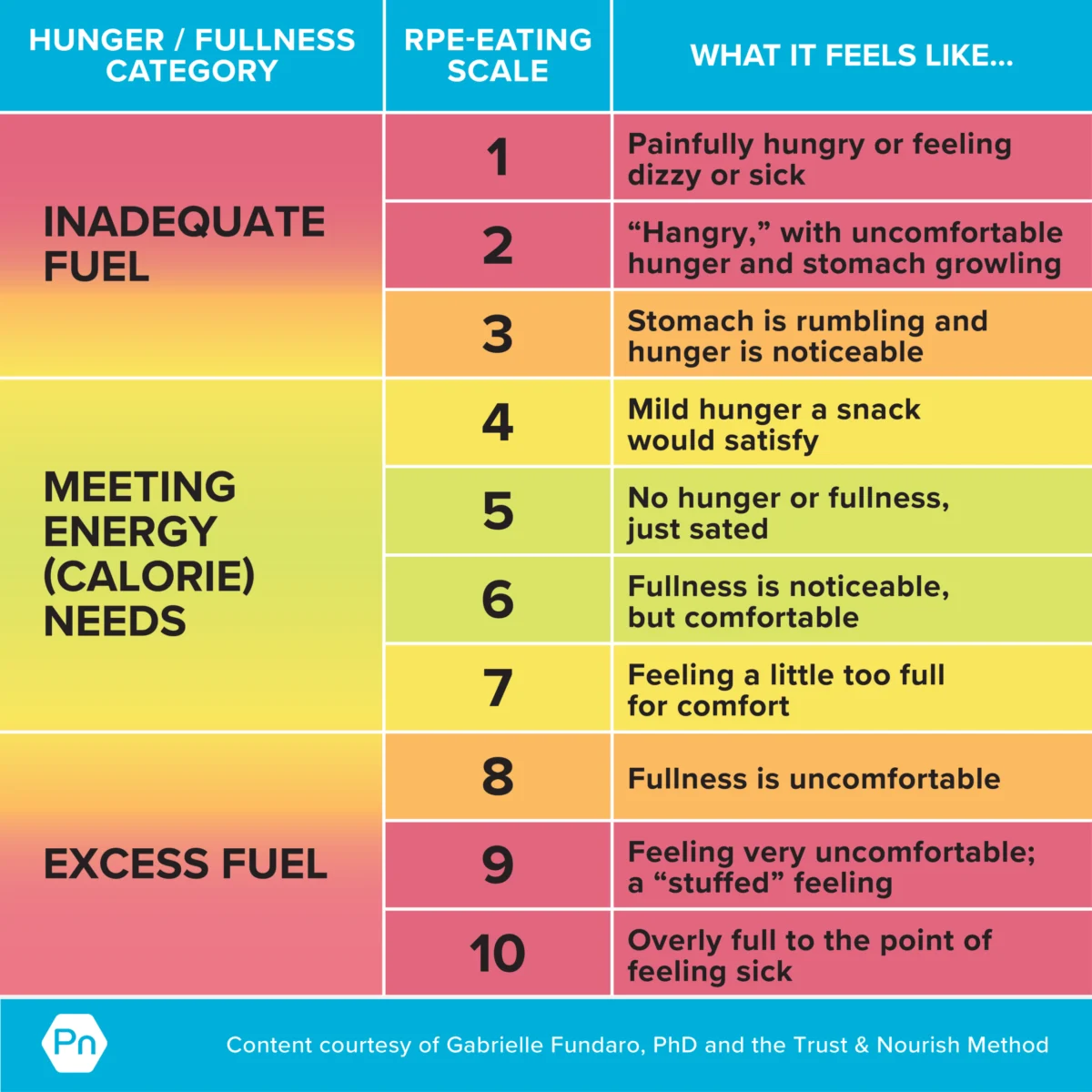
The RPE-Eating scale, adapted from Gunnar Borg’s 1960s physiotherapy model, uses a 1–10 spectrum to categorize hunger and fullness:

- 1–3: Inadequate fuel (dizziness, irritability, physical emptiness).
- 4–7: Adequate fuel (satiety, comfort, absence of extreme hunger).
- 8–10: Excess fuel (stuffed, lethargic, physical discomfort).
By practicing the skill of identifying these numbers, individuals are training their brain to recognize the biochemical feedback loop that modern society often ignores. Much like an athlete learns to recognize when a lift is becoming dangerous, an RPE-Eater learns to recognize when their hunger is satisfied before they hit the point of physical distress.
The Four Pillars of Practice
Dr. Fundaro outlines a clear, four-step process for those looking to implement this system:
1. Defining the Goal
The objective of RPE-Eating is not to manipulate body composition at maximum speed. It is to build self-trust. While it can be adapted for weight loss or gain, its primary function is to foster a sustainable, life-long relationship with nourishment.
2. Identifying Hunger vs. Appetite
One of the most critical steps is learning the distinction between physiological hunger and psychological appetite. Hunger is the body’s "gas light" turning on; appetite is the desire for something tasty regardless of fuel status. By practicing mindful eating—eating without distractions and checking in halfway through a meal—one learns to "download" the sensation of satiety into their long-term memory.
3. Decoding Non-Hunger Triggers
Everyone has "stress-eating" moments. The RPE-Eating framework encourages "noticing and naming" these triggers. By identifying the emotional state (anxiety, boredom, sadness) that precedes a binge, one can develop a toolkit of non-food coping mechanisms, such as walking or deep breathing.
4. Balancing Satiety and Satisfaction
Crucially, Dr. Fundaro emphasizes that food must be satisfying, not just fuel. Restricting "fun" foods leads to the "pendulum effect"—restricting today leads to binging tomorrow. RPE-Eating allows for the inclusion of all food groups, provided the individual checks in with their body to ensure they are eating for both physiological needs and psychological enjoyment.
Implications for the Future of Nutrition
The implications of this shift are significant. For coaches and clients alike, RPE-Eating offers a "safety net" that traditional tracking often lacks. By moving away from the binary "on-track/off-track" mentality, individuals reduce their risk of developing disordered eating patterns or high body dissatisfaction.
A Tool for the Right Job
It is essential, however, to acknowledge the limitations of this method. Dr. Fundaro is quick to note that RPE-Eating is not for everyone. It is a "tool in the shed," not a panacea.
- Who it helps: Those who feel trapped by the "tracking-to-binge" cycle or those who are physically and mentally exhausted by the demands of digital food logs.
- Who it may not suit: Those who require precise, calculated intake for elite-level athletic competition (e.g., bodybuilding stage prep) or those who need a medical professional’s guidance for disordered eating.
Conclusion: Reclaiming Autonomy
The shift toward RPE-Eating represents a maturation of the fitness industry. We are moving from a phase of "blind adherence" to a more sophisticated era of "biological literacy."
As Dr. Fundaro concludes, the goal of any nutritional program should eventually be to render the program unnecessary. "The goal is to know that you are nourishing yourself—and you don’t need a food tracker to do that." By fostering an internal compass, practitioners of RPE-Eating are not just changing what they eat; they are changing who they are in relation to their bodies: moving from a master-servant dynamic to a partnership of trust and mutual respect.
In a world obsessed with data, the most radical act may simply be to listen to what your body has been telling you all along.