











By Karina Sturm | January 2026
Netflix’s latest adaptation of a Harlan Coben thriller, Run Away, is ostensibly a dark, high-stakes drama centered on Simon Greene and his desperate search for his estranged daughter, Paige. As the narrative unfolds, uncovering secrets that threaten to dismantle the Greene family, the audience is treated to the signature twists and turns associated with Coben’s storytelling. However, for a significant segment of the viewing public—specifically the Ehlers-Danlos Syndrome (EDS) and chronic illness communities—the most profound revelation in the series has nothing to do with the plot.
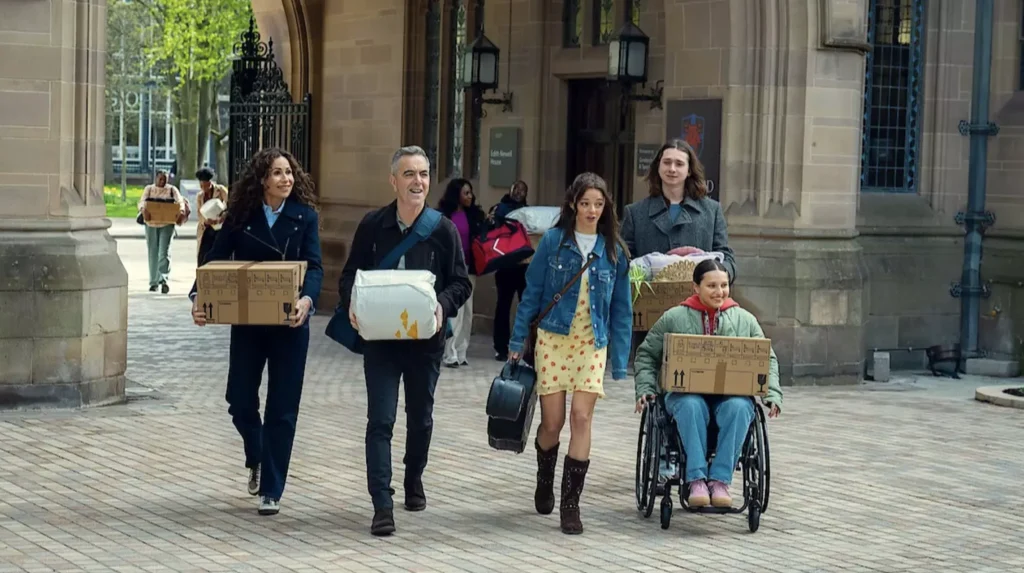
Instead, the series has garnered attention for its quiet, revolutionary depiction of Anya, the youngest daughter of the Greene family, played by Ellie Henry. In the show, Anya is an ambulatory wheelchair user, appearing in a chair in some scenes while walking or standing unaided in others. By refusing to offer an expositional explanation for this reality, Run Away has inadvertently sparked a national conversation about the misconceptions surrounding dynamic disabilities and the critical importance of authentic representation in media.
The Anatomy of a Misunderstanding: What is Ambulatory Wheelchair Use?
To understand the public’s confusion regarding Anya’s character, one must first confront the deep-seated, stereotypical tropes that have dominated screen portrayals of disability for decades. Most mainstream media presents disability as a binary state: one is either "fully able" or "paralyzed." This rigid, narrow perception has created a societal framework where the use of a mobility aid is synonymous with an absolute, permanent inability to walk.
However, the reality of disability is often fluid. Ambulatory wheelchair users—individuals who use a wheelchair for some tasks or during certain timeframes but who can also walk or stand—represent a large portion of the disabled population. Many conditions, such as Ehlers-Danlos Syndrome (EDS), Multiple Sclerosis, or POTS (Postural Orthostatic Tachycardia Syndrome), are "dynamic." This means symptoms fluctuate daily, hourly, or even minute-to-minute based on pain levels, fatigue, dizziness, or systemic instability.
When the public encounters an ambulatory user who stands to reach a high shelf in a grocery store or walks into a room, they are often met with suspicion or hostility. This is the "miracle cure" trope, where strangers assume the individual has been "faking it" because they witnessed a deviation from the expected performance of disability. In Run Away, when viewers saw Anya moving between her chair and her feet, many took to social media to cry "continuity error," assuming the production team had made a mistake. What was actually a standard day in the life of a disabled person was perceived as a failure of film craft.
A Shift in Industry Standards: The Casting of Ellie Henry
The significance of Anya’s character is compounded by the circumstances of her casting. In a move that subverts the traditional Hollywood pipeline, Ellie Henry was not cast to play a character written as disabled. Rather, the producers adapted the character to reflect Henry’s own reality.
Historically, the entertainment industry has operated under two exclusionary models: either disability is completely erased from a character, or a disabled actor is only considered for roles specifically written around their disability, often serving as a "tragedy" or "inspiration" trope. Run Away broke this mold by allowing the actor’s identity to shape the character. By keeping Anya’s disability as a "natural fact"—a peripheral attribute that requires no "issue-based" monologue or explanation—the production team afforded her a level of humanity rarely seen on screen.
Henry, who lives with EDS in her personal life, confirmed that she proactively raised the issue of her mobility with the production team. She consciously decided against including a scene where her character explains why she uses a chair. By choosing silence, the show forced the audience to sit with their own biases, effectively turning a narrative choice into a social experiment.
Chronology of a Controversy: The Online Reaction
The reaction to Run Away provides a fascinating case study in how social media can simultaneously act as a catalyst for misinformation and a platform for education.
- Release Week: Following the premiere of Run Away, forums such as Reddit and X (formerly Twitter) saw a surge in comments questioning the show’s editing. Users repeatedly pointed to scenes featuring Anya as evidence of poor continuity.
- The "Continuity Error" Narrative: As the show’s popularity grew, so did the vitriol directed at the production team. Many viewers framed their confusion as a critique of the show’s quality, unaware that their confusion was rooted in a lack of awareness regarding dynamic disabilities.
- The Advocacy Response: Within days, members of the EDS and chronic illness communities began posting video explainers and threads detailing the realities of ambulatory wheelchair use. These creators used clips from the show to educate their followers, effectively correcting the narrative that the show had made a mistake.
- Media Acknowledgment: Recognizing the cultural moment, outlets such as RadioTimes.com reached out to Ellie Henry, who confirmed the intentionality behind the portrayal. This shifted the public discourse from "the show is broken" to "the audience’s understanding of disability is limited."
Supporting Data: The Representation Gap
The scarcity of disabled representation in media is not merely anecdotal; it is a well-documented structural issue. According to the Geena Davis Institute on Gender in Media, disabled characters remain significantly underrepresented in television, and when they do appear, they are frequently depicted through the lens of their limitations rather than their personhood.
Furthermore, the "invisible" nature of many disabilities—like the connective tissue disorders prevalent in the EDS community—means that even when representation does occur, it is often inaccurate. A 2024 study by the Ruderman Family Foundation noted that while inclusive casting is slowly increasing, the types of disabilities represented are overwhelmingly limited to those that are visibly "fixed." Dynamic disabilities, which defy the binary expectation of the general public, are almost entirely absent from the mainstream lexicon.
This is why Anya’s presence in Run Away is so impactful. By existing in a space where her disability is neither the plot nor the punchline, she provides a template for future writers. The "representation gap" isn’t just about the number of characters on screen; it is about the quality and nuance of the stories being told.
Official Responses and Creative Intent
The production team of Run Away has remained relatively quiet regarding the "backlash," which, in itself, is a powerful editorial choice. By refusing to apologize or issue a statement "correcting" the scenes, the show maintains the dignity of the character.
In her interview with RadioTimes.com, Henry noted that she was prepared for the commentary. Her approach was to treat her wheelchair as an extension of herself—a tool for mobility—rather than a narrative device meant to be justified to the audience. This aligns with the "Nothing About Us Without Us" philosophy that has driven disability advocacy for decades.
The silence from the producers speaks volumes: they did not feel the need to justify the presence of a disabled person in the world of the show, because disabled people exist in the real world without needing to justify their presence to strangers.
Implications: The Future of Dynamic Disability on Screen
The long-term implications of Run Away are significant for the entertainment industry. The show proves that audiences are capable of engaging with complex, nuanced characters, even if they initially react with confusion. More importantly, it provides a roadmap for production companies to embrace authenticity.
- Normalization over Tokenism: If more writers and directors allow characters to be disabled without making the disability the central "issue," it will go a long way toward dismantling the stigma surrounding chronic illness.
- Informed Casting: The success of the Run Away model suggests that casting directors should be open to adjusting scripts to fit the lived experiences of their actors. When a character’s identity is authentic, the performance is inherently more grounded.
- The End of the "Continuity" Excuse: Moving forward, viewers who complain about "continuity errors" when seeing an ambulatory user will be met with a well-educated counter-narrative. The show has successfully moved the goalposts for what constitutes a "believable" character.
Conclusion: A Milestone for the EDS Community
For the Ehlers-Danlos community, which is often forced to navigate a world that demands they prove their pain, Run Away offers a rare moment of validation. For years, patients have had to endure the "grocery store" syndrome—being harassed by strangers for using a mobility aid one day and walking the next. To see that reality reflected on a major, global platform like Netflix is a milestone.
Anya’s role in Run Away may be small in terms of screen time, but its weight is immense. It is a reminder that what some viewers perceived as a "continuity error" was, in fact, a reflection of the beautiful, messy, and non-linear reality of the human experience. By choosing not to explain away the disability, Run Away did something far more important: it made the invisible, visible. It did not just fill a representation gap; it challenged the audience to grow, to learn, and to accept that disability does not have to be a tragedy—it can simply be a part of life.