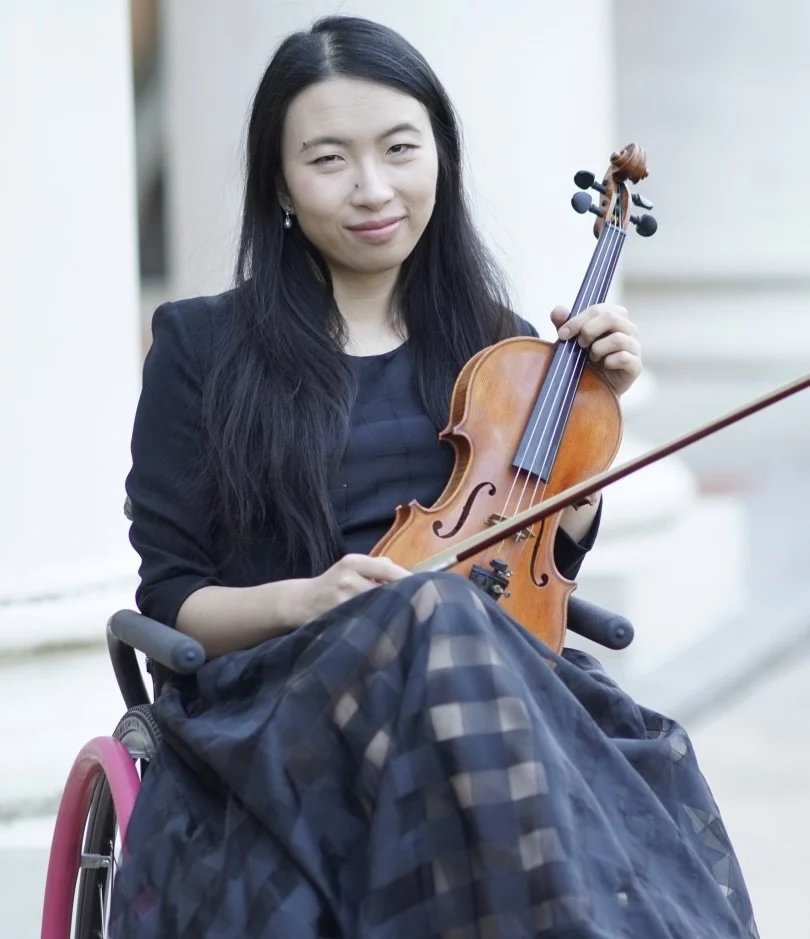
In the landscape of modern medicine, the intersection of chronic illness and the arts often remains an untold story. For Amy Wang-Hiller—a professional violinist, educator, and advocate—this intersection has become the cornerstone of her life’s work. Living with quadriplegia, hypermobile Ehlers-Danlos syndrome (hEDS), and a constellation of neuro-connective tissue disorders, Wang-Hiller has transformed her personal medical odyssey into a mission for systemic change. As the founder of the InclusiVibe Foundation and host of The Hidden Diagnoses Impact podcast, she is redefining what it means to live with a complex, often misunderstood, disability.
A Life Measured in Notes and Resilience
Amy Wang-Hiller’s relationship with the violin began at the tender age of three. What started as a parental suggestion for a creative outlet quickly evolved into an all-consuming passion. "I think what really made me fall in love with it was watching the older students perform," she reflects. "I remember thinking, ‘Oh my God, they’re so good.’ I wanted to play like them."
For many years, the violin was not merely a hobby; it was an anchor. Even during childhood bouts of high fever or illness, her first instinct upon recovery was to return to the instrument. This rigorous dedication, combined with the aspiration to bridge the gap between amateur playing and professional artistry, fostered a profound commitment to the craft. However, the body that facilitated this musical pursuit was simultaneously battling a series of systemic health challenges that would eventually demand a total recalibration of her existence.
The Chronology of an Unseen Struggle
Wang-Hiller’s health history is a sobering example of how medical fragmentation can delay critical diagnoses. Throughout her youth, she navigated a series of seemingly disparate symptoms: persistent fevers, tonsillitis, ocular disturbances, chronic jaw pain, and gastrointestinal distress. Because these issues were addressed in silos, the underlying connective tissue disorder remained obscured.
The trajectory shifted sharply following a move to the United States in 2012. A car accident followed by a fall in 2015 acted as catalysts for a decline that became impossible to ignore. "I started having unexplained falls, balance problems, and difficulty eating," she recalls. "I simply didn’t have the language to describe symptoms that were unfamiliar to me and didn’t fit what clinicians expected."
The year 2020 served as a grim turning point. A neck hyperextension injury triggered a cascade of severe neurological and physiological events, including Postural Orthostatic Tachycardia Syndrome (POTS), dystonia, drop attacks, and periods of temporary paralysis. It was during this period of progressive motor loss that the medical community finally identified the primary culprit: hypermobile Ehlers-Danlos syndrome (hEDS). This was accompanied by diagnoses of occult tethered cord and craniocervical instability with severe upper cervical ligament damage. For Wang-Hiller, these labels were not merely medical terms; they were pieces of a puzzle that had been scattered for decades.
Debunking the Myth of "Complete" Paralysis
One of the most persistent hurdles Wang-Hiller faces is the public and medical misconception surrounding the term "quadriplegia." The common, stereotypical image of total, permanent paralysis often obscures the reality of those living with incomplete quadriplegia.
"I am classified as AIS B, which means sensory incomplete," she explains. "In practical terms, I have some sensation and very limited movement, but not enough for independent function." She offers a visceral metaphor to help others understand: "Imagine your body encased in cement. You know exactly what you want your body to do, but the signals simply aren’t able to easily pass through those injured segments."
This "spectrum of paralysis" is frequently misunderstood by healthcare providers who equate limited mobility with a lack of impairment. Because Wang-Hiller may retain small, intermittent motor functions, she has faced skepticism from clinicians who failed to reconcile her musical capability with her physical reality. This leads to a dangerous assumption that her condition is "functional" or "inconsistent," rather than a complex, fluctuating neurological injury.
The Cost of Misdiagnosis and Medical Gaslighting
The psychological toll of navigating a medical system that relies heavily on "functional" labels cannot be overstated. Throughout her journey, Wang-Hiller has faced the debilitating reality of medical gaslighting—a process where a patient’s genuine physiological symptoms are dismissed as psychological in origin.
In 2022, her relationship with her neurology team reached a breaking point when she was referred to a clinic for Functional Neurological Disorder (FND). Her ability to play the violin—a skill she maintained through immense effort and adaptation—was cited as "evidence" that her weakness was inconsistent. "Once those labels are attached to a patient, they can continue to shape how future clinicians interpret new symptoms," she warns.
This systemic skepticism persisted as late as 2024, when early signs of paralysis were again misattributed to psychological causes, only to be taken seriously once her dependence on a ventilator became undeniable. This cycle of diagnostic delay creates a secondary trauma that complicates the patient’s ability to trust the very institutions meant to provide care.
Cultural Perspectives and Global Advocacy
As a Chinese-born patient, Wang-Hiller brings a unique perspective to the discourse surrounding EDS. She argues that there is an urgent need for greater cultural and ethnic diversity in how these disorders are identified and represented.
"When people only encounter one picture of EDS, patients from different ethnic backgrounds tend to be overlooked or diagnosed much later," she observes. By highlighting her own experiences and those of her peers, she is working to dismantle the "standard" profile of the EDS patient, encouraging a more inclusive clinical approach that accounts for biological and cultural nuances.
The InclusiVibe Foundation: A New Blueprint for Care
In response to these systemic gaps, Wang-Hiller founded the InclusiVibe Foundation. The organization is built on the premise that lived experience is as vital as clinical research. The foundation serves as a hub for patients, researchers, and artists to collaborate on care models that are more holistic and compassionate.
"Many of us live with complex neuro-connective tissue conditions that don’t fit neatly into one specialty," she explains. "The common thread wasn’t that everyone had the same diagnosis; it was that so many of us were facing the same gaps in understanding and pathways to care." By integrating music and storytelling into its advocacy, InclusiVibe aims to humanize the patient experience and bridge the communication gap between patients and medical professionals.
Implications for the Future of Chronic Pain Management
The implications of Amy Wang-Hiller’s work extend far beyond the rare disease community. Her story challenges the medical establishment to:
- Re-evaluate "Functional" Labels: Clinicians must exercise caution before attributing complex, multi-systemic symptoms to psychiatric causes, as this often delays life-saving interventions.
- Foster Cross-Disciplinary Care: The future of treating neuro-connective tissue disorders lies in the integration of neurology, rheumatology, and pain management, rather than isolated specialty care.
- Validate Patient Experience: Healthcare systems must move toward a model of "shared decision-making," where the patient’s lived reality is treated as valid data.
Final Reflections: Fortune and Misfortune
When asked about her outlook on life, Wang-Hiller invokes the Chinese proverb, fú huò xiāng yī—"Fortune and misfortune are interdependent." This philosophy does not seek to minimize the agony of her condition, but rather to recognize the duality of life.
"I found a new purpose through education, advocacy, writing, and eventually founding the InclusiVibe Foundation," she says. "Healing doesn’t always mean getting better physically. Sometimes it means discovering that your life can still have meaning, connection, creativity, and hope, even if it looks very different from what you imagined."
For those currently in the "middle of a difficult chapter," her message is clear: You do not have to find meaning immediately. You only need to persevere. By sharing her journey, Amy Wang-Hiller is not just advocating for herself; she is creating a path for others to follow, proving that even when the body is constrained, the human spirit—and the music it creates—remains unbound.