
As we navigate our golden years, the importance of lower-body strength cannot be overstated. It is the primary currency of independence. Whether it is rising from a dining chair, navigating a flight of stairs, or maintaining balance on uneven outdoor terrain, our daily lives are built upon the integrity of our hips, glutes, and quadriceps. For those over the age of 65, maintaining this physical foundation is not just about aesthetics—it is about functional longevity and the preservation of personal autonomy.
Fortunately, you do not need an elaborate home gym or a membership to a high-end fitness facility to see meaningful results. With as little as ten minutes, a sturdy chair, and a simple mini-band, you can cultivate a routine that restores power, stability, and confidence to your movement.
Main Facts: Why Lower-Body Strength Is Non-Negotiable
The aging process naturally involves a decline in muscle mass, a condition clinically referred to as sarcopenia. If left unchecked, this loss of muscle can lead to decreased mobility, a higher risk of falls, and a general reduction in the ability to perform activities of daily living (ADLs).
According to research published in the Journal of Frailty & Aging, targeted resistance training is the single most effective intervention for mitigating age-related muscle loss. By focusing on the major muscle groups of the lower body—the quadriceps, hamstrings, and glutes—older adults can effectively "re-engineer" their movement patterns.
The strategy behind this specific 10-minute routine is simple: by using a chair for support, you remove the fear of instability, allowing your nervous system to focus entirely on muscle recruitment. Adding a mini-band introduces "constant tension," which forces the lateral hip stabilizers to activate. When these muscles are firing correctly, the entire kinetic chain—from your ankles to your lower back—benefits from improved alignment and strength.
Chronology: A Progressive Approach to Movement
To see real, lasting change, one must approach exercise as a practice rather than a chore. This program is designed as a "superset" protocol, which minimizes downtime and keeps the heart rate elevated just enough to improve cardiovascular efficiency without causing excessive fatigue.
The Protocol (10 Minutes)
The structure of this routine is intentional. You will perform five rounds of two specific movements. By alternating between them, you allow one muscle group to recover while the other works.

- The Warm-up: Spend one minute marching in place or doing gentle, unweighted sit-to-stands.
- The Superset:
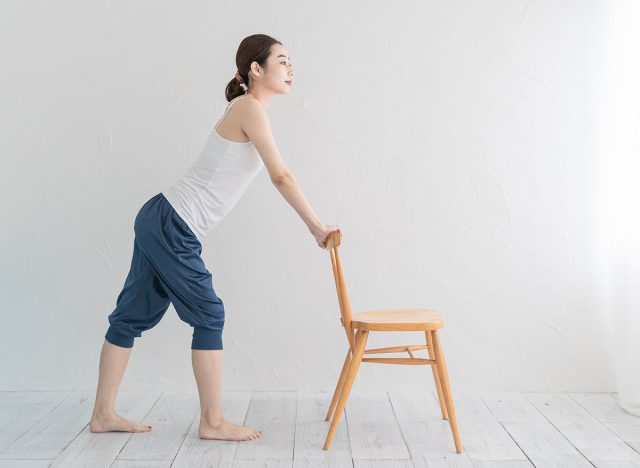
- 5 Supported Reverse Lunges (per side)
- 5 Mini-Band Lateral Walks (per side)
- Rest for 30 seconds.
- Repeat: Complete this cycle five times.
Supporting Data: The Mechanics of Balance and Strength
Why these two specific movements? The answer lies in how our bodies function in the real world.
The Supported Reverse Lunge
When you step backward, you are engaging in a movement pattern that mimics the natural act of bracing for a fall or navigating a step. By holding onto a chair or a sturdy kitchen counter, you offload a portion of your body weight. This allows you to achieve a deeper range of motion safely. As you press through the front heel to return to a standing position, you are forcing the glutes and quads to perform the "heavy lifting."
Studies in the Journal of Strength and Conditioning Research have shown that unilateral (single-leg) exercises are superior for correcting muscle imbalances. Because we rarely use our legs perfectly symmetrically in daily life, this exercise helps "even out" your strength, ensuring that one side of your body isn’t compensating for the other.
The Mini-Band Lateral Walk
Many people suffer from "gluteal amnesia," a phenomenon where the side-hip muscles (the gluteus medius) become dormant due to prolonged sitting. The mini-band lateral walk acts as a wake-up call for these stabilizers. When you move laterally, you are training the hips to act as the primary support for your knees. If your hips are strong, your knees are protected from unnecessary stress. This is critical for preventing the joint pain that often leads seniors to become sedentary.
Implications for Long-Term Health
The implications of adopting a consistent, 10-minute strength routine are profound. Beyond the physical metrics of muscle mass and bone density, the psychological impact of feeling "physically capable" is life-changing.
Enhanced Proprioception
Proprioception is your body’s ability to sense its position in space. By practicing controlled, weighted movements, you are essentially "re-calibrating" your internal gyroscope. This leads to better balance, a more confident gait, and a significantly reduced risk of slips and falls—the leading cause of injury in the 65+ demographic.
Metabolic Health
Resistance training is a powerful tool for metabolic regulation. By increasing muscle mass, you improve your body’s ability to manage blood sugar levels. Even a short, 10-minute bout of strength training can increase insulin sensitivity for hours after the workout is finished, making it a powerful tool for those managing or trying to prevent Type 2 diabetes.
Expert Coaching Cues: Making the Reps Count
It is not about how many reps you do; it is about how well you do them. As a coach, I emphasize the "mind-muscle connection."
- For the Reverse Lunge: Imagine you are pushing the floor away from you. Keep your torso upright. If you feel pain in your knees, shorten your step. The goal is a controlled descent, not a race to the bottom.
- For the Lateral Walk: Keep your feet wider than your shoulders. Maintain a "soft" knee bend. Do not let your knees cave inward toward each other; push against the band to keep your knees tracking over your toes. If the band feels too difficult, move it from your ankles to just above your knees.
A Path Forward: Scaling Your Progress
Consistency is the bedrock of progress. If you are new to this, start with only two or three rounds instead of five. Once you feel comfortable, increase the number of rounds, or move to a slightly more resistant mini-band.
Progressive Overload Checklist:
- Weeks 1-2: Focus on balance and range of motion. Use the chair for significant support.
- Weeks 3-4: Increase the depth of your lunge. Aim for 5 full rounds.
- Weeks 5+: Reduce your reliance on the chair. Use it only for safety, not for balance.
Conclusion: You Are the Architect of Your Mobility
Rebuilding leg strength after 65 is not about achieving the physique of an athlete; it is about reclaiming the freedom to live your life on your own terms. The chair is not just a piece of furniture—it is a tool for empowerment. The band is not just an accessory—it is a pathway to joint health.
By dedicating ten minutes a day to these two fundamental movements, you are making a down payment on your future mobility. You are choosing to remain active, capable, and confident. Whether you are playing with grandchildren, traveling, or simply enjoying a walk in the park, the strength you build today will be the foundation for your independence tomorrow.
References
- Journal of Frailty & Aging: "The Efficacy of Resistance Training in Older Populations: A Systematic Review."
- Journal of Strength and Conditioning Research: "Unilateral vs. Bilateral Exercise for Functional Independence in the Elderly."
- National Institutes of Health (PMC6239135): "Functional Strength Training and its Impact on Gait and Balance in Adults Over 65."
- PubMed (26551663): "The Role of Hip Abductor Strength in Knee Joint Stability and Pain Prevention."