




For years, the gold standard of nutritional discipline has been the macro tracker. From mobile apps to digital food scales, millions of fitness enthusiasts and athletes have relied on the precise quantification of protein, fats, and carbohydrates to sculpt their physiques and monitor their health. But for Dr. Gabrielle Fundaro—a PhD in Human Nutrition, a veteran coach with over a decade of experience, and a competitive powerlifter—the very system she championed began to feel like a cage.
Despite her professional expertise, Dr. Fundaro found herself trapped in a cycle of dependency. The numbers that once provided clarity had become a source of anxiety. She realized that she was no longer eating to nourish her body; she was eating to satisfy an algorithm. Her journey to break free from the shackles of data-driven dieting has led to the creation of "RPE-Eating," a paradigm-shifting approach that replaces external metrics with internal awareness.
The Problem with Precision: Why Tracking Often Fails
The reliance on tracking macros—or "if it fits your macros" (IIFYM)—is rooted in the assumption that human biology behaves like a laboratory experiment. While caloric and macronutrient intake are undeniably the building blocks of body composition, the psychological toll of rigid tracking is frequently overlooked.
For Dr. Fundaro, the breaking point was the loss of autonomy. She grew tired of the mental exhaustion involved in balancing her daily intake perfectly, and she became frustrated by her inability to enjoy a social meal without checking a database. The fear of "going off-track" was constant. She worried that without the safety net of an app, she would inevitably lose muscle mass, gain unwanted body fat, or lose the very expertise she claimed to possess as a nutritionist.
This phenomenon is not unique to Dr. Fundaro. Many individuals who engage in long-term macro tracking develop a form of "data-dependency." When the tracker is removed, they are left without an internal compass, unable to distinguish between genuine hunger and psychological craving.
Chronology of an Idea: From the Squat Rack to the Dinner Table
The transition from tracking to intuitive regulation didn’t happen overnight. It was born out of a realization that occurred within the gym, rather than the kitchen.
In strength training, the Rate of Perceived Exertion (RPE) is a well-established framework. Developed by Gunnar Borg in the 1960s, RPE allows athletes to gauge their intensity on a scale of 1 to 10. Rather than relying on a predetermined percentage of their one-rep max, a powerlifter uses RPE to adjust their effort based on how they feel on any given day. If they are sleep-deprived or stressed, their "7 out of 10" effort will naturally involve less weight than on a day when they are fully recovered.
Dr. Fundaro observed that applying RPE to her training led to better recovery and consistent strength gains. It provided structure without the rigidity of a fixed percentage. The "Eureka" moment came when she asked herself a simple, yet profound question: If RPE can optimize physical performance, why couldn’t a similar framework optimize nutritional intake?
She began to pilot this method on herself. She moved away from the digital tracker and toward a scale of internal sensations, testing whether she could maintain her physique and health by listening to her body’s feedback loop. The result was not a loss of control, but a shift toward a more sustainable, self-trusting relationship with food.
Supporting Data: The Science of Interoceptive Awareness
The efficacy of RPE-Eating rests on a concept known as interoceptive awareness—the ability to perceive and interpret signals from inside the body. Science has consistently shown that individuals who are more attuned to these signals (such as stomach distension, hunger pangs, and satiety) are more successful at maintaining a healthy weight without the need for constant dietary restriction.
While traditional dieting treats the body as a machine that must be programmed, RPE-Eating treats the body as an intelligent, responsive organism. When we eat, our digestive system sends hormonal signals—like ghrelin (the hunger hormone) and leptin (the satiety hormone)—to the brain. Decades of "dieting" often dull these signals.
RPE-Eating acts as a bridge, helping individuals "re-sensitize" themselves to these natural cues. By regularly checking in with the RPE scale, practitioners learn to distinguish between physiological hunger and emotional appetite. This process creates a "mental software update," where the brain learns to recognize the physical sensation of fullness as a reliable signal to stop eating, rather than relying on an arbitrary calorie limit.

The Mechanics of the RPE-Eating Scale
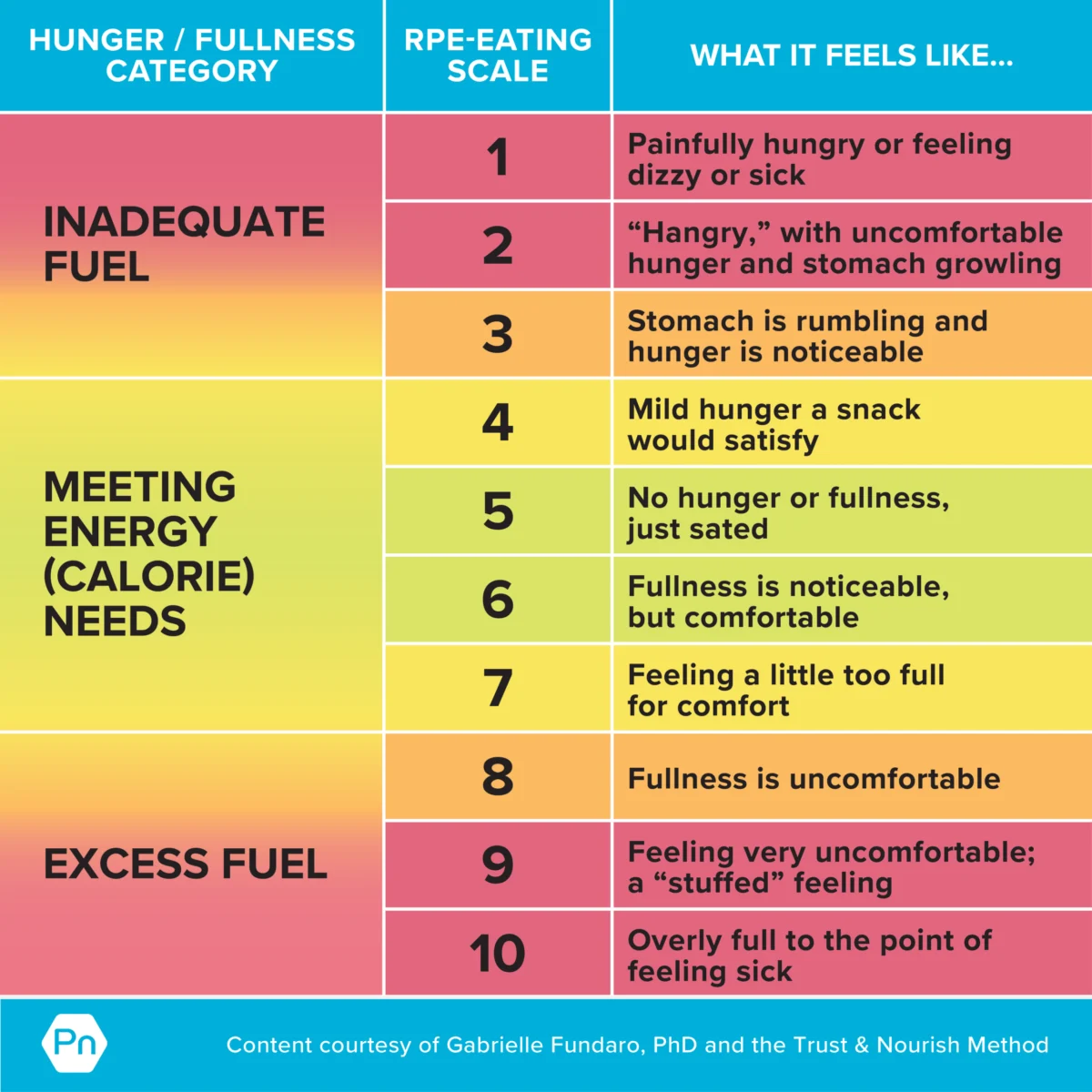
To put this method into practice, one must first adopt the 1–10 RPE-Eating scale. This scale measures the spectrum of hunger and fullness:
- 1–3 (Inadequate Fuel): Characterized by physical pain, dizziness, or the classic "hangry" irritability.
- 4–7 (Adequate/Neutral Fuel): The target zone. Hunger is satisfied, the stomach feels comfortable, and energy levels are stable.
- 8–10 (Excess Fuel): Ranging from "a little too full" to physical sickness and lethargy.
Practicing this requires "mindful presence." Dr. Fundaro suggests that before a meal, one should identify their current hunger level. Halfway through, they should pause to reassess. This intentional pause is the critical intervention that prevents mindless overeating.
Implications for Health and Behavioral Change
The implications of adopting an RPE-based approach are significant, particularly for those with a history of disordered eating or chronic yo-yo dieting.
1. Building Self-Trust
The primary goal of RPE-Eating is not to manipulate body weight, but to build internal confidence. By proving to oneself that they can eat without a tracker and still remain healthy, the individual breaks the cycle of fear that keeps them tethered to diet apps.
2. Addressing Non-Hunger Triggers
A major component of the RPE-Eating philosophy is identifying why we eat when we aren’t hungry. Whether it is stress, boredom, or sadness, identifying these triggers ("Notice and Name") allows individuals to find non-food coping mechanisms. Instead of reaching for a snack, the person might take a walk, breathe, or reach out to a friend.
3. Satiety vs. Satisfaction
Dr. Fundaro emphasizes that food serves a dual purpose: physical fuel (satiety) and psychological pleasure (satisfaction). A diet that provides perfect macros but feels miserable is unsustainable. By allowing room for "satisfaction"—incorporating foods that bring joy—RPE-Eating prevents the "pendulum effect," where restricted foods are eventually binged upon.
Official Perspectives and Expert Nuance
It is important to note that RPE-Eating is not a "magic bullet," nor is it intended for everyone. Dr. Fundaro is transparent about the limitations of her method. It is not designed for elite athletes preparing for a bodybuilding show, where extreme, data-driven precision is required to achieve specific aesthetic goals.
Furthermore, for those who struggle with severe eating disorders, RPE-Eating is not a replacement for clinical care. It is a tool for behavioral change, not a medical intervention. As with any transition, there is a learning curve. The process requires a level of emotional labor and self-reflection that can be challenging for those with high-pressure, on-the-go lifestyles.
However, for the average person seeking to escape the "tracker trap," the benefits are clear. It shifts the burden of proof from a third-party app to the only person who truly knows the body: the individual themselves.
Conclusion: The Path Toward Sustainable Nourishment
As we look toward the future of nutrition, the pendulum is swinging away from the hyper-quantified "bio-hacking" era and toward a more integrated, human-centric approach. Dr. Fundaro’s work serves as a reminder that health is not merely a set of numbers on a spreadsheet, but a dynamic, lived experience.
RPE-Eating offers an "off-ramp" for those who are ready to stop tracking but are afraid of the uncertainty that follows. By teaching us to listen to our bodies, it provides a foundation for a lifetime of intuitive, sustainable, and joyful eating. We may not need to be robots to be healthy—we just need to learn how to be human again.