




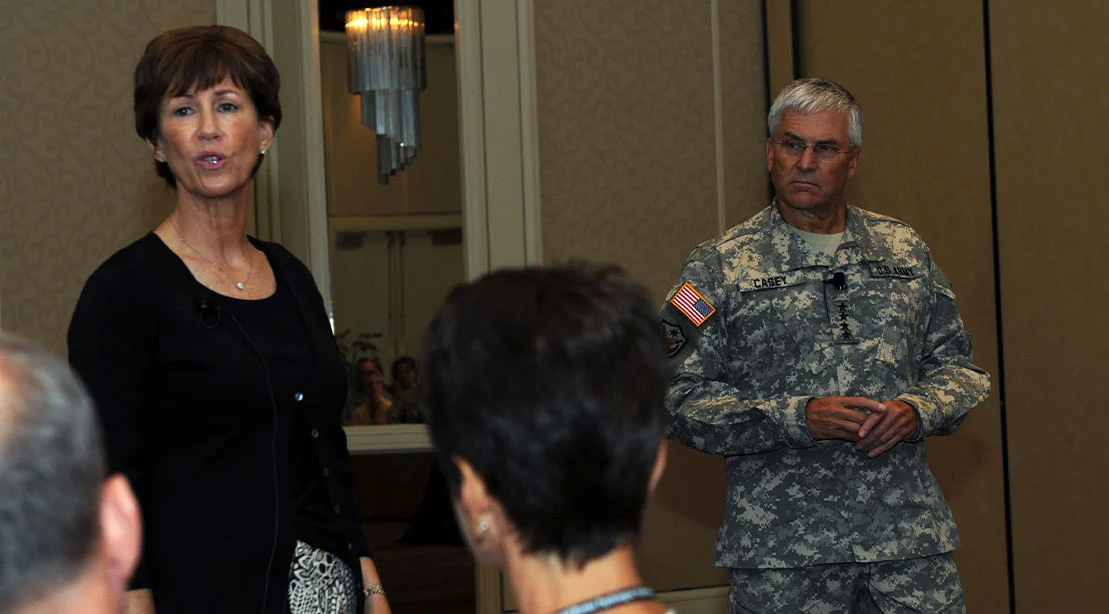
The nearly two million men and women serving in the United States Armed Forces represent the backbone of our national security. While their sacrifice is often immortalized in headlines and ceremonies, there is a secondary, often invisible front line: the military families who sustain the household, manage the transitions, and provide the emotional scaffolding that allows service members to fulfill their duties. Among the most prominent advocates for this community is Sheila Casey, wife of retired four-star General and 36th Army Chief of Staff George Casey Jr.
Beyond her role as a military spouse, Sheila Casey has forged an identity defined by professional rigor, a commitment to public service, and an unwavering belief in the necessity of personal physical fitness. Her journey serves as a powerful testament to the idea that one cannot truly support others without first fortifying oneself.
The Chronology of a Resilient Life
Sheila Casey’s life has been defined by constant motion and profound adaptation. Born into an era where opportunities for female athletes were far more limited than today, she found her early sanctuary in the pool, competing in swimming for 12 years. This foundation in athletics would prove to be the precursor to a lifetime of discipline.
A Life in Transit
Upon marrying George Casey Jr., Sheila entered a world characterized by the nomadic nature of military life. Over 41 years of marriage, the couple relocated 25 times. These weren’t merely changes of address; they were complete life overhauls. Each move required Sheila to orchestrate the logistical complexities of relocating a household, integrating into a new community, and ensuring stability for their two sons—all while managing the frequent, high-stakes absences of her husband.
The Trial of Parenting in Wartime
The true test of her resolve arrived when her son deployed to a combat zone. Despite her years of experience as an Army spouse, the shift from supporting a husband to supporting a child in harm’s way was visceral. "I thought I understood what it would be like to send a child to a war zone," Casey reflects. "I quickly realized once that happened, I didn’t have a clue until I actually experienced it myself." This period underscored the unique, often harrowing mental burden placed on military parents, reinforcing her conviction that caregivers must maintain their own health to navigate such profound stress.
Professional Evolution and Public Impact
While many military spouses feel pressured to subordinate their professional ambitions to their partner’s career, Sheila Casey chose a different path. She recognized early on that her happiness and personal agency could not be entirely derived from her husband’s career trajectory.
A Career of Consequence
Casey’s professional resume is as robust as her dedication to service. Her career includes a two-decade tenure as the Chief Operating Officer of The Hill, a premier D.C.-based political news organization. Her transition into the public sector saw her serving as a Special Assistant to President Biden and as the Director of "Joining Forces," the White House initiative championed by First Lady Jill Biden to support military families, caregivers, and survivors.
Her contributions have been recognized with the Defense Distinguished Civilian Service Medal, awarded to her twice. Currently, she serves as a Senior Advisory Partner for American Corporate Partners (ACP), a nonprofit dedicated to providing one-on-one mentorship to veterans and military spouses to combat underemployment—a systemic issue within the military community. She also works extensively with "Hiring Our Heroes," helping service members navigate the often-difficult transition from active duty to the civilian workforce.
Supporting Data: The Reality of Military Spousal Caregiving
The narrative of the "supporting spouse" is backed by stark statistics. According to a 2017 Department of Defense study, approximately 92 percent of military spouses are women. This demographic reality creates a specific set of cultural pressures where the instinct to prioritize family needs over personal health is deeply ingrained.
The "Self-Care" Paradox
Casey’s work with organizations like ACP and Hiring Our Heroes is grounded in data-backed advocacy. She argues that the "martyrdom" model of caregiving—where a spouse sacrifices their own health, career, and mental well-being for the sake of the family—is ultimately unsustainable.
"I think that women, who are generally the caregivers, tend to think, ‘I’ll take care of myself later,’ but in the long run, it doesn’t help," Casey notes. By neglecting their own needs, caregivers risk burnout, which diminishes their capacity to serve as the pillar of strength their families require. This is why she advocates for at least 30 minutes of daily physical activity—not as a luxury, but as a mandatory tool for mission readiness at the home front.
The Physicality of Purpose: Climbing Mountains
The psychological "weight" of moving, parenting, and navigating the risks of war is a burden that few outside the military understand. In a symbolic turn of events, Sheila Casey has taken to climbing literal mountains to process these experiences.
Recently, the Casey family, including eight members spanning three generations, embarked on a grueling three-day trek to Machu Picchu. The journey involved climbing to 13,500 feet and enduring freezing, 30-degree nights in tents. For Casey, these challenges are not just physical; they are a manifestation of the same resilience required to manage a military household. While she jokes that she has told her husband the upcoming climb of Mount Fuji will be her final mountain, the physical discipline required for these feats remains a core pillar of her life.
"I don’t have cholesterol issues, blood pressure issues," she says, crediting her consistent commitment to exercise. "I don’t have any of that, and so I want to do what I can to stay that way."
Implications: A Call to Action for All Families
Sheila Casey’s journey offers a roadmap for any individual—military or civilian—who finds themselves in a position of high-stakes caregiving. Her message is one of empowerment: You do not need permission to pursue your own potential.
The Permission Paradox
Casey often encounters spouses who feel they are "allowed" to have a career or a fitness regimen only after everything else is perfect. Her response is direct: "You don’t need my permission. You need to do what is important for you and your family."
The implication here is that personal professional growth and physical health are not in conflict with family support; they are the engines that make that support possible. By creating a life outside of the military identity, spouses like Casey are better equipped to handle the turbulence of military life. They bring a broader perspective to the family, a sense of personal accomplishment, and a robust physical constitution that allows them to remain "Fit to Serve."
Final Reflections
As the military community continues to grapple with the challenges of modern warfare, long deployments, and the transition to civilian life, the leadership of figures like Sheila Casey becomes increasingly vital. She has transformed the role of a "General’s wife" into a platform for systemic change. Whether through mentorship, policy advocacy, or simply leading by example on a mountain trail, Casey proves that the strength of the nation’s military rests not only on the soldiers in the field but on the resilient, healthy, and empowered individuals who hold the home front together.
For the millions of spouses and parents navigating the complexities of service life, Sheila Casey’s life provides a clear, actionable directive: Take care of yourself, so that you may better care for those you love. In the grand calculus of service, your health and your ambition are not just personal gains—they are national assets.