




For decades, the medical community’s war on cancer has been primarily reactive—an intense, high-stakes battle waged against tumors that have already established themselves within the body. However, a seismic shift is underway. For the first time, the Cancer Research Institute (CRI) has designated "primary and secondary cancer prevention and interception" as the central theme for its CLIP (Cancer Research Institute Lloyd J. Old STAR) applications. This pivot marks a bold departure from traditional oncology, signaling a commitment to a future where cancer is not merely treated, but intercepted before it can ever manifest as a life-threatening disease.
The Paradigm Shift: Redefining Cancer as a Process, Not an Event
Cancer does not emerge in a vacuum; it is a long-gestating biological process. A tumor that appears on a scan today likely began its trajectory years, or even decades, earlier. For instance, the development of pancreatic cancer from initial genetic aberrations to a malignant, invasive state can span over a decade. Historically, this "pre-clinical" interval was a blind spot in medicine—a period where the disease was present but invisible to diagnostic tools and unreachable by therapeutic interventions.
Today, however, the convergence of high-resolution genetics, advanced immune monitoring, and sophisticated precancer mapping is illuminating this hidden timeline. Much like modern cardiology, which routinely manages cholesterol and blood pressure to avert a heart attack years before it occurs, oncology is beginning to identify a "window of opportunity" to act. By understanding a patient’s risk profile and monitoring biological shifts, clinicians are moving toward a future where early intervention renders invasive cancer obsolete.
Three Windows of Opportunity: A Strategic Framework
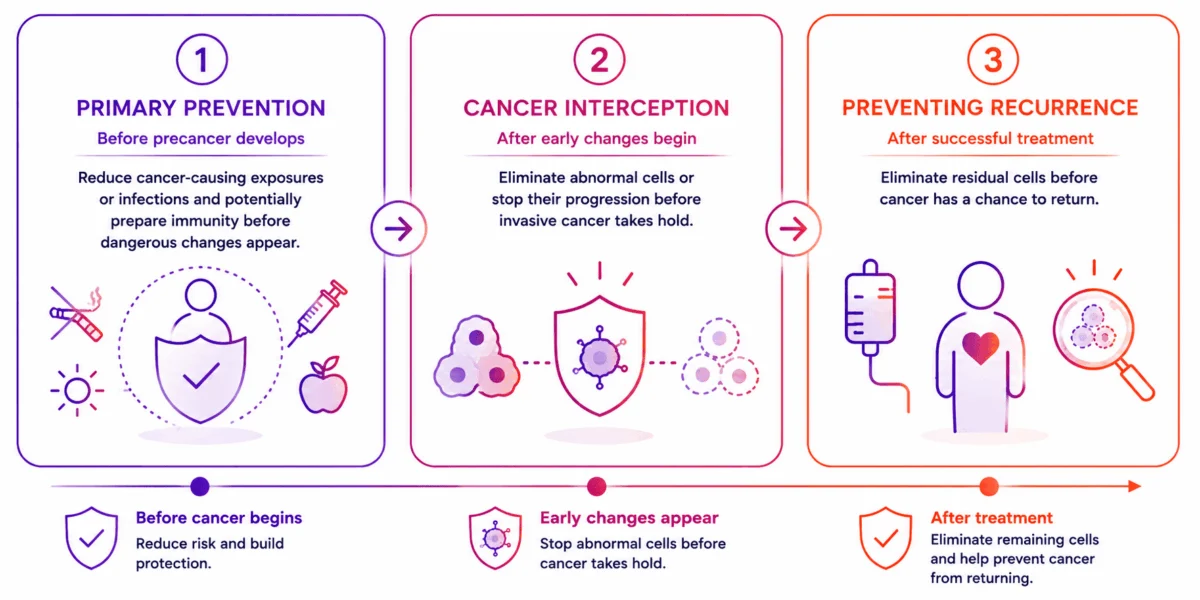
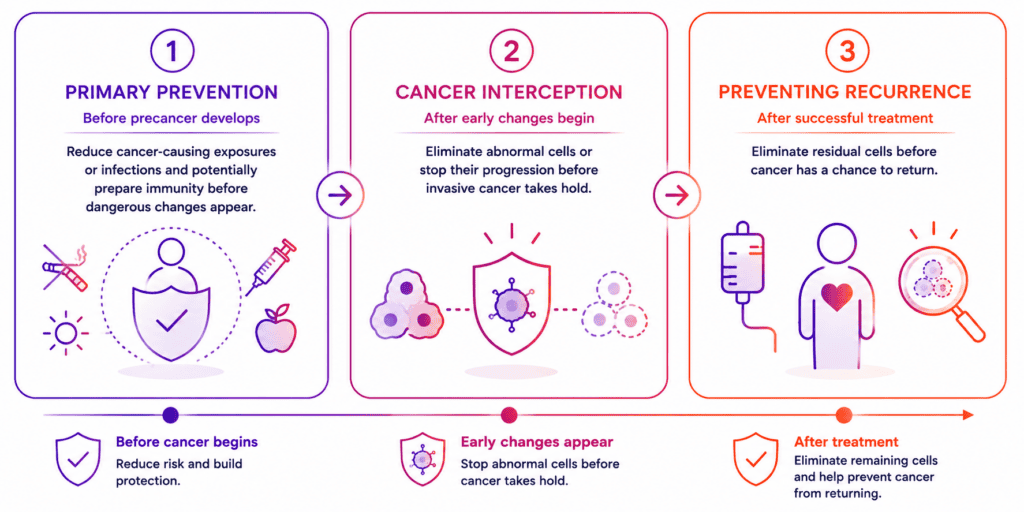
To effectively intercept cancer, researchers have categorized the fight into three distinct chronological windows, each requiring unique immunological approaches:

- Primary Prevention: This is the most proactive stage, acting before precancerous changes even emerge. It involves mitigating environmental exposures, addressing chronic infections, or priming the immune system to recognize and eliminate threats before they take root.
- Cancer Interception: This window begins once the earliest dangerous genetic or cellular changes are detected but before the disease has become invasive. The goal here is to eradicate these abnormal cells or halt their progression entirely.
- Preventing Recurrence: This stage focuses on the post-treatment landscape. Even after a primary tumor is removed, microscopic residual cells can linger. By deploying immune-based therapies, clinicians aim to clear these cells, preventing the devastating phenomenon of cancer recurrence.
Across all three windows, the immune system holds the strategic advantage. When a tumor is absent or limited to a microscopic level, the immune system is less likely to be suppressed or exhausted by the complex microenvironment of a full-blown tumor.
Chronology of Progress: From Vaccines to mRNA
The concept of immune-based prevention is not theoretical—it is already a proven reality, most notably in virally driven cancers.
- 1999: A pivotal moment for cancer immunology occurred when CRI began supporting the work of Dr. Ian H. Frazer. His research into virus-like particles became the cornerstone of the HPV vaccine, Gardasil®.
- The Global Impact: Today, programs backed by Gavi, the Vaccine Alliance, have protected approximately 86 million girls in lower-income nations, with projections suggesting 1.4 million cervical cancer deaths will be averted. If global HPV vaccination reaches 80% coverage, over 50 million cases of cervical cancer could be prevented over the next century.
- 2026: A landmark milestone in recurrence prevention was reached when Merck and Moderna announced that a personalized mRNA vaccine, when combined with pembrolizumab, significantly reduced the risk of melanoma recurrence in a Phase III trial. This serves as a vital proof-of-concept for using immune-based strategies to clear microscopic residual disease.
Supporting Data and Clinical Realities
While the potential is vast, early clinical trials have provided both encouragement and sobering lessons. In a trial targeting MUC1—a protein often altered in precancerous colon growths—only 25% of participants developed a strong immune response. Notably, those who did respond saw their risk of recurrence drop by 38 percentage points compared to the placebo group. The data suggests that success is contingent upon the patient’s baseline immune health; those who did not respond were found to have higher levels of immune-suppressing cells, indicating that "reconditioning" the immune system may be a necessary precursor to effective prevention.
Similarly, trials using nivolumab on high-risk mouth lesions showed that while the drug could shrink lesions in one-third of participants, it did not eliminate the risk of invasive disease for all. Furthermore, the risk of immune-related side effects highlights a critical challenge: when treating a patient who does not yet have cancer, the "safety threshold" for toxicity must be significantly higher than in traditional cancer care.
However, genetic targeting shows immense promise. In a study of 20 high-risk pancreatic cancer patients, a vaccine targeting common KRAS mutations generated an immune response in 90% of participants, with these cells remaining detectable for up to two years. Similar success has been observed in patients with Lynch syndrome, where a vaccine targeting 209 shared mutations successfully elicited an immune response in every participant.
Official Stance: The CRI Vision
The Cancer Research Institute is clear: the future of oncology lies in a multidisciplinary approach that bridges basic mechanistic discovery and clinical application. The CLIP applications represent a call to action for multi-investigator teams to tackle the "Five Challenges" of the field:
- Defining the Right Targets: Identifying which genetic or cellular changes are truly "drivers" of cancer.
- Developing Predictive Models: Creating lab models that accurately mirror human precancer.
- Refining Biomarkers: Finding reliable markers to indicate when and whom to treat.
- Optimizing Immune Timing: Ensuring the intervention occurs when the immune system is most capable of mounting a response.
- Establishing Safety Profiles: Developing therapies that are as gentle as they are effective.
"CRI believes cancer interception could reshape cancer care," the institute stated in its latest announcement. "We are committed to investing in the scientists, collaborations, and translational research needed to turn early promise into interventions that save lives."
Implications for the Future of Healthcare
The shift toward interception implies a complete overhaul of how we define "patient care." It necessitates a move toward more granular monitoring, where individuals at high risk—whether due to inherited mutations like BRCA or lifestyle factors—are managed through an immunological lens.

This approach carries profound socio-economic implications. By preventing cancer, the healthcare system reduces the crushing burden of advanced-stage chemotherapy, radiation, and surgical oncology, not to mention the immense personal toll on patients and families. However, it also demands rigorous ethical standards; if we are to treat "precancerous" conditions, we must be absolutely certain that our interventions do more good than harm.
The window before cancer is real, and the science to act upon it is maturing rapidly. By shifting the focus from "treating the tumor" to "empowering the host," the medical community is on the cusp of an era where cancer is a managed risk rather than a sudden, life-altering diagnosis. As researchers continue to bridge the gap between bench and bedside, the promise of a world where we stop cancer before it starts becomes increasingly attainable.