










ALTADENA, CA — In a landmark move to address the escalating mental health crisis among American youth, Active Minds, the nation’s premier nonprofit dedicated to student-led mental health advocacy, has announced a massive national expansion of its digital wellbeing programming. Bolstered by a $5 million grant from Google.org, Google’s philanthropic arm, the initiative aims to equip 100,000 youth and young adults with the tools necessary to navigate an increasingly complex digital landscape dominated by Artificial Intelligence (AI) and social media.
The announcement, made on June 12, 2026, marks a pivotal shift in how mental health organizations and tech giants collaborate. Rather than focusing solely on passive safety filters, this initiative prioritizes "proactive empowerment," placing young people at the center of the solution-making process. By integrating mental health literacy with digital safety skills, the program seeks to foster a generation of "digital citizens" who are not only safe online but are also capable of advocating for their own wellbeing and that of their peers.
Main Facts: A $5 Million Investment in Youth Agency
The core of this partnership is a $5 million commitment from Google.org, which will facilitate the expansion of Active Minds’ programming into 154 high schools across the United States. This expansion is part of a broader strategic goal by Active Minds to reach 100,000 youth and young adults by 2028.
The initiative is designed to bridge a critical gap: while many digital safety programs focus on what not to do, the Active Minds model focuses on what students can do. Key components of the program include:
- Mental Health Literacy: Training students to recognize signs of distress in themselves and their peers.
- Digital Safety Co-Creation: Workshops where students work alongside tech experts to develop safety protocols that reflect their lived experiences.
- Peer Support Networks: Establishing robust, student-led chapters in high schools to ensure mental health support is accessible and destigmatized.
- Equity-Focused Funding: Through the Active Minds Program Fund, a significant portion of the resources will be directed toward under-resourced schools, rural communities, and communities of color.
This national expansion comes at a time when the "always-on" nature of digital life, exacerbated by the rapid integration of AI into educational and social platforms, has created new stressors for Gen Z and Gen Alpha.
Chronology: From Local Resilience to National Strategy
The journey toward this national launch is rooted in local community action and the response to recent regional crises.
The Catalyst: The 2025 Eaton Fire
The context for the California launch is inextricably linked to the devastating Eaton Fire of 2025. In the aftermath of the blaze, which displaced thousands and caused significant trauma within the Pasadena Unified School District (PUSD), community leaders realized that traditional disaster recovery was insufficient. Students were grappling not only with the loss of physical homes but with the "compounding pressures" of a digital world where misinformation and social isolation could flourish during times of crisis.
The Pilot and Engagement Phase
Throughout early 2026, Active Minds worked closely with the Eaton Fire Collaborative and local educators to pilot a curriculum that combined trauma-informed care with digital wellbeing. These workshops allowed students to voice their concerns about how technology impacted their recovery.
The June 12 Launch Event
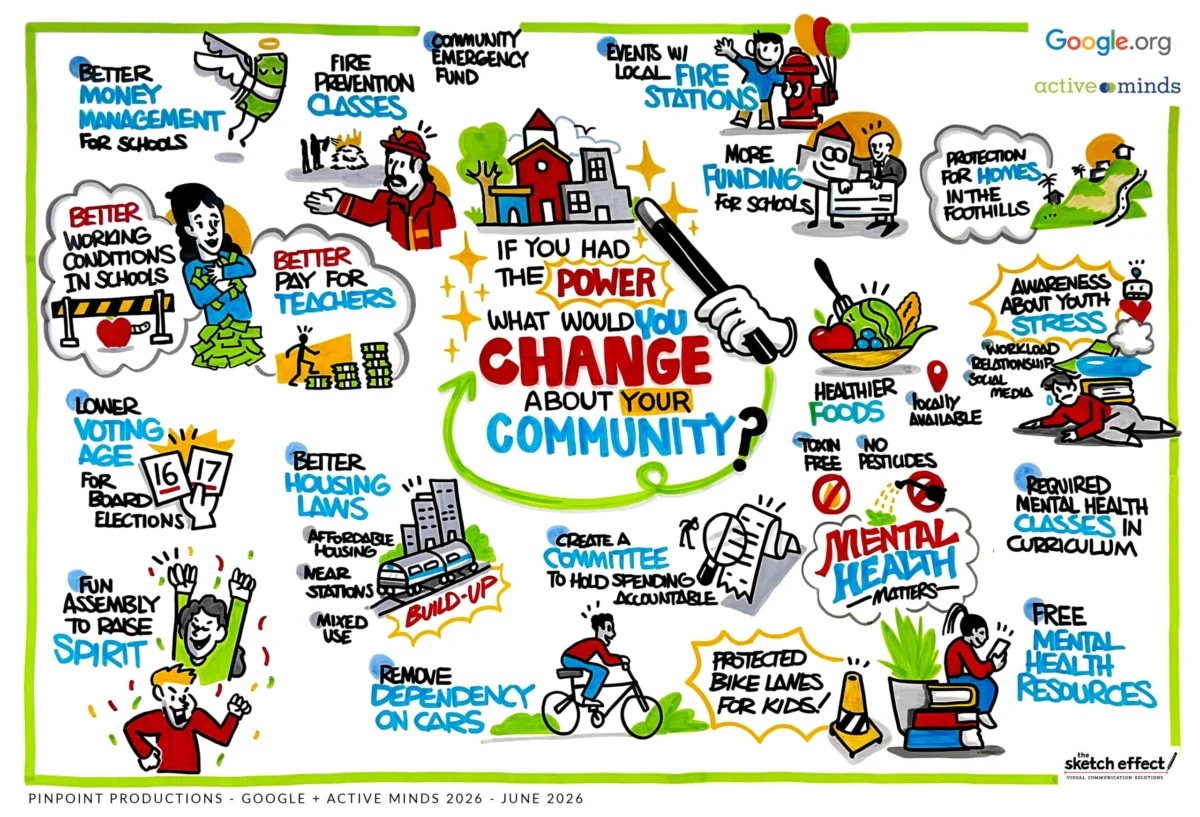
The official announcement in Altadena was more than a press conference; it was a demonstration of the program’s methodology. High school students participated in an interactive workshop where they brainstormed community needs. These ideas were captured in real-time by a local artist who created a live mural, translating abstract feelings of anxiety and hope into a visual roadmap for community resilience. This "live-mapping" directly informed a panel discussion featuring industry leaders from Google and state legislators, ensuring that the student voice was the primary driver of the conversation.
Supporting Data: Scaling the Movement
The scale of the initiative is supported by data highlighting the urgent need for peer-led intervention. According to Active Minds, peer-to-peer connection remains the most effective way for young people to seek help, yet many schools lack the formal infrastructure to support these networks.
Reach and Demographic Focus
- Target Population: 100,000 students by 2028.
- Institutional Reach: 154 high schools in the initial expansion phase.
- Financial Commitment: $5 million from Google.org, adding to the Active Minds Program Fund.
- Geographic Diversity: The program specifically targets rural areas and "under-resourced" urban districts where mental health professional-to-student ratios are often far below recommended levels.
The Digital Landscape
Research cited by Google.org suggests that youth are spending an average of seven to nine hours a day on digital platforms. With the rise of generative AI, the nature of this engagement is changing. The Active Minds initiative includes specific modules on "Responsible Mental Health Video Creation" and "Being Young in the Age of AI," addressing the specific data privacy and psychological implications of these technologies.

Official Responses: Voices of Leadership
The partnership has drawn praise from clinical experts, nonprofit founders, and policymakers, all of whom emphasize the necessity of a "youth-led" approach.
Alison Malmon, Founder and Executive Director of Active Minds, highlighted the intersectional nature of the modern youth experience. "Youth and young adults are navigating an increasingly complex world where mental health, technology, and connection are deeply intertwined," Malmon stated. "This support from Google.org allows us to significantly expand our work, ensuring that more young people have access to the stories, resources, and peer connections that help them feel seen and supported."
Representing the legislative perspective, Assemblymember John Harabedian (D-Pasadena) emphasized the role of students in shaping future policy. "The youth of Pasadena Unified School District have shown immense resilience in the wake of last year’s devastating Eaton Fire," Harabedian said. "Through this long-term programming, Active Minds and Google.org provide students with the skills to navigate digital pressures and advocate for their own wellbeing. I am proud to see the future leaders of California at the forefront of this movement, using their voices to inform the policies that govern our state."
From the tech industry, Dr. Megan Jones Bell, Senior Director of Clinical at Google, framed the initiative as a proactive protection measure. "At Google, we believe that child safety and digital wellbeing warrant unique, proactive protections," Bell remarked. "By supporting Active Minds to put youth at the center of this movement, we are championing student-led leadership that shifts the paradigm toward proactive empowerment and long-term resilience."
Implications: A New Blueprint for Digital Citizenship
The implications of this $5 million expansion extend far beyond the 154 schools initially involved. This initiative represents a "reproducible blueprint" for how society addresses the intersection of technology and mental health.
Shifting the Paradigm from Protection to Empowerment
For years, the conversation around digital safety has been one of restriction: parental controls, firewalls, and age gates. While Google continues to offer these tools, this partnership signals a move toward "digital agency." By teaching students how to co-create safety solutions, the program recognizes that youth are often more tech-savvy than the adults tasked with protecting them. Empowering them to be the architects of their digital environments creates a more sustainable safety model.
Addressing the "Digital Divide" in Mental Health
By utilizing the Active Minds Program Fund to reach under-resourced and rural schools, the initiative addresses a growing "wellness gap." Students in affluent districts often have access to private therapy and advanced digital literacy courses. This program ensures that mental health literacy is treated as a fundamental right rather than a luxury, providing evidence-informed experiences to students regardless of their school’s budget.
AI and the Future of Social Connection
As AI becomes more integrated into daily life—from AI-driven tutors to social chatbots—the psychological impact of these interactions remains a frontier of study. This initiative places students at the forefront of this research. By documenting student responses to AI through the program’s workshops, Active Minds and Google.org are essentially conducting a national longitudinal study on youth digital wellbeing, the results of which could shape future product development and government regulation.
Long-Term Community Resilience
Finally, the focus on "localized stressors"—such as the Eaton Fire recovery—shows that digital wellbeing does not exist in a vacuum. It is tied to physical safety, housing, and climate resilience. By training students to advocate for wellbeing in the context of their specific community’s needs, the program is building a more robust civic infrastructure. These students are not just learning to be "safer online"; they are learning how to be the leaders, policymakers, and advocates of tomorrow.
As the program rolls out across the country over the next two years, the eyes of the nation will be on these 154 schools. The success of this initiative could redefine the standard for mental health education in the 21st century, proving that when youth are given the power to lead, they can create a healthier, safer future for everyone.