









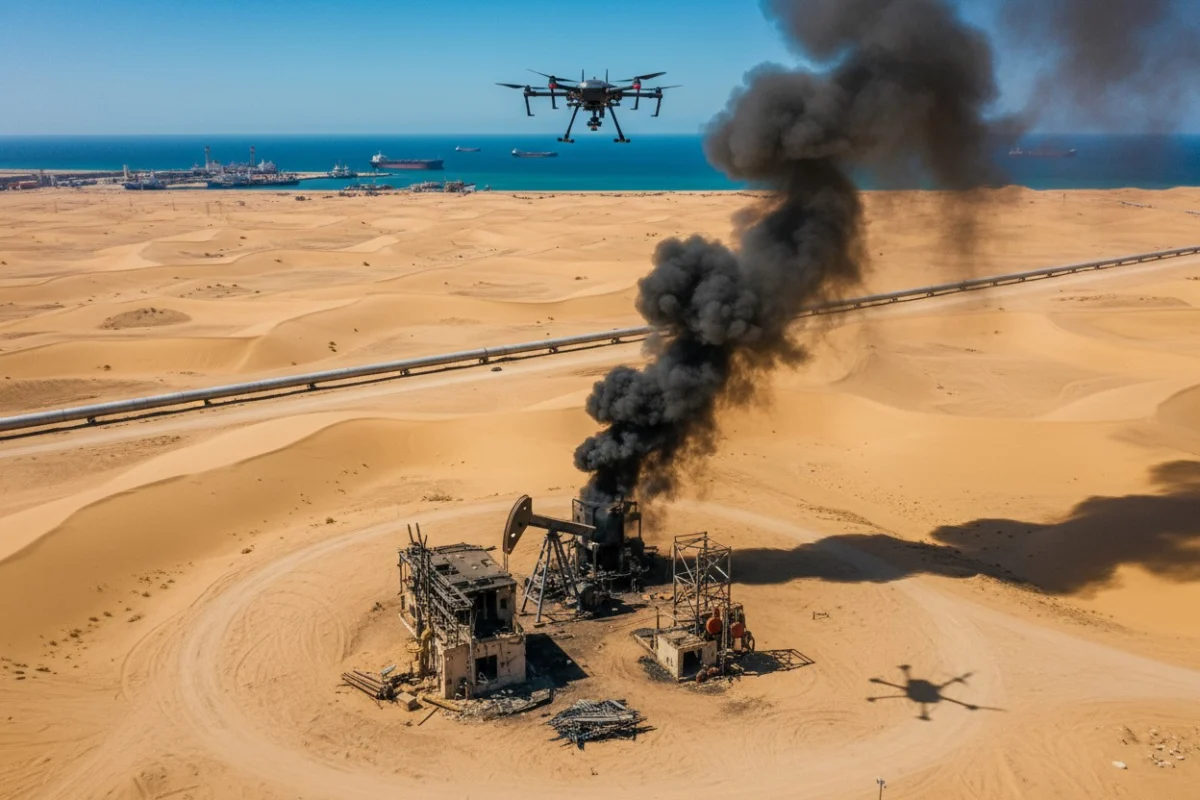
The geopolitical architecture of the Middle East is currently facing a profound stress test, as the fundamental arteries of global energy supply come under direct, sustained assault. On Monday, a critical Saudi Arabian pipeline—the East-West link, which serves as the kingdom’s primary "back door" for oil exports—was struck near the Medina region. This incident represents a dangerous escalation in the shadow war between Riyadh and Yemen’s Iran-backed Houthi rebels, threatening to choke off the world’s final remaining major export bypass at a time when the Strait of Hormuz remains effectively shuttered.
While state media reports confirm that the fire caused by the strike was "limited" and quickly extinguished, allowing oil flows to continue, the symbolic and strategic significance of the event cannot be overstated. The attack follows a harrowing 48-hour period in which Riyadh residents were forced to seek shelter from aerial threats, and a key Aramco facility in the capital suffered shrapnel damage. As the regional conflict intensifies, the intersection of military aggression and energy infrastructure has pushed global markets toward a precarious tipping point.
Chronology of a Collapsing Security Environment
The recent surge in hostilities marks a sharp departure from the relative stability that defined the region’s energy sector prior to the collapse of the Saudi-Houthi truce in July. The following timeline outlines the rapid deterioration of security:
- July: The fragile ceasefire between the Saudi-led coalition and the Houthi movement unravels, leading to a resumption of cross-border strikes.
- September: A drone attack, attributed to Iraq-based militias aligned with Tehran, forces a temporary shutdown of the East-West pipeline, providing a blueprint for current actors.
- Early October: Over a ten-day period, the coalition reports that Houthi projectiles struck Riyadh’s King Khalid International Airport on 20 separate occasions, resulting in significant casualties and highlighting a massive failure in regional defense perimeters.
- November 9 (Sunday): Houthis claim a direct strike on an Aramco tower in Riyadh. Saudi officials acknowledge minor shrapnel damage.
- November 10 (Monday): Residents of Riyadh receive emergency alerts to shelter from a "hostile aerial threat." Simultaneously, the East-West pipeline near Medina is struck, sparking a fire.
- November 11 (Tuesday): Major-General Turki al-Maliki, spokesman for the Saudi-led coalition, confirms the interception of three additional missiles aimed at Riyadh and the kingdom’s southern provinces.
The Strategic Importance of the East-West Pipeline
The East-West pipeline, or Petroline, is a massive engineering marvel designed to transport crude oil from the petroleum-rich Eastern Province to the Red Sea port of Yanbu. For decades, it was viewed as a prudent insurance policy. However, in the current climate—where the U.S.-Israeli conflict with Iran has rendered the Strait of Hormuz a high-risk zone for maritime transit—this pipeline has evolved from a secondary route into a primary, existential lifeline for the Saudi state.
The Strait of Hormuz typically facilitates the transit of roughly 20% of the world’s daily oil consumption. With that maritime bottleneck largely paralyzed, the global economy has become disproportionately dependent on Saudi Arabia’s ability to move crude overland to the Red Sea. By targeting the Medina section of the pipeline, insurgents are not merely attacking Saudi infrastructure; they are attacking the global market’s ability to hedge against the total closure of the Persian Gulf.
Official Responses and Tactical Retaliation
The response from Riyadh has been a combination of military counter-strikes and domestic reassurance campaigns. The Saudi Energy Ministry has maintained a posture of "business as usual," emphasizing that the strike did not disrupt export volumes. Yet, the military response suggests a much higher level of alarm.
On Monday, the Saudi-led coalition launched a series of retaliatory sorties targeting missile production facilities and fuel depots in and around Sanaa. The coalition maintains that these strikes are necessary to degrade the Houthis’ capacity to project force into the Saudi interior. However, the human cost is rising rapidly. Houthi-controlled media outlets have accused the coalition of killing 44 civilians in a weekend strike on a village in the Sanaa province, more than half of whom were reported to be children.
Major-General Turki al-Maliki’s briefing on Tuesday underscored the persistence of the threat, noting that despite the coalition’s efforts to destroy missile assembly sites, the frequency of launch attempts remains high. This creates a cycle of violence that shows no signs of a diplomatic exit ramp, as both sides appear committed to a war of attrition.
Domestic Impact: Life Under the Shadow of Conflict
The psychological impact of these attacks on the Saudi populace is becoming increasingly visible. The decision by educational authorities to revert to remote learning in Riyadh on Monday—only two days after students had returned to classrooms—illustrates the "whiplash" effect currently gripping the capital.
For the residents of Riyadh, the emergency alerts and the threat of aerial strikes have transformed a modern metropolitan center into a frontline city. The directive to stay away from windows and remain indoors, while standard in conflict zones, is a jarring reality for a city that has spent the last decade positioning itself as a hub of global business and tourism. The disruption to the education system is but one indicator of how the security situation is beginning to fray the social fabric of the kingdom.
Economic Implications: The "Squeeze" on Global Wallets
The geopolitical calculus for the global economy is increasingly sobering. The "Double-Squeeze"—the combined closure of the Strait of Hormuz and the targeted disruption of the East-West pipeline—represents a worst-case scenario for energy markets.
The Impact on American Consumers
For American motorists, the implications are direct and painful. Oil is a globally priced commodity; when a major producer like Saudi Arabia struggles to guarantee the security of its supply chains, the risk premium on every barrel of oil increases immediately. If the "back door" route continues to face interference, the market will lose its last safety valve, likely leading to sustained upward pressure on gasoline prices at the pump.
The Geopolitical Fallout
Analysts point to the irony that Washington’s aggressive posture toward Iran, while intended to curb regional influence, has paradoxically made the global oil supply chain more vulnerable. While the current administration may describe the military conflict with Iran as "effectively over," the regional fallout is proving to be a slow-burning crisis. The Houthis, emboldened by their regional alignment, have demonstrated that they can hold the world’s energy supply hostage with relatively inexpensive drone and missile technology.
Conclusion: A Future of Volatility
The strikes on the East-West pipeline serve as a stark reminder that energy infrastructure is never merely a technical asset; it is a political instrument. As the Saudi-led coalition and the Houthi movement remain locked in a cycle of near-daily escalation, the window for a negotiated settlement appears to be narrowing.
The stability of the global oil market—and, by extension, the economic well-being of nations far removed from the conflict—now depends on the ability of Saudi security forces to protect a vast, sprawling network of infrastructure from an enemy that has mastered the art of asymmetrical warfare. As the world watches, the "back door" to the Red Sea is being pried open by the very forces that seek to force a global energy reckoning. Until a sustainable security framework is established, or a de-escalation of the Yemen conflict is achieved, the threat to the kingdom’s energy lifeline will remain a permanent feature of the international economic landscape, ensuring that volatility remains the only constant in the energy sector for the foreseeable future.