Pickleball has a funny way of pulling people in fast. One week, you’re playing a casual, low-stakes game with friends in a local park. A few weeks later, you find yourself browsing online retailers for a high-modulus carbon fiber paddle, obsessively watching YouTube tutorials on the perfect "dink," and wondering why your calves feel like they’ve been through a meat grinder after a standard Wednesday evening session.
While the sport appears deceptively simple from the sidelines—a slower-paced alternative to tennis—the reality of high-level play tells a different story. Once the rallies speed up, the game transforms into a high-intensity test of agility, balance, and rapid-fire decision-making. For the modern pickleball enthusiast, the transition from "recreational participant" to "competitive athlete" requires a shift in mindset: you can no longer rely on raw enthusiasm alone. You need a body that can handle the specific, high-stress demands of the court.
The Pickleball Explosion: A Statistical Phenomenon
The growth of pickleball is not just anecdotal; it is a full-scale cultural shift. According to the Sports & Fitness Industry Association’s (SFIA) latest participation data, a staggering 24.3 million Americans played pickleball in 2025. The numbers are nothing short of historic, representing a 479% growth rate from 2020 to 2025.
Between 2022 and 2025 alone, the sport grew by 171.8%. This meteoric rise has turned neighborhood courts into battlegrounds. As the population of players expands, the quality of play has naturally followed suit. We are seeing longer, more tactical rallies, sharper court movement, and an increasing number of players who know exactly how to punish a weak return. The "slow game" is getting faster, and the physical toll on the human body is rising in direct correlation.
Needs Analysis: What the Sport Actually Demands
A formal needs analysis—a staple of sports science—reveals that pickleball is far more physically demanding than the average weekend warrior assumes. It is not merely a game of hand-eye coordination; it is a sport defined by repetitive, high-impact movement patterns.
The Mechanics of the Game
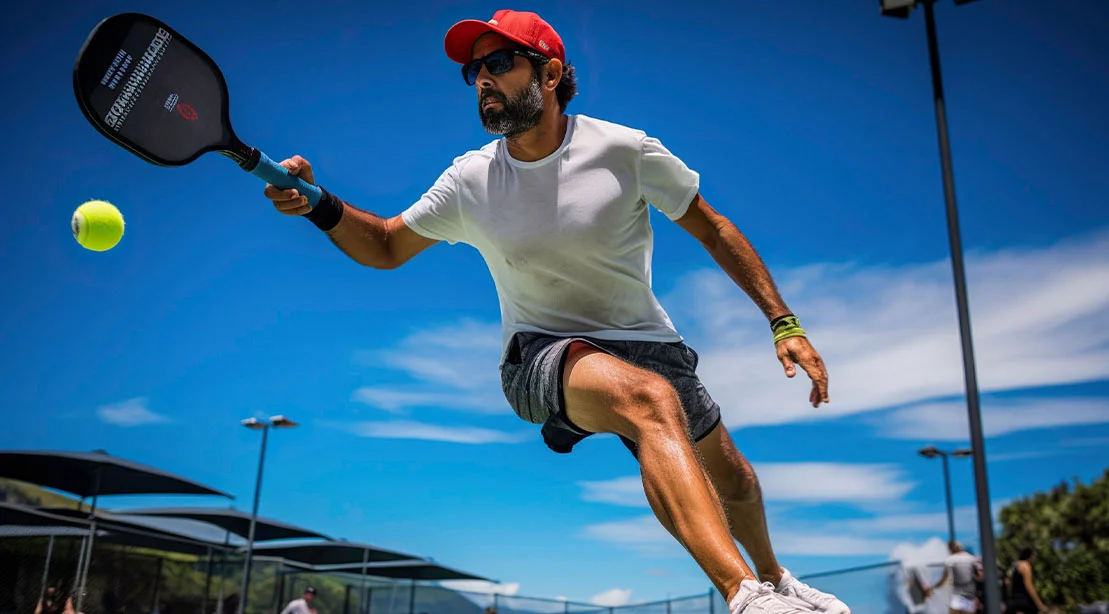
The sport requires a unique blend of explosive acceleration and sudden, jarring deceleration. When a player lunges for a wide cross-court dink or scrambles back to defend a smash, they are asking their ankles, knees, and hips to manage significant force. Cedric Scotto, MS Kinesiology and founder of Notace Footwear, notes that recreational players often underestimate the "wear and tear" factor. "Quick cuts and reactive movement patterns place significant, repetitive stress on the lower kinetic chain," Scotto explains. "For those playing multiple days a week, the cumulative stress can lead to overuse injuries if the player isn’t physically prepared for the load."
Essential Athletic Qualities
To compete effectively and stay healthy, players must cultivate four specific pillars of physical performance:
- Lower-Body Elasticity: The ability to move quickly and change direction without losing balance.
- Rotational Power: The foundation of a strong serve and a piercing drive.
- Core Stability: The "anchor" that keeps your upper body composed even when your feet are scrambling.
- Aerobic Work Capacity: The endurance to maintain high-level decision-making even in the final points of a long match.
The Performance-First Training Blueprint
Training for pickleball does not require the schedule of a professional athlete. Instead, it requires a "performance-first" approach that prioritizes movement quality over heavy, ego-driven lifting. By dedicating just two structured sessions per week to off-court training, players can bulletproof their joints and sharpen their court presence.
The Foundation: The Warm-Up
The most common mistake amateur players make is walking onto the court "cold." A proper warm-up should prioritize:
- Ankle Mobility: Essential for the low-to-the-ground stances required in dinking.
- Hip Activation: The glutes are the engines of your movement; if they are dormant, your knees will take the brunt of the load.
- Thoracic Rotation: The upper back must be mobile to allow for fluid, powerful swings.
Sample Warm-up Routine:
- Ankle Circles & Calf Raises: 2 sets of 15 reps (prepares for impact).
- Lateral Lunges: 2 sets of 10 per side (mimics court movement).
- Bird-Dogs: 2 sets of 10 per side (activates the core).
- Arm Circles & Band Pull-Aparts: 2 sets of 15 (shoulder health).
Training Day 1: Acceleration and Power
The goal of Day 1 is to train the nervous system to fire quickly and to strengthen the muscles responsible for explosive, linear movement.
Superset A: Plyometric Power & Rotational Explosion
- Box Jumps or Broad Jumps: 3 sets of 5 reps (Focus: Explosive take-off).
- Medicine Ball Rotational Throws: 3 sets of 8 reps per side (Focus: Translating power through the core).
Superset B: Agility & Control
- Lateral Shuffle-to-Sprint: 3 sets of 5 yards in each direction.
- Single-Leg RDLs: 3 sets of 8 per side (Builds balance and hamstring strength).
Superset C: Strength & Stability
- Goblet Squats: 3 sets of 10 (Focus: Deep hip control).
- Push-ups with Shoulder Taps: 3 sets of 12 (Focus: Anti-rotation and chest health).
Training Day 2: Lateral Movement and Durability
Day 2 shifts focus toward the side-to-side demands of the court and the deceleration mechanics required to stop safely after a sprint.
Superset A: Lateral Plyometrics
- Lateral Skater Jumps: 3 sets of 8 per side (Focus: Force absorption).
- Woodchoppers (Cable or Band): 3 sets of 10 per side (Focus: Rotational strength).
Superset B: Acceleration and Deceleration
- Split Squats: 3 sets of 10 per leg (Focus: Leg drive).
- Lateral Bounds: 3 sets of 10 (Focus: Pushing off the outside edge of the foot).
Superset C: Posterior Chain and Pulling
- Kettlebell Swings: 3 sets of 15 (Focus: Explosive hip drive).
- Face Pulls: 3 sets of 15 (Focus: Upper back and shoulder integrity).
Implications: The Long-Term Athlete
The goal of this training isn’t just to win more games—it’s to ensure you can keep playing for decades. Pickleball is a "lifetime sport," but it is only a lifetime sport if you take care of the vessel.
Professional Insight on Sustainability
Recovery is not a passive activity; it is a deliberate one. As Scotto emphasizes, the gear you wear—specifically footwear designed for the lateral demands of the court—and the habits you adopt off-court are the difference between a thriving player and one plagued by tendinitis.
Key Recovery Habits:
- Hydration & Electrolytes: Muscle cramps are often a failure of preparation.
- Soft Tissue Work: Foam rolling the calves and glutes once or twice a week is non-negotiable.
- Consistency Over Intensity: It is better to perform 20 minutes of movement work twice a week for a year than to grind through an intense, hour-long workout once a month.
Conclusion: Ready to Play
Pickleball is undoubtedly the most exciting sporting development of the decade, pulling millions into the joy of competition. However, as the game evolves into a more athletic, high-speed endeavor, the players who will find the most success—and the most enjoyment—are those who treat their bodies with the same level of care as they do their equipment.
By integrating these movement patterns, focusing on your deceleration mechanics, and respecting the need for recovery, you aren’t just training for a tournament; you are investing in your own longevity. So, the next time you step onto the court, walk on with the confidence that you’ve done the work, you’ve prepped your body, and you’re ready for whatever the game throws at you—even if it’s just another round of trash talk from your neighbor.