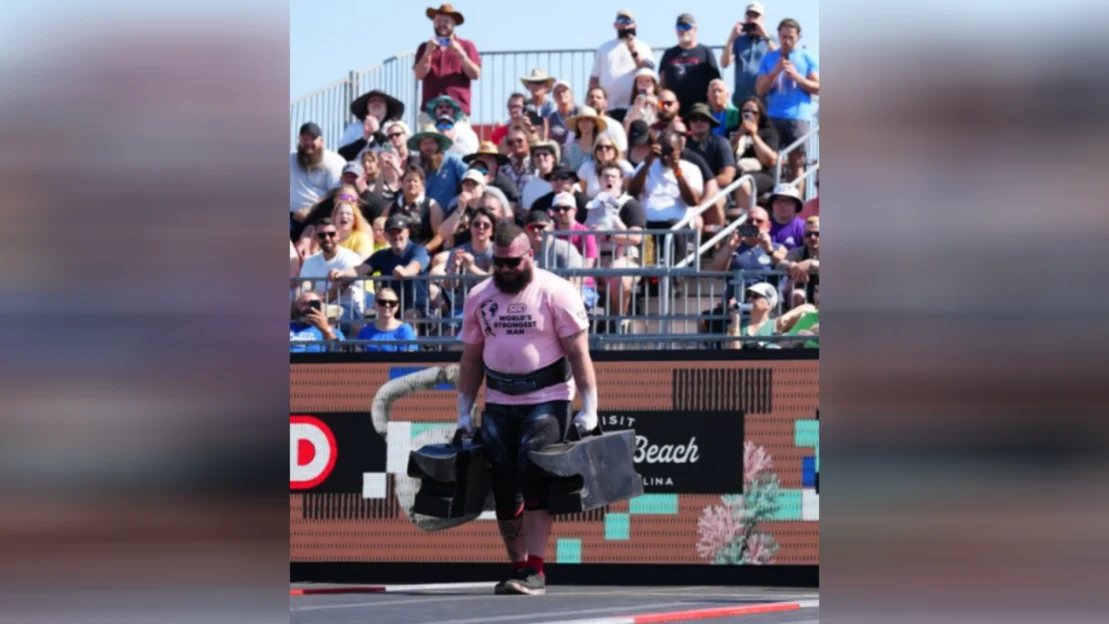
Every year, the World’s Strongest Man (WSM) competition serves as the ultimate crucible for human potential. It is a stage where legends are cemented and history is quietly written in the form of shattered records and the arrival of new, Herculean talent. While the 2026 edition of the WSM will be remembered primarily for the tactical brilliance of Mitchell Hooper, who reclaimed his title in a razor-thin margin, the narrative arc of the event featured a poignant underdog story: the debut of Mississippi’s first-ever professional strongman, Levi Strong.
At 6’8” and tipping the scales at over 370 pounds, Strong is a man whose physical dimensions seem custom-built for the sport. However, his journey to the international stage is not one of a lifetime of pampered athletic development, but rather a testament to the grit forged in the high-stakes world of electrical line work and the relentless pursuit of self-improvement.
The Genesis of a Strongman
Levi Strong’s entry into the elite sphere of strength sports was serendipitous. While working a job in New Orleans, he crossed paths with a bodybuilder who introduced him to the rigors of serious training. Yet, it was the raw, primal spectacle of the sport—specifically after viewing the iconic documentary featuring British powerhouse Eddie Hall—that solidified his path.
"I thought that looked cool," Strong recalls of his initial exposure to the sport. "So, I found a competition, entered it, and I did well. So, I just kept doing it."
What began as a curious hobby quickly transformed into a full-blown professional pursuit. As the first-ever pro strongman from the state of Mississippi, Strong faced the unique challenge of being a trailblazer in a region better known for its football heritage than its strongman infrastructure. He didn’t just walk the path alone; he brought his family along, coaching his wife, Rebecca Strong, to become the state’s first professional strongwoman, marking the pair as a genuine powerhouse couple in the strength community.
A Chronology of Grit: The Road to Myrtle Beach
The road to the 2026 World’s Strongest Man was far from linear. For Strong, the sport exists in the margins of a demanding career as a lineman, a profession characterized by grueling hours and, frequently, emergency response efforts in the wake of natural disasters.
In 2024, the inherent conflict between his profession and his athletic ambitions came to a head. While training for America’s Strongest Man, Strong was deployed to Florida for two weeks of intensive storm recovery work. The lack of proper nutrition and the physical toll of line work—combined with the inability to train with specialized implements—resulted in a 25-pound weight loss and a difficult outing in Las Vegas.
Rather than deterring him, the setback served as a lesson in adaptation. Strong refined his approach, shifting his focus to the international circuit in 2025. His redemption arc was swift and decisive; he secured victories at both the Magnus Ver Magnusson Classic in Gimli, Canada, and the subsequent Magnus Classic in Iceland. These podium finishes were the vital credentials that earned him his invitation to the 2026 WSM in Myrtle Beach, South Carolina.
The WSM Baptism
Entering the 2026 WSM, Strong was placed in a "group of death." The qualifying stage pitted the rookie against three-time world champion Tom Stoltman, alongside established veterans Austin Andrade and Matthew Ragg. While Strong did not advance to the finals, his performance was a clear signal to the rest of the field that the "Mississippi Giant" had arrived.
For many rookies, the pressure of the WSM stage leads to injury or mental collapse. Strong, however, utilized the experience as a data-gathering mission. By observing the elite standard of the Stoltman era firsthand, he has already begun to architect his 2027 campaign, focusing on the specific deficiencies exposed by the world’s most grueling events.
Expert Insights: Training for the Real World
Beyond his own competitive aspirations, Strong has become an advocate for the sport, providing a blueprint for aspiring strongmen who lack the luxury of high-end equipment or full-time sponsorship. His philosophy is rooted in three core pillars that emphasize mental fortitude over expensive gear.
1. The Art of Adaptive Programming
Strong’s career is a case study in adaptability. He recounts a chaotic five-week window earlier in 2026 where he had prepared for a max deadlift contest in Siberia, only to have his visa denied. Two days later, he received the invite to WSM.
"You have to be able to make adjustments with training, nutrition, and recovery," he explains. "If you are rigid, you will break. If you are fluid, you survive the transition." This ability to pivot—shifting from a peak deadlift block to a comprehensive event-based WSM prep—is what separates hobbyists from professionals.
2. Mental Fortitude Over Physical Pain
Strong emphasizes that the sport is fundamentally a mental game. When the body reaches its physiological limit, the mind decides whether to continue or concede.
"There are events that are grueling and make you want to give up, but you must shut those thoughts out," says Strong. "The only way to do that is to keep doing it and pushing yourself." For the beginner, this means finding the "dark place" in training—the final set of an exhausting carry or the last inches of a truck pull—and staying there longer than is comfortable.
3. The Sled as the Great Equalizer
Recognizing that many local gyms lack specialized equipment like yokes or logs, Strong advocates for the heavy sled push as the fundamental tool for any strength athlete.
"Aside from the strength it takes to move it, it will teach you the footwork you need for a pull and help with that mental fortitude," Strong notes. He argues that the repetitive, grinding nature of heavy sled work mimics the metabolic demand of high-level strongman events more accurately than almost any other accessible training tool.
Implications for the Future of Strongman
Levi Strong’s emergence highlights a growing trend in the sport: the professionalization of the "everyman" athlete. As strongman gains global traction, the barrier to entry is lowering, not necessarily through better gym equipment, but through the dissemination of knowledge.
Strong’s role as a coach—having mentored his wife to a professional career—demonstrates that the future of the sport is becoming increasingly communal. By leveraging family support systems to manage the logistics of training, he has pioneered a model that allows for longevity in a sport notorious for burning out its athletes.
Furthermore, his commitment to his profession as a lineman provides a relatable narrative for the average gym-goer. He is not a genetic anomaly residing in a high-performance center; he is a working father who finds his strength in the stolen hours between shifts and the logistical support of his spouse.
Looking Ahead to 2027
As Mitchell Hooper continues his reign, the landscape behind him is becoming increasingly crowded. Levi Strong represents the new breed of competitor: one who understands that while raw power is the foundation, the true victory is found in the ability to recover, adapt, and return to the iron after a failure.
With his first WSM experience in the rearview mirror, Strong is currently deep in a training block, preparing for a return to the international circuit. Whether he will stand on the podium in 2027 remains to be seen, but his trajectory suggests that Mississippi’s first professional strongman is far from finished. He has proven that the road to the top is not paved with ease, but with the persistence to keep moving forward, regardless of the weight on your back.
For those who wish to follow his journey, Strong continues to share his training logs and recovery protocols via his Instagram and his YouTube channel, providing an unfiltered look at what it takes to survive—and eventually thrive—at the highest level of human strength.