







For the vast majority of elite athletes, success is a quantifiable metric: a shiny collection of trophies, a specific world ranking, or the permanent immortality of a podium finish. For seven-time AVP champion Betsi Flint, those milestones remain significant, yet they have been relegated to a secondary status. In the high-stakes world of professional beach volleyball, where the margin between victory and defeat is measured in millimeters and milliseconds, Flint has undergone a profound personal and professional metamorphosis.
"I love when they introduce me as a mom of two," Flint tells Muscle & Fitness. "That holds a lot more weight to me than any other accolade."
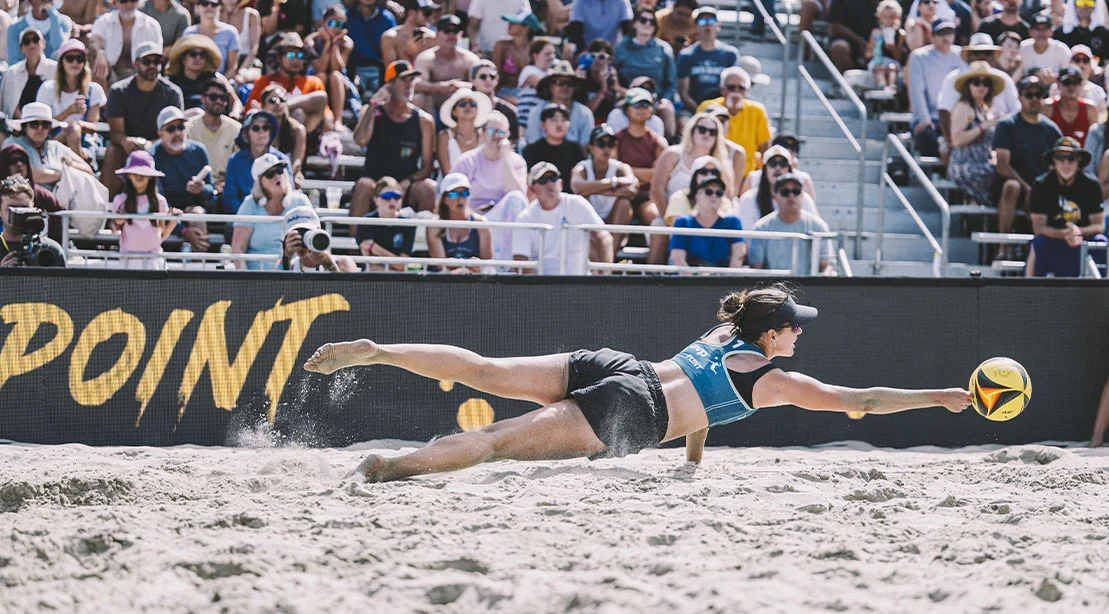
This sentiment captures the core of her current journey. After stepping away from the 2025 AVP season to welcome her son, Odin, Flint has returned to the professional circuit with the Dallas Dream. Her comeback has seen her competing in Miami, Las Vegas, and Long Beach, navigating one of the most demanding balancing acts in modern professional sports: the intersection of motherhood and elite athletic performance.
The Reality of the Postpartum Comeback
While social media and highlight reels often portray the "postpartum return" as a seamless, high-speed bounce back, Flint is candid about the grueling reality. Her return to the sand was anything but effortless. With her daughter, Cora, now five years old, and the demands of an infant, Flint’s life is no longer centered solely on volleyball; instead, she has built a life around family, with volleyball acting as a vital outlet.
"Family is my main priority right now," she explains. "Volleyball is awesome, and it gives me a great outlet. I’m giving as much as I can, but I know at some point I’ll be able to give even more to the sport."
This shift in perspective has altered her approach to performance. The logistical hurdles were immense—early in the season, she was pumping breast milk between matches and traveling with a mobile nursery’s worth of equipment to maintain her breastfeeding journey while competing at the highest level. However, the physical toll was perhaps even more daunting.
A Complicated Medical Path
Flint’s second pregnancy proved to be significantly more taxing than her first. She developed a severe iron deficiency that required medical intervention in the form of late-pregnancy infusions. The physical depletion was profound. "I had no energy," she recalls. "I would sit down and fall asleep. Some doctors told me it was just a normal part of pregnancy, but it didn’t feel normal."
This medical complication delayed her physical readiness. When she finally stepped back onto the sand, she was forced to confront the harsh truth that her body was not immediately capable of the explosive movements that defined her earlier career. "I want to do things that I used to do, but I’m not doing them," she admits. "I’m not jumping as high, running as fast, or hitting as hard yet." Rather than succumbing to the frustration of comparing her current self to her past, she has adopted a philosophy of celebrating incremental, weekly progress.
Building a Resilient Support Ecosystem
The most critical lesson Flint learned during her postpartum return was that elite success—especially after childbirth—cannot be achieved in isolation. While she has long utilized world-class strength coaches and athletic trainers, she identified a gap in her traditional training regimen: specialized postpartum care.
The Role of Pelvic Floor Therapy
Adding a pelvic floor physical therapist to her inner circle fundamentally changed her recovery. "I had some of the best strength trainers and athletic trainers in the world," Flint says, "but finding a pelvic floor physical therapist who understands the nuances of women returning to competition after having babies made such a difference."
This support went beyond simple rehabilitation. Her therapists provided crucial insight into the hormonal shifts, joint instability, and recovery timelines that are often ignored in standard high-performance programs. For example, the physical aches she experienced while breastfeeding were, as her team reassured her, a standard physiological response to hormonal fluctuations rather than an indicator of injury. This expert validation allowed her to trust the process rather than pushing through pain that could have led to long-term damage.
Adaptability as a Competitive Advantage
Beach volleyball is inherently unpredictable. Unlike indoor volleyball, where the environment is climate-controlled and static, the beach is an ever-changing landscape of wind, shifting sand, humidity, and extreme temperature fluctuations. For Flint, the ability to adapt to these variables is the true mark of an elite athlete.
During the 2026 AVP League season, she has faced everything from the stifling humidity of Miami to the punishing heat of Las Vegas, where courts were built atop radiating blacktop parking lots. In Vegas, the standard 50-minute warm-up was discarded in favor of a condensed, high-intensity routine to ensure she didn’t burn out before the match began.
The New Format: Quality Over Quantity
The AVP League’s innovative format—which features shorter races to 15 points and a single match-per-day schedule—has been a revelation for Flint. "It’s nice to know what time we’re playing, and we know we’re playing one match a day," she notes. "I think you get to see the best performance then, versus when we play tournaments where you’re physically exhausted by the end."
By eliminating the survival-of-the-fittest grind of multiple daily matches, the league allows athletes like Flint to showcase their skills at higher capacities, focusing on tactical execution rather than mere energy conservation.
Longevity: The Discipline of the "Little Things"
Flint attributes her longevity in the sport to a relentless focus on the minutiae of professional life. Her day begins before the sun rises, usually between 5:00 and 6:00 a.m., catering to the needs of her children before transitioning into a rigorous schedule of training, recovery, and therapy.
"There isn’t much sitting down anymore," she jokes. "Sometimes my conditioning is just chasing my daughter on her bike."
The Strategic Mindset
Beyond the physical, Flint has adopted a "work smarter, not harder" philosophy. She notes that younger athletes often fall into the trap of over-specialization and over-training, which leads to early burnout. Her own diverse athletic background—which included basketball and softball—provided her with a varied movement vocabulary that has shielded her from chronic overuse injuries.
"When I was younger, I was like, ‘Yeah, you have time, you can do it all,’" Flint reflects. "But now it’s just about maximizing the time I do have."
Implications: A New Definition of Success
Perhaps the most significant development in Flint’s career is her abandonment of "perfection" as a goal. Success is no longer a binary of winning or losing; it is the capacity to bring 100% of whatever percentage she has available on a given day. Whether she is at 60% or 100%, she strives to maximize that specific output.
Looking Toward the Future
When she eventually decides to hang up her jersey, Flint’s aspirations for her legacy are clear. She does not want to be remembered solely for her seven AVP titles, but as a teammate who elevated her partners and as a woman who demonstrated that professional excellence and motherhood are not mutually exclusive.
The sight of her five-year-old daughter, Cora, donning a miniature Dallas Dream jersey and mimicking her mother’s movements in the living room serves as the ultimate testament to her success. Betsi Flint is not just playing to win matches; she is playing to redefine the parameters of what an elite female athlete can achieve. By prioritizing her family, embracing the necessity of specialized recovery, and mastering the art of adaptability, she has turned a challenging postpartum return into a masterclass in professional longevity.
In a sport where the sand is always shifting, Flint has found her footing—not by standing still, but by moving with intention, purpose, and a newfound grace that turns every match into a victory, regardless of the score.