






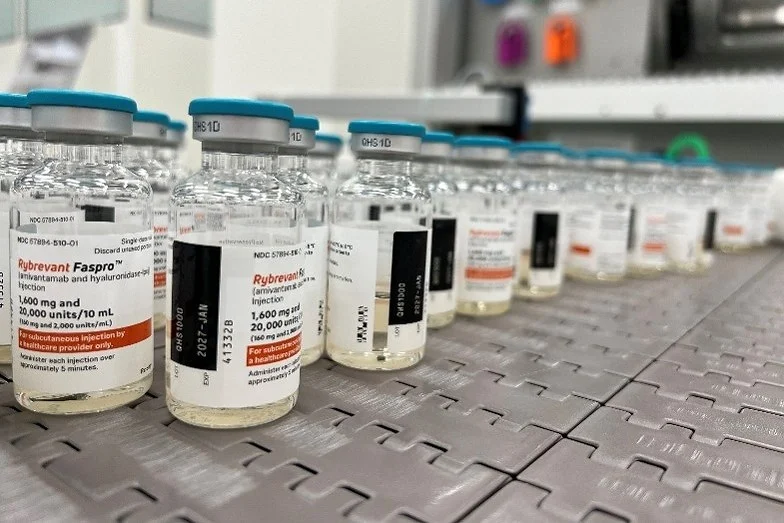
In a significant advancement for oncology, the U.S. Food and Drug Administration (FDA) has granted accelerated approval to Johnson & Johnson’s Rybrevant Faspro (amivantamab-vmjw and hyaluronidase-fsjc) for the treatment of adult patients with head and neck squamous cell carcinoma (HNSCC). This milestone offers a new therapeutic avenue for patients whose cancer has progressed despite standard-of-care treatments, including chemotherapy and immunotherapy.
The approval, announced shortly after the close of markets this past Thursday, marks a strategic expansion for J&J’s oncology portfolio. Rybrevant Faspro, a dual-targeted therapy, is designed to intercept two distinct receptors—EGFR and MET—that are frequently overexpressed in various aggressive cancers. By attacking these pathways simultaneously, the therapy aims to circumvent the resistance mechanisms that often render single-target inhibitors ineffective.
The Evolution of the Rybrevant Franchise
To understand the significance of this latest regulatory milestone, one must look at the historical trajectory of the Rybrevant brand. Initially, the intravenous (IV) version of Rybrevant received its inaugural FDA approval in 2021, targeting non-small cell lung cancer (NSCLC) patients harboring specific EGFR mutations.
The strategy behind Rybrevant evolved further in 2024 with the introduction of Lazcluze (lazertinib), an oral small-molecule EGFR inhibitor. The combination of Rybrevant and Lazcluze was designed to provide a more robust blockade of the EGFR pathway, effectively stalling the drug resistance that commonly plagues lung cancer treatment.
The "Faspro" iteration of the drug represents a technological leap in delivery. Utilizing Halozyme’s proprietary delivery platform, Rybrevant Faspro is formulated for subcutaneous injection. This shift is transformative for clinical practice: while a traditional IV infusion of the drug can require two to five hours to administer, the injectable version reduces the dosing time to approximately five minutes, significantly easing the burden on both patients and healthcare infrastructure.
Clinical Efficacy and Trial Data
The accelerated approval granted by the FDA for HNSCC is rooted in compelling data from Phase 1b/2 clinical trials. The results demonstrated an overall response rate (ORR) of 42% among patients with advanced head and neck cancer, a cohort that has historically faced limited options after the failure of frontline therapies.
Furthermore, the data highlighted the durability of the treatment: 15% of patients achieved a complete response, and among those who initially responded to the therapy, 56% maintained that response for a period exceeding six months.
While these results are encouraging, the FDA’s decision remains an "accelerated approval," meaning that J&J must conduct further confirmatory trials to verify the clinical benefit. A Phase 3 trial is currently underway. Should this trial meet its endpoints, it could provide the necessary evidence to expand the indication for Rybrevant Faspro into the first-line treatment setting, potentially changing the standard of care for head and neck cancer globally.
However, the current indication comes with a specific exclusion: it does not cover patients with oropharyngeal squamous cell carcinoma associated with human papillomavirus (HPV). Given that HPV is a primary driver of many oral and throat cancers, this restriction highlights the nuance of the FDA’s decision-making process regarding specific molecular and viral subsets of disease.
Strategic Implications for Johnson & Johnson
For Johnson & Johnson, the Rybrevant franchise is not merely a clinical success; it is a cornerstone of the company’s long-term oncology growth strategy. As of the first nine months of 2026, the company reported $866 million in global sales for the Rybrevant/Lazcluze combination, reflecting a robust 67.4% increase year-over-year.
Company leadership remains bullish on the product’s potential. Yusri Elsayed, J&J’s global therapeutic head for oncology, framed the approval as the beginning of a new era. "Having redefined outcomes in EGFR+ non-small cell lung cancer, we are unlocking the next chapter of this treatment and bringing meaningful innovation to patients with certain head and neck cancers," Elsayed stated. Market analysts have previously projected that the Rybrevant franchise could eventually reach $5 billion in peak annual sales, a target that now appears increasingly achievable given these label expansions.
A Broad Landscape of Regulatory Activity
The approval of Rybrevant Faspro is part of a broader, hyper-active season of regulatory decisions that are reshaping the treatment landscape across oncology, infectious disease, and neurology.
Advances in Cancer Care
The oncology sector has seen a flurry of recent approvals:
- GSK’s Jemperli: The PD-1 inhibitor has expanded its reach to include advanced cases of rectal cancer, building on its initial 2021 approval for endometrial cancer.
- Pfizer’s Tukysa: Following the acquisition of Seagen, Pfizer has secured approval for Tukysa as a front-line treatment for HER2-positive metastatic breast cancer.
- Eli Lilly’s Jaypirca (pirtobrutinib): This BTK inhibitor, originally approved for mantle cell lymphoma, has now moved into the first-line treatment setting for chronic lymphocytic leukemia and small lymphocytic lymphoma.
- Elevar Therapeutics: The company received an FDA nod for Lyrfigtu (lirafugratinib), targeting FGFR2-positive cholangiocarcinoma, a rare and difficult-to-treat bile duct cancer.
Infectious Disease and Virology
Progress has also been made in chronic disease management:
- HIV Care: In a major move for global health, the FDA granted tentative approval to Dr. Reddy’s Laboratories for a generic version of Gilead’s long-acting HIV drug, lenacapavir. This initiative, supported by the PEPFAR program, aims to expand access to twice-yearly injections in 120 countries.
- Hepatitis B: GSK’s Hibsago (bepirovirsen) has been approved for chronic hepatitis B, showing the potential for a "functional cure" in certain patient populations by reducing viral proteins and DNA.
- Antivirals: Asahi Kasei’s Hovilpri has been cleared for treatment-resistant herpes simplex virus lesions, an acquisition-driven success following the company’s purchase of AiCuris.
Breakthroughs in Neuroscience and Immunology
- Parkinson’s Disease: AbbVie’s Juvmo (tavapadon) has been approved for Parkinson’s, offering a targeted approach to dopamine receptors that aims to minimize the side effects associated with earlier therapies.
- Schizophrenia: Digital health is gaining ground with the FDA clearance of Click Therapeutics’ Motvista, a smartphone app designed to manage the negative symptoms of schizophrenia as an adjunct to traditional medication.
- Immunology: Sun Pharma’s Ilumya, AstraZeneca’s Ultomiris, and Novartis’s Rhapsido have all secured expanded labels, addressing conditions ranging from psoriatic arthritis to rare kidney disorders and chronic hives.
Clinical Setbacks and Regulatory Caution
Not all news in the pharmaceutical sector has been positive. The FDA has recently issued warnings and holds that reflect the inherent risks of drug development. Bright Minds Biosciences has faced a partial clinical hold on its BMB-101 trial for epilepsy, citing toxicity concerns in preclinical models. Similarly, Gilead Sciences is navigating a partial hold on its KITE-753 program, a CAR T-cell therapy, while it investigates safety discrepancies observed between different phases of testing.
Conclusion: The Path Forward
The approval of Rybrevant Faspro in head and neck cancer serves as a potent reminder of the value of dual-targeted therapy in overcoming biological resistance. As the medical community waits for the results of the confirmatory Phase 3 trial, the immediate impact of this approval is a renewed sense of hope for patients with limited options.
Johnson & Johnson’s ability to pivot its technology from lung cancer to head and neck squamous cell carcinoma demonstrates the modular nature of modern drug development. As companies continue to leverage combinations, subcutaneous delivery, and novel molecular targets, the pharmaceutical industry appears to be entering a phase of rapid, highly specialized innovation that promises to redefine the treatment of once-intractable diseases.