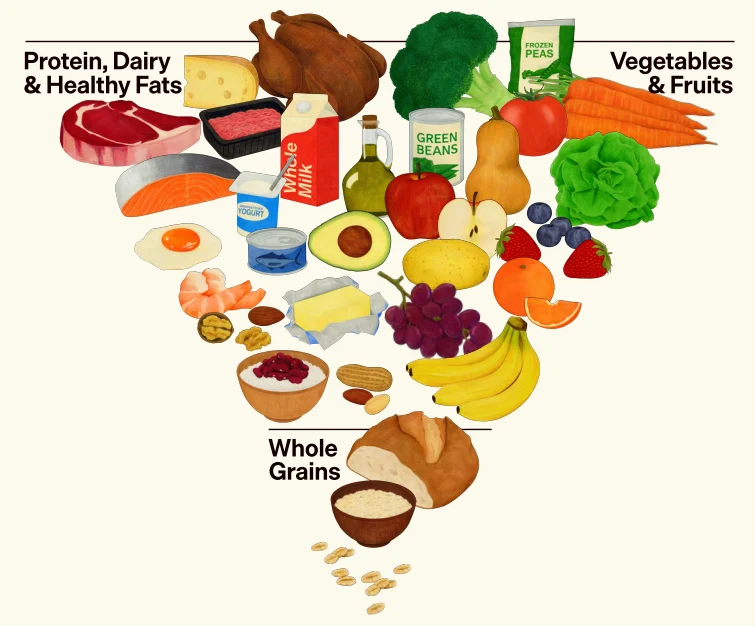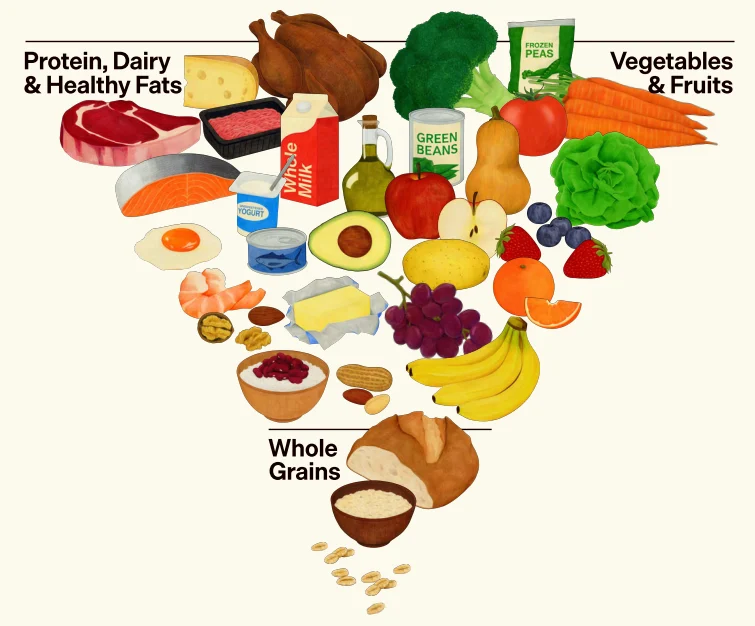
The release of the 2025–2030 Dietary Guidelines for Americans (DGAs) was met with high anticipation, arriving under the banner of a simplified, consumer-friendly directive: “Eat real food.” At a glance, the new federal recommendations appear to align with modern nutritional science by taking a more aggressive stance against the consumption of added sugars and highly processed food products. However, beneath the polished, minimalist aesthetic of the new, inverted food pyramid lies a series of contradictions that have left public health experts and nutritionists questioning the integrity of the guidance.
While the text of the guidelines maintains the long-standing scientific consensus on limiting saturated fat to 10% of total daily calories, the visual representation—the very graphic meant to guide the American public—tells a different story. By placing steak, butter, and full-fat dairy in prominent, elevated positions, the new pyramid risks undermining decades of cardiovascular health education, creating a chasm between the written policy and the visual "how-to" guide provided to the average consumer.
The Chronology of a Controversial Update
The creation of the DGAs is a multi-year, rigorous endeavor involving the U.S. Departments of Agriculture (USDA) and Health and Human Services (HHS). Historically, this process begins with the appointment of an independent Dietary Guidelines Advisory Committee (DGAC), a body of leading nutrition scientists tasked with synthesizing current evidence. Their report serves as the bedrock for the final policy document.
However, the path to the 2025–2030 edition was anything but conventional. Following the submission of the DGAC’s initial scientific report, the findings were unexpectedly rejected by the administration. In an unprecedented move, the government pivoted to a “supplemental scientific analysis” conducted by a group of individuals selected via a federal contracting process rather than the traditional, transparent advisory committee structure.
This procedural shift has raised significant red flags within the scientific community. Deirdre Tobias, an assistant professor in the Department of Nutrition at the Harvard T.H. Chan School of Public Health, who served on the original 2025–2030 DGAC, noted a glaring lack of transparency. “There is no transparency in the methodology and rigor that was employed, or why certain topics were selected to be relitigated,” Tobias stated. The move has led to widespread concern regarding potential influence from the beef and dairy industries, a fear bolstered by reports of financial ties between the selected reviewers and these specific agricultural sectors.
Unpacking the “Highly Processed” and “Added Sugar” Mandates
A notable advancement in the 2025–2030 guidelines is the formal move to categorize and limit “highly processed” foods. While nutritionists have long recognized that food processing exists on a spectrum—from minimal washing and chopping to the creation of hyper-palatable, nutrient-void industrial products—this is the first time the DGAs have explicitly targeted this broad category.
The guidance explicitly advises against sugar-sweetened beverages and ready-to-eat, nutrient-poor snacks. Furthermore, the stance on added sugars has sharpened significantly. The new guidelines state that “no amount of added sugars or non-nutritive sweeteners is recommended or considered part of a healthy or nutritious diet.”
This is a profound shift from the previous limit of 10% of total daily calories. The new directive suggests that a single meal should contain no more than 10 grams of added sugar—a metric that, while scientifically sound in intent, remains notoriously difficult for the average consumer to track. Perhaps most significantly, the guidelines now recommend that children avoid all added sugars until the age of 10, a dramatic increase from the previous threshold of age two. While the intent is to foster healthier metabolic habits early in life, the guidelines stop short of offering practical, day-to-day implementation strategies for parents.
Saturated Fat: The Math vs. The Pyramid
The most glaring inconsistency in the new guidelines is the "Saturated Fat Paradox." While the scientific text remains firm on the 10% daily limit, the new "New Food Pyramid" heavily emphasizes animal-based saturated fats.
To understand the mathematical conflict, consider a standard 2,000-calorie diet. Under the 10% cap, an individual is limited to roughly 22 grams of saturated fat per day. If a consumer follows the DGA recommendation for three daily servings of dairy—opting for the "full-fat" versions featured in the pyramid—the math falls apart quickly:
- One 8-oz cup of whole milk: 5 grams of saturated fat.
- ¾ cup of full-fat Greek yogurt: 6 grams.
- 1 ounce of cheddar cheese: 6 grams.
These three items alone account for 17 grams of saturated fat. If the consumer then follows the pyramid’s implicit suggestion to use butter (7 grams) or beef tallow (6 grams) for cooking, they immediately eclipse the 22-gram limit before consuming a single piece of protein, vegetable, or fruit.
Dr. Frank Hu, chair of the Department of Nutrition at Harvard, warns that these mixed messages are dangerous. "The mixed messages surrounding saturated-fat-rich foods such as red meat, butter, and beef tallow may lead to confusion and potentially higher intake of saturated fat, which is directly linked to increased LDL cholesterol and cardiovascular risk," Dr. Hu explained.
The Protein Conundrum
The 2025–2030 guidelines also propose a substantial increase in recommended protein intake, moving to 1.2 to 1.6 grams of protein per kilogram of body weight per day—an increase of up to 100% over previous minimums.
While protein is an essential macronutrient, the guidelines fail to distinguish between the "protein package." Not all protein sources are created equal; the metabolic impact of a serving of lentils or fatty fish is vastly different from that of processed red meat. By failing to emphasize plant-based proteins or lean, heart-healthy options over processed meats, the guidelines miss a critical opportunity to improve the long-term health outcomes of the American population. As Dr. Hu points out, "Substantially raising overall protein intake without distinguishing between different protein sources may have unintended long-term health implications."
Environmental and Social Omissions
A recurring criticism of the DGAs is their isolation from the broader context of modern life. The 2025–2030 update once again ignores the environmental impact of food production. As climate change continues to alter agricultural landscapes, the disconnect between national dietary policy and sustainable food systems becomes more pronounced.
Furthermore, the guidelines offer little to no guidance on how to navigate the "food environment"—the socioeconomic and structural realities that make fresh, whole foods inaccessible to millions of Americans. For low-income families living in food deserts, "eating real food" is not merely a matter of education; it is a matter of supply chain, cost, and logistics. By failing to address these systemic issues, the DGAs remain an aspirational document rather than a functional tool for the nation’s most vulnerable populations.
Implications for Public Health
The release of these guidelines leaves the American public in a state of uncertainty. If the goal of the USDA and HHS is to provide clear, actionable advice to reduce the prevalence of obesity, type 2 diabetes, and heart disease, this edition falls short.
The visual prominence of animal fats, combined with the lack of transparency regarding the authorship of the guidelines, creates a "trust gap." When national health policy appears to prioritize the interests of agricultural lobbies over the established body of cardiovascular research, it is the public that suffers.
For those seeking to navigate their health with scientific rigor, the confusion generated by these guidelines may be best mitigated by looking toward independent, evidence-based alternatives, such as the Healthy Eating Plate or the Healthy Eating Pyramid. These models consistently prioritize unsaturated fats, whole grains, and a high intake of fruits and vegetables, maintaining a focus on long-term disease prevention that is free from industry interference.
As we look toward 2030, the true test of these guidelines will be their real-world impact. Will they lead to a reduction in the consumption of processed sugars? Or will they, as critics fear, lead to a resurgence of high-saturated-fat diets under the false impression that such eating habits are now "government-approved"? Only time, and longitudinal health data, will reveal the answer. In the interim, consumers are encouraged to view the new pyramid with a healthy dose of skepticism and rely on the guidance of registered dietitians and verified scientific consensus.