The release of the 2025–2030 Dietary Guidelines for Americans (DGAs)—a document that shapes federal nutrition policy, school lunch programs, and the clinical practice of millions—has arrived with a catchy, consumer-friendly tagline: "Eat Real Food." Yet, beneath the approachable branding lies a complex web of contradictory visuals and policy shifts that have ignited a firestorm of debate among nutrition scientists, public health experts, and consumer advocates.
While the document makes strides in curbing the intake of ultra-processed foods and added sugars, it simultaneously introduces a "New Food Pyramid" that seems to defy the very science the guidelines claim to uphold. For the average American, the result is a landscape of conflicting signals that threatens to complicate, rather than clarify, the pursuit of a healthy diet.
The Main Facts: What the Guidelines Propose
The 2025–2030 DGAs are, at their core, an attempt to distill years of nutritional research into actionable advice. The most notable shifts in this edition include:
- The War on "Highly Processed" Foods: For the first time, the DGAs explicitly target the broad category of "highly processed" foods. The guidance encourages a pivot toward whole, fiber-rich, minimally processed ingredients while advising against sugar-sweetened beverages and ready-to-eat packaged snacks.
- Aggressive Stance on Added Sugars: The guidelines take a hardline position, stating that no amount of added sugar is technically "part of a healthy diet." Most strikingly, the guidelines now suggest children avoid added sugars entirely until age 10—a significant escalation from the previous threshold of age 2.
- The Protein Pivot: There is a notable increase in the recommended daily protein intake, now set at 1.2 to 1.6 grams per kilogram of body weight. This represents a 50–100% increase over previous minimums, placing a heavier emphasis on protein as a cornerstone of the American diet.
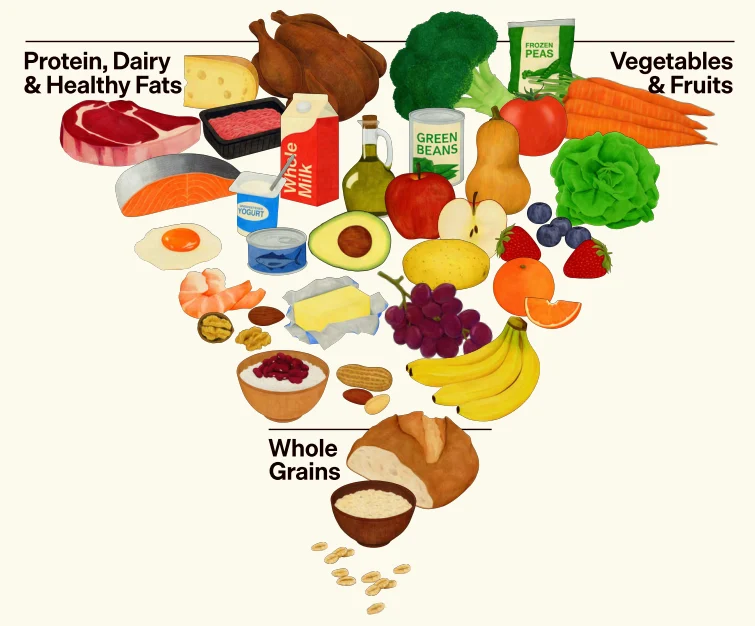
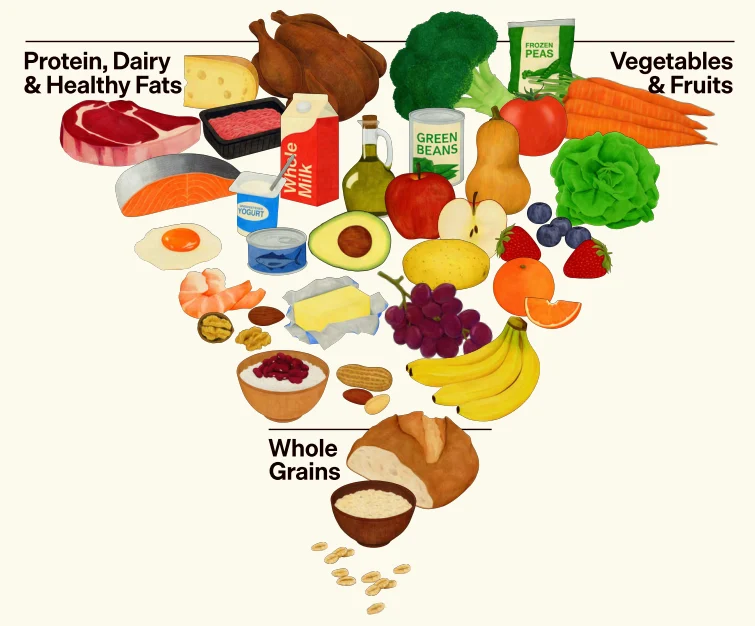
- The "New" Pyramid: The visual centerpiece of the document is a reimagined food pyramid, which appears to flip traditional nutritional hierarchies on their head, placing animal proteins—such as steak, butter, and full-fat dairy—in positions of prominence.
Chronology of the 2025–2030 Development
The path to these guidelines was far from conventional. Traditionally, the DGAs are developed through a rigorous, multi-year process involving an independent Dietary Guidelines Advisory Committee (DGAC) composed of nutrition scientists. This group synthesizes the latest evidence to produce a scientific report that serves as the foundation for the final government guidelines.
However, the 2025 cycle took a different turn. The initial report from the independent committee was effectively sidelined by the current administration. In its place, the government commissioned a "supplemental scientific analysis" conducted by a group of individuals chosen via a federal contracting process rather than the traditional, transparent academic pipeline.
This deviation has drawn sharp criticism. Deirdre Tobias, an assistant professor in the Department of Nutrition at the Harvard T.H. Chan School of Public Health and a member of the 2025-2030 Advisory Committee, noted that the process lacked the transparency and methodological rigor typically expected of such high-stakes public health documents. Questions have also been raised regarding the financial ties between several members of the supplemental review panel and the beef and dairy industries, creating a backdrop of potential conflict of interest that has cast a long shadow over the final publication.
Supporting Data: The Saturated Fat Conundrum
Perhaps the most glaring inconsistency within the new guidelines is the disconnect between the written text and the visual hierarchy of the "New Food Pyramid."
The written text of the DGAs maintains the long-standing clinical consensus that saturated fat should account for no more than 10% of total daily calories. However, the pyramid’s emphasis on animal-based foods makes this target mathematically difficult to achieve.
Consider the "Saturated Fat Math":
- In a standard 2,000-calorie diet, the 10% limit allows for approximately 22 grams of saturated fat.
- The guidelines recommend three servings of dairy daily. If a consumer chooses the full-fat versions highlighted in the pyramid—one cup of whole milk (5g), ¾ cup of Greek yogurt (6g), and one ounce of cheddar cheese (6g)—they have already reached 17 grams of saturated fat.
- Adding a single tablespoon of butter or beef tallow for cooking—both prominently featured in the new guidelines—adds another 6–7 grams, instantly pushing the individual over their daily limit before the day’s protein or other meals are even accounted for.
"The mixed messages surrounding saturated-fat-rich foods such as red meat and butter may lead to confusion and a potentially higher intake of saturated fat, which is directly linked to increased LDL cholesterol and cardiovascular risk," says Frank Hu, chair of the Department of Nutrition at Harvard.
Official Responses and Expert Critique
The response from the broader nutrition community has been one of cautious skepticism. While experts like Dr. Hu applaud the explicit call to reduce refined grains and added sugars, they worry that the "protein-heavy" and "animal-fat-friendly" messaging will be interpreted by the public as a license to abandon heart-healthy principles.
Furthermore, the guidelines remain silent on the environmental impact of these dietary choices. As global food systems face the dual pressure of climate change and population growth, many scientists argue that dietary guidelines must reflect the sustainability of the food we consume. The omission of environmental and socioeconomic factors ignores the reality that food choices are not made in a vacuum; they are deeply influenced by cost, access, and the long-term viability of our agricultural infrastructure.
On the topic of alcohol, the guidelines are frustratingly vague, simply stating "consume less alcohol for better health." Without specific, actionable limits, public health advocates worry that the message will be lost in a sea of ambiguity, failing to provide the guidance necessary to address the health risks associated with excessive consumption.
Implications for the American Public
The implications of this document are profound. Because these guidelines dictate the nutritional standards for the National School Lunch Program and the Supplemental Nutrition Assistance Program (SNAP), the "New Food Pyramid" will soon be reflected on cafeteria trays and in government-funded dietary advice across the country.
If the goal of the DGAs is to provide a clear roadmap for health, this edition struggles to find its way. The lack of clarity on protein quality—distinguishing between processed deli meats and heart-healthy legumes or fish—means that consumers are being told to eat more protein without being told how to prioritize their sources.
A Path Forward
For those navigating these conflicting messages, the experts suggest looking past the government’s updated, marketing-heavy graphics. The "Healthy Eating Plate," developed by researchers at the Harvard T.H. Chan School of Public Health, remains a reliable alternative. It focuses on:
- Prioritizing Plant Proteins: Focusing on beans, nuts, seeds, and fish rather than relying on red meat.
- Choosing Healthy Fats: Emphasizing unsaturated fats, such as olive oil, over animal-based saturated fats.
- Whole Grains over Refined: Ensuring that fiber-rich, intact grains remain the foundation of one’s carbohydrate intake.
Ultimately, the 2025–2030 Dietary Guidelines serve as a reminder that science—and the policies that attempt to translate it—can be subject to influence, oversight, and internal contradiction. For the American consumer, the best strategy remains informed skepticism, a reliance on peer-reviewed, independent science, and perhaps, a consultation with a registered dietitian who can provide guidance tailored to individual health needs rather than generalized, and often confusing, federal advice.
As we look toward the next five years, the challenge will be to see if these guidelines lead to better health outcomes or if they become another chapter in the history of well-intentioned, but ultimately flawed, nutritional policy. The data is clear: our health depends on what we eat, but it also depends on our ability to discern truth from marketing.