






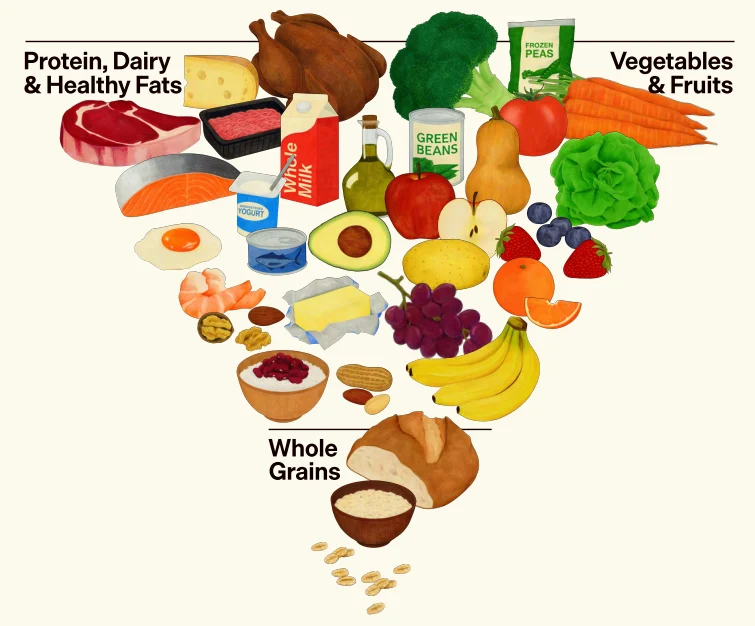
The release of the 2025–2030 Dietary Guidelines for Americans (DGAs) arrived this week with a deceptively simple rallying cry: "Eat real food." While the intent appears to be a pivot toward whole-food nutrition and away from the ultra-processed landscape of the modern American diet, the rollout has been met with a mix of cautious applause and deep scientific skepticism. At the center of the controversy is a newly debuted "Food Pyramid" that—in a surprising inversion of historical guidance—elevates animal-based products like steak, butter, and full-fat dairy to positions of prominence, raising questions about the intersection of nutrition science and policy.
The Core Mandate: Progress and Paradox
On the surface, the 2025–2030 DGAs offer several long-awaited updates. Most notably, this edition marks the first time the government has explicitly called out "highly processed foods" as a category to avoid. By targeting sugar-sweetened beverages, refined grains, and packaged snacks, the Guidelines align with a growing body of evidence linking ultra-processed consumption to chronic disease.
However, the visual representation of these goals tells a different story. The new pyramid, which places animal-based saturated fats near the top (often interpreted as the "foundation" or preferred tier in such graphics), creates a jarring dissonance with the text of the Guidelines themselves. While the document maintains the long-standing scientific consensus that saturated fat should be capped at 10% of total daily calories, the imagery suggests a dietary pattern that could make adhering to that limit mathematically impossible for the average consumer.
"I think the new Guidelines move in the right direction by reinforcing the importance of reducing added sugars and cutting back on refined grains," says Frank Hu, chair of the Department of Nutrition at the Harvard T.H. Chan School of Public Health. "However, there appear to be several contradictions within the DGAs and between the DGAs and the new pyramid. The mixed messages surrounding saturated-fat-rich foods such as red meat, butter, and beef tallow may lead to confusion and potentially higher intake of saturated fat and increased LDL cholesterol and cardiovascular risk."
A Chronology of the 2025–2030 Process
The path to this year’s Guidelines was anything but standard. Typically, the DGAs are developed through a multi-year, highly transparent process involving an independent Dietary Guidelines Advisory Committee (DGAC). This committee of nutrition experts reviews the current state of science, holds public meetings, and submits a comprehensive report to the USDA and HHS.
For the 2025–2030 cycle, this protocol was significantly disrupted. The administration ultimately rejected the findings of the expert-led DGAC, opting instead to commission a "supplemental scientific analysis" conducted by a group selected through a federal contracting process.
This deviation has drawn sharp criticism from the scientific community. Deirdre Tobias, an assistant professor who served on the original 2025–2030 DGAC, highlighted the lack of transparency in the final document’s authorship. "There is no transparency in the methodology and rigor that was employed, or why certain topics were selected to be relitigated," Tobias noted. Furthermore, investigative reports have uncovered that several individuals involved in the supplemental analysis held disclosed financial ties to the beef and dairy industries—a revelation that many believe explains the surprising prominence of those products in the new visual pyramid.
Unpacking the Data: Saturated Fat and Protein Inflation
The tension between the written text and the visual hierarchy is most evident in the "saturated fat math." A standard 2,000-calorie diet allows for roughly 22 grams of saturated fat. If a consumer follows the pyramid’s recommendation for three daily servings of dairy—opting for the suggested full-fat versions like whole milk, Greek yogurt, and cheddar—they will consume approximately 17 grams of saturated fat before the day has truly begun. Adding a single tablespoon of butter or beef tallow for cooking pushes the individual over their daily limit, effectively leaving no room for the fats naturally present in other proteins or whole grains.
Equally controversial is the new stance on protein. The Guidelines now suggest a daily intake of 1.2 to 1.6 grams of protein per kilogram of body weight. This represents a 50–100% increase over previous minimum intake recommendations. While protein is a vital macronutrient, experts like Dr. Hu warn that this blanket recommendation lacks nuance.
"Substantially raising overall protein intake without distinguishing between different protein sources may have unintended long-term health implications," says Dr. Hu. The "protein package"—the fiber, vitamins, and minerals that accompany protein—varies wildly between a serving of lentils or salmon versus a serving of processed red meat. By failing to emphasize quality, the Guidelines may encourage higher consumption of red meats, which are associated with higher cardiovascular risk compared to plant-based or fish-based proteins.
Official Responses and Public Confusion
In an era where "nutrition misinformation" is a primary public health concern, the release of these Guidelines is being viewed through a lens of extreme scrutiny. The government’s decision to move toward a more "consumer-friendly" format—shorter, more visual, and highly interactive—is designed to improve compliance. Yet, historical data from the CDC suggests that Americans rarely follow the DGAs to begin with.
When the primary visual aid (the pyramid) contradicts the scientific text (the 10% saturated fat limit), the resulting confusion often leads consumers to revert to the path of least resistance: the standard American diet. Advocacy groups and public health researchers are currently calling for a "supplemental interpretation" of the guidelines that emphasizes the Healthy Eating Plate—a model developed by Harvard researchers that prioritizes vegetables, fruits, and healthy plant oils over the animal-heavy focus seen in the new federal pyramid.
Implications for Public Health
The implications of these Guidelines extend far beyond the kitchen. Because the DGAs inform federal nutrition programs, school lunches, and institutional menus, they set the standard for what millions of Americans eat every day.
1. Environmental and Social Omissions
Perhaps most notably, this edition of the DGAs continues the long-standing trend of ignoring the environmental impact of food production. As climate change continues to stress food systems, the omission of sustainability metrics makes the document feel detached from the modern global reality. Similarly, the Guidelines fail to address the socioeconomic disparities that make "real food" inaccessible to millions of low-income families, offering little in the way of actionable policy to improve food equity.
2. The Alcohol Vague-ness
On the topic of alcohol, the Guidelines offer only a generic plea to "consume less." In previous cycles, there were clearer definitions of moderate consumption. The current, nebulous language provides no measurable target, leaving the public to guess at what "less" actually means in the context of their own health.
3. The Future of Dietary Policy
The 2025–2030 Guidelines represent a pivotal moment in the history of U.S. nutrition policy. By moving away from the consensus-driven, independent advisory model and toward a process that allowed for industrial input, the government has created a document that serves as both a health guide and a political statement.
For the average consumer, the path forward remains clear despite the noise:
- Prioritize whole, unprocessed foods.
- Limit added sugars strictly.
- Focus on the "protein package," choosing plant-based proteins, fish, and poultry over red and processed meats.
- Consult a registered dietitian for personalized advice rather than relying solely on the visuals of a government-issued pyramid.
As we look toward 2030, the true measure of these Guidelines will not be found in the popularity of their new pyramid, but in whether they help reverse the staggering rates of metabolic disease in the United States. Until the federal messaging is fully reconciled with the rigorous, independent science, the public would do well to approach these new recommendations with a healthy dose of professional skepticism.