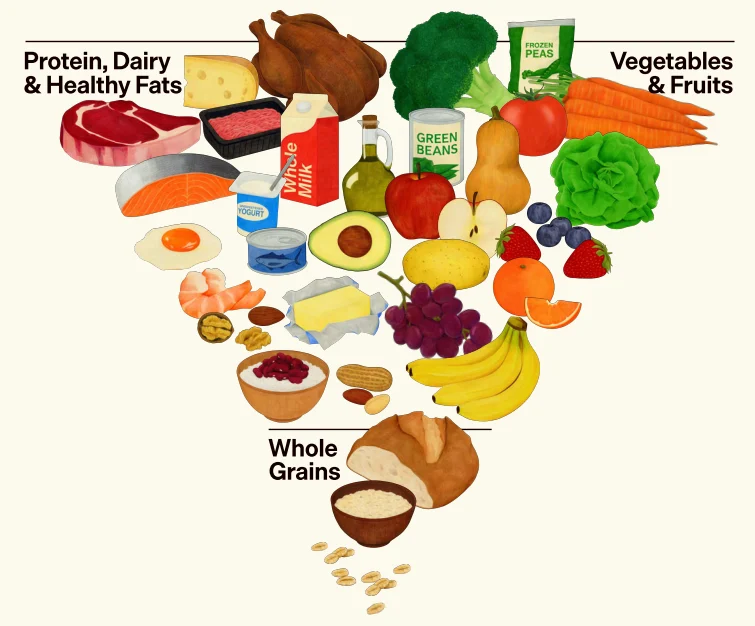
The federal government’s release of the 2025–2030 Dietary Guidelines for Americans (DGAs) has sparked a firestorm of debate among nutrition scientists, public health advocates, and industry stakeholders. Positioned under the catchy, consumer-facing mantra of "Eat Real Food," the new guidelines ostensibly aim to simplify healthy eating. However, beneath the polished, minimalist branding lies a complex web of contradictory imagery and policy shifts that have left many experts questioning whether the guidelines serve the public interest or the influence of special interests.
Main Facts: A New Direction with Familiar Conflicts
The 2025–2030 DGAs represent a departure from previous iterations in both tone and visual presentation. The document leans heavily into the "real food" philosophy, urging Americans to cut back on ultra-processed snacks, refined grains, and, most notably, added sugars. For the first time, the guidelines suggest that no amount of added sugar or non-nutritive sweetener is part of a healthy diet, and they have significantly lowered the age of recommended sugar avoidance for children—now advising zero added sugar until age 10.
Yet, these progressive stances on processed food are visually undermined by the return of a "pyramid" graphic. Unlike its predecessors, this version is inverted, placing high-saturated-fat staples like steak, full-fat dairy, and butter in a position of visual prominence. This has created a cognitive dissonance for the average consumer: the text warns against exceeding a 10% daily caloric limit for saturated fat, while the primary instructional graphic seems to invite the consumption of the very foods that make hitting that target nearly impossible.
A Chronology of Controversy: The Shift in Scientific Review
The path to the 2025–2030 guidelines was markedly different from the standard protocol. Historically, the DGAs are built upon a foundation laid by the Dietary Guidelines Advisory Committee (DGAC), an independent group of experts who synthesize the latest peer-reviewed science.
- The Advisory Report: The 2025–2030 DGAC spent two years conducting a rigorous, transparent review of the current nutritional landscape, releasing a comprehensive scientific report to the USDA and the Department of Health and Human Services (HHS).
- The Rejection: In an unprecedented move, the administration bypassed significant portions of the Committee’s expert findings.
- The Supplemental Analysis: Instead of relying solely on the Committee, a supplemental scientific analysis was commissioned via a private federal contracting process.
- The Final Release: The resulting document, while claiming to be based on "scientific rigor," has been criticized for a lack of transparency. Researchers like Dr. Deirdre Tobias, a member of the original DGAC, have noted that the methodology employed in this final version deviates from the established, replicable, and unbiased standards typically required for federal policy.
The process has been further clouded by revelations that several reviewers involved in the supplemental analysis held financial ties to the beef and dairy industries—an irony not lost on observers who noted the prominent placement of those exact food groups in the final pyramid graphic.
Supporting Data: The Saturated Fat Arithmetic
To understand the frustration of nutrition experts, one must look at the "saturated fat math." For an average 2,000-calorie diet, the 10% limit equates to approximately 22 grams of saturated fat.
If a consumer follows the DGAs’ recommendation of three servings of dairy per day, and chooses the full-fat versions often showcased in the guide—such as one cup of whole milk (5g), 3/4 cup of full-fat Greek yogurt (6g), and one ounce of cheddar cheese (6g)—they have already hit 17 grams of saturated fat. Adding a single tablespoon of butter (7g) for cooking puts the consumer at 24 grams, exceeding the daily limit before they have consumed a single gram of protein from meat, eggs, or plant sources.
Dr. Frank Hu, chair of the Department of Nutrition at the Harvard T.H. Chan School of Public Health, warns that this creates a dangerous contradiction. "The mixed messages surrounding saturated-fat-rich foods… may lead to confusion and potentially higher intake of saturated fat and increased LDL cholesterol and cardiovascular risk," Hu states. While the guidelines mention olive oil as a healthy fat, they fail to clarify that plant-based oils and essential fatty acids are superior to the animal fats being given visual center-stage.
Protein: Quantity vs. Quality
The new guidelines also suggest a significant increase in protein intake, recommending 1.2 to 1.6 grams per kilogram of body weight—a jump of 50–100% over previous minimums. While protein is essential, nutritionists argue that the guidelines fail to distinguish between the "protein package."
When an individual consumes protein, they are also consuming the associated fats, fibers, and sodium. A piece of salmon offers a vastly different health profile than a portion of processed red meat, yet the guidelines treat them as interchangeable units of protein. By pushing for higher total intake without emphasizing the quality of the source, the policy risks encouraging the consumption of processed meats, which are linked to higher rates of chronic disease.
Official Responses and Industry Influence
The USDA and HHS have defended the new guidelines as a "consumer-friendly" update. By shortening the text and providing interactive digital tools, they argue the policy is now more accessible to the average American. However, the lack of transparency regarding the "federal contracting process" used to replace the Advisory Committee’s findings remains a sticking point.
Critics argue that the guidelines are effectively a policy document, not just a nutrition pamphlet. Because these guidelines dictate the food served in school lunches, military rations, and federal assistance programs like WIC, the inclusion of certain food groups—and the omission of environmental or socioeconomic impacts—has massive, real-world consequences. The total exclusion of environmental sustainability metrics, despite the known impact of industrial agriculture on climate change, further separates the DGAs from the global scientific consensus on planetary health.
Implications for Public Health
The core question remains: will these guidelines actually improve the health of the American public? History suggests caution. Americans have historically struggled to adhere to previous iterations of the DGAs, and the addition of confusing, conflicting messaging is unlikely to improve compliance.
- Consumer Confusion: The "pyramid" graphic effectively encourages the intake of foods that the text (and the 10% saturated fat rule) discourages.
- Health Risks: If consumers follow the visual cues—prioritizing red meat, butter, and full-fat dairy—the population-level risk for cardiovascular disease may rise.
- The "Expert Gap": As the gap between independent scientific advisory reports and federal policy widens, public trust in the guidelines may erode further.
For the average citizen, the 2025–2030 guidelines serve as a reminder that health literacy requires more than just following government charts. As experts like Dr. Hu suggest, individuals should look toward evidence-based resources like the Healthy Eating Plate—which distinguishes between healthy and unhealthy fats and proteins—rather than relying solely on the potentially compromised visual hierarchy of the new federal pyramid.
Ultimately, while the government’s shift toward calling out "highly processed" foods is a step in the right direction, the remaining contradictions suggest that the 2025–2030 guidelines are a compromise between health science and industry pressure. For now, the most effective approach for the public may be to navigate these guidelines with a healthy dose of skepticism and a reliance on established, transparent nutritional science.