











Main Facts: The Intersection of Academic Pressure and Psychological Well-being
Finals week has long been characterized as a rite of passage in the academic world—a period defined by caffeine-fueled all-nighters, library marathons, and a singular focus on cumulative assessments. However, recent shifts in educational psychology and student-led initiatives are highlighting a more concerning reality: the "everything hitting at once" phenomenon is a significant driver of the current mental health crisis among high school and university students.
The core challenge of finals week is not merely the volume of material to be mastered, but the psychological bottleneck created by the convergence of multiple high-stakes exams. When students face an overwhelming workload, the brain’s executive functions often falter, leading to a paralysis known as "task freeze." This state makes it increasingly difficult to focus, easier to succumb to procrastination, and tempting to sacrifice mental health in favor of a few extra hours of "cramming"—a strategy that research suggests is often counterproductive.
In response to this, student innovators and researchers are advocating for a shift from "brute-force" studying to a tactical, science-backed approach. Theo Kertesz, a junior at Scarsdale High School and co-founder of the mental health platform StayMindful, argues that the solution lies not in a "perfect" routine, but in a toolkit of micro-interventions that can be deployed in moments of peak stress. By leveraging physiological resets and cognitive reframing, students can maintain the calm necessary for high-level cognitive performance.
Chronology: The Anatomy of the Finals Week Pressure Cooker
The stress associated with finals does not emerge in a vacuum; it follows a predictable chronological arc that, if understood, can be managed more effectively.
1. The Accumulation Phase (Weeks 10–14)
As the semester nears its end, the workload begins to transition from discrete weekly assignments to large-scale projects and the realization of upcoming cumulative exams. During this phase, students often experience "anticipatory anxiety," where the looming threat of finals begins to erode their sleep quality and baseline focus.
2. The Bottleneck (The Week Prior to Finals)
This is the period of maximum mental friction. Students often attempt to "look at everything at once," leading to the cognitive overload described by Kertesz. The mental command to "study for biology" or "review all of history" feels too gargantuan to initiate, leading many to avoid the task entirely through digital distractions.

3. The Peak Stress Period (Exams Week)
During the actual week of finals, the sympathetic nervous system (the "fight or flight" response) is often in a state of chronic activation. This is when physical symptoms—such as tension headaches, digestive issues, and rapid heart rate—become most prevalent. It is at this stage that "in-the-moment" tools, such as the cyclic sigh, become critical for maintaining a functional baseline.
4. The Post-Finals Slump
The sudden cessation of high-cortisol activity after the final exam often leads to an emotional and physical "crash." Experts suggest that the way a student manages the preceding weeks dictates how quickly they recover during the ensuing break.
Supporting Data: The Efficacy of Physiological and Cognitive Resets
To combat the physiological toll of finals, Kertesz and the StayMindful team have integrated research-backed techniques into their platform, specifically focusing on the cyclic sigh.
The Stanford Connection
Research conducted by the Huberman Lab at Stanford Medicine has identified the cyclic sigh as one of the most effective ways to lower stress levels in real-time. Unlike standard meditation, which may take minutes or hours to yield results, the cyclic sigh targets the autonomic nervous system through a specific breathing pattern:
- A deep inhale through the nose.
- A second, shorter "top-off" inhale to fully inflate the alveoli (air sacs) in the lungs.
- A long, slow exhale through the mouth.
This practice facilitates the offloading of excess carbon dioxide and triggers the parasympathetic nervous system, which signals the brain to lower the heart rate. Stanford’s findings indicate that structured breathing practices can significantly reduce anxiety and improve mood, with cyclic sighing showing particularly strong immediate effects compared to passive meditation.
StayMindful User Data
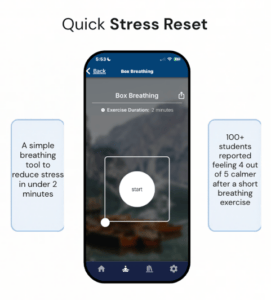
The practical application of these techniques has shown promising results in student populations. In testing conducted by StayMindful, over 100 students were monitored after engaging in a short guided breathing exercise. The results were quantifiable: on a scale from "not calm" to "extremely calm," participants reported a calmness rating of 4 out of 5 on average. This data suggests that even minimal interventions—lasting less than five minutes—can create the mental "breathing room" necessary to resume productive work.
The Myth of the Study Marathon
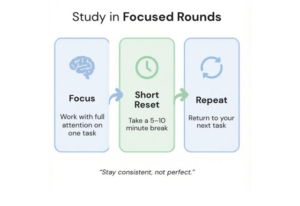
Data also supports the transition away from "endless marathons" toward "focused rounds." The human brain is not wired for sustained, high-level focus over several hours. Studies on the Pomodoro Technique and similar interval-based work methods show that cognitive decline begins after approximately 50 to 90 minutes of intense focus. By breaking study sessions into rounds with scheduled resets—such as stretching, hydration, or a brief walk—students can maintain a higher "effective focus" rate throughout the day.
Official Responses: Institutional and Expert Perspectives
The shift toward prioritizing student mental health during finals is gaining traction among major advocacy groups. Active Minds, a leading nonprofit organization dedicated to promoting mental health for young adults, has been vocal about the need to decouple academic performance from self-worth.
"Finals week is not just a test of knowledge; it is a test of consistency and mindset," says Kertesz. This sentiment is echoed by Active Minds, which emphasizes that "students are more than their academic performance." The organization advocates for "mood protection," suggesting that schools and students alike should view mental health as a prerequisite for academic success rather than a luxury to be addressed after the exams are over.
Educational psychologists also point to the importance of "micro-targeting" as a response to the procrastination epidemic. By breaking down a massive syllabus into specific, actionable targets—such as "Read pages 40-50" or "Complete three practice problems"—students reduce the "mental friction" required to start. Experts agree that the hardest part of studying is the transition from rest to work; once the "activation energy" is lowered through small goals, momentum tends to carry the student forward.
Furthermore, institutions are beginning to recognize the dangers of "digital burnout" during study breaks. While many students reach for their phones to scroll through social media during a break, experts warn that this does not allow the brain to reset. Instead, it provides a different form of high-intensity stimulation, making the return to focused study more difficult. Official recommendations now lean toward "low-stimulation" breaks: walking, drinking water, or simple stretching.
Implications: Redefining the Future of Academic Success
The rise of platforms like StayMindful and the integration of Stanford-backed breathing techniques signal a broader shift in the educational landscape. The implications of this movement are three-fold:
1. The De-Stigmatization of Academic Struggle
By providing students with tools to manage stress, the narrative is shifting from "suffering in silence" to "proactive management." When students understand that their stress is a physiological response that can be hacked through techniques like the cyclic sigh, the shame associated with feeling overwhelmed begins to dissipate.
2. The Role of Technology in Wellness
While technology is often blamed for the decline in student attention spans, StayMindful demonstrates that it can also be the delivery mechanism for wellness. Daily motivational inputs, guided breathing, and structured study prompts use the same "push notification" logic of social media to reinforce positive habits rather than distracting ones.
3. A Holistic View of Achievement
As Theo Kertesz and organizations like Active Minds continue to influence student culture, the definition of a "successful" finals week is evolving. Success is increasingly being measured not just by the final GPA, but by the student’s ability to navigate high-pressure environments without compromising their long-term psychological health.
In conclusion, finals week will likely always remain a period of intense effort. However, the emerging data suggests that the most successful students will not be those who work the longest hours, but those who best manage their internal state. Through micro-targeting, physiological resets, and a mindset that separates worth from grades, the "finals week crisis" can be transformed into a manageable, and even growth-oriented, experience.
About the Author:
Theo Kertesz is a junior at Scarsdale High School and co-founder of StayMindful, a mental wellness app designed to help students manage stress through practical tools like breathing exercises and mindfulness techniques. He works closely with students to better understand how to support mental health in academic environments.