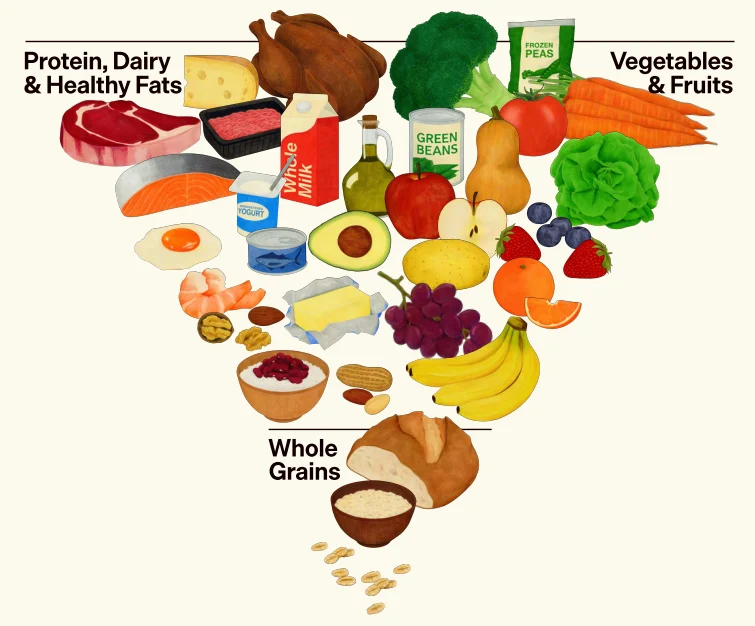
The release of the 2025–2030 Dietary Guidelines for Americans (DGAs) was intended to be a landmark moment for public health, arriving with the ambitious, simplified mantra: "Eat real food." However, rather than providing the clarity needed to combat the nation’s ongoing metabolic health crisis, the new federal guidelines have ignited a firestorm of debate among nutrition scientists, public health advocates, and policymakers. While the document makes commendable strides in addressing ultra-processed foods and added sugars, its visual centerpiece—a "new" food pyramid—has left experts questioning whether political influence has overshadowed scientific consensus.
The Core Mandate: Progress and Paradox
At its face, the 2025–2030 DGAs attempt to modernize the American diet. For the first time, the federal government explicitly calls out "highly processed foods" as a category to be minimized. This move aligns with a growing body of evidence suggesting that the structural matrix of food—not just its individual nutrients—plays a critical role in obesity, diabetes, and cardiovascular disease. The guidelines correctly advise a shift away from refined, shelf-stable snacks and sugar-sweetened beverages in favor of whole, fiber-rich options.
Yet, a profound dissonance exists between the text of the guidelines and the imagery used to promote them. The return of a pyramid-like graphic—flipped on its head to prioritize animal-based staples like steak, full-fat milk, and butter—threatens to undo years of public health education regarding heart-healthy fats. While the written guidelines technically maintain the long-standing recommendation to limit saturated fat to 10% of total daily calories, the visual prominence of high-saturated-fat animal products in the new pyramid creates a "mixed messaging" problem that could inadvertently lead consumers toward higher LDL cholesterol levels and increased cardiovascular risk.
Chronology of a Disrupted Process
The creation of the 2025–2030 DGAs represents a significant departure from the established, transparent protocols of previous cycles. Traditionally, the DGAs are drafted by a Dietary Guidelines Advisory Committee (DGAC), an independent group of experts who synthesize the latest science free from industry influence. Their findings are usually presented as a comprehensive Scientific Report.
In this cycle, however, the process took an unprecedented turn:
- The Advisory Phase: The independent DGAC conducted its rigorous review and submitted its report, as mandated by the U.S. Departments of Agriculture (USDA) and Health and Human Services (HHS).
- The Rejection: In a move that surprised many in the scientific community, the administration ultimately rejected the Committee’s primary findings.
- The Supplemental Pivot: Rather than relying on the vetted committee, the government initiated a "federal contracting process" to conduct a supplemental scientific analysis.
- The Final Release: The resulting guidelines, while incorporating some of the committee’s work, shifted significantly in tone and visual representation, leading to widespread concern regarding the lack of transparency in the selection of the supplemental reviewers.
Dr. Deirdre Tobias, an assistant professor in the Department of Nutrition who served on the 2025–2030 DGAC, has been vocal about this breach in protocol. "There is no transparency in the methodology and rigor that was employed, or why certain topics were selected to be relitigated," she noted. "The reviews deviate significantly from the rigorous process… to ensure the evidence base was replicable, unbiased, and free from non-scientific influences."
Supporting Data: The Saturated Fat Math
The most alarming inconsistency lies in the math of saturated fats. For a standard 2,000-calorie diet, the 10% limit equates to approximately 22 grams of saturated fat. If a consumer follows the DGAs’ recommended three servings of dairy—selecting the full-fat options visually implied by the new pyramid—they reach 17 grams of saturated fat from dairy alone.
When you factor in the additional "suggested" cooking fats like butter (7 grams per tablespoon) or beef tallow (6 grams), the consumer has already exceeded their daily limit before consuming a single bite of meat, grains, or vegetables.
Dr. Frank Hu, chair of the Department of Nutrition at the Harvard T.H. Chan School of Public Health, emphasizes that the type of fat is the single most important factor for long-term heart health. "Replacing saturated fat with unsaturated fat—like that found in olive oil, canola oil, or soybean oil—is scientifically proven to lower cardiovascular risk," Hu explains. "The new pyramid fails to distinguish between these fats, effectively placing butter and olive oil on equal footing, which is a dangerous oversimplification."
Official Responses and Industry Ties
The controversy has been further fueled by revelations regarding the backgrounds of the supplemental reviewers. Investigative reports have highlighted that several of the individuals involved in the supplemental analysis held disclosed financial ties to the beef and dairy industries.
While transparency is a hallmark of the official DGAC process, the "federal contracting" approach used for this edition lacked the same level of public accountability. Critics argue that the prominence of animal products in the new graphics is a direct reflection of this industry influence, rather than a reflection of current nutritional science. When the guidelines offer a "variety of protein" without clarifying that plant-based proteins and fish are associated with superior long-term health outcomes compared to red meat, the result is a failure to provide the public with the tools necessary to make health-promoting choices.
Implications for Public Health
The implications of these "mixed messages" are profound. History has shown that Americans struggle to adhere to federal guidelines even when they are clear and evidence-based. By muddying the waters with a pyramid that contradicts the established scientific consensus on saturated fat, the government risks losing the trust of both the medical community and the public.
The "Protein Package" Problem
The new guidelines also recommend a significant increase in daily protein intake—1.2 to 1.6 grams per kilogram of body weight—which is 50-100% higher than previous minimums. While active individuals or specific populations may benefit from increased protein, the lack of distinction between "protein packages" is problematic. A piece of red meat and a serving of lentils are not nutritionally equivalent; the former brings high levels of saturated fat and sodium, while the latter offers fiber and phytonutrients. By ignoring the "package" that protein comes in, the guidelines may encourage a diet that, while sufficient in protein, remains high in inflammatory markers.
Environmental and Socioeconomic Neglect
Furthermore, this edition of the DGAs continues to ignore the environmental and socioeconomic impacts of food production. As the global climate crisis intensifies, the connection between what we eat and the health of the planet is inseparable. By failing to integrate sustainability into the guidelines, the U.S. government has once again missed an opportunity to align personal health with environmental stewardship.
Conclusion: Navigating the Confusion
The 2025–2030 Dietary Guidelines for Americans serve as a cautionary tale of what happens when the rigor of science meets the opacity of political influence. While the crackdown on added sugar and ultra-processed foods is a step in the right direction, the broader narrative presented by the "New Food Pyramid" is one that prioritizes commercial interests over the cardiovascular health of the American population.
For the average consumer, the best advice remains the same as it has been for years: prioritize whole, plant-based foods, minimize added sugars, and focus on healthy, unsaturated fats. If the federal guidelines leave you feeling confused, it is advisable to consult the Healthy Eating Plate—a tool developed by independent researchers—or speak with a registered dietitian who can provide evidence-based, personalized guidance tailored to your specific health needs. As the nation grapples with record rates of diet-related disease, the need for clear, objective, and science-driven nutritional advice has never been more urgent.