









As we navigate our sixth decade and beyond, the language of our bodies begins to change. The effortless grace with which we once navigated a flight of stairs or reached for a high shelf can sometimes be replaced by a subtle, creeping sense of restriction. Mobility—the ability to move a joint through its intended range of motion—is often the first casualty of a sedentary lifestyle or repetitive movement patterns. However, recent research suggests that this decline is not an inevitable consequence of aging, but rather a condition that can be managed and even reversed with the right approach.
While commercial gym machines are staples of fitness culture, they often lock the body into fixed, linear planes of movement. To truly thrive after 60, we must move beyond the constraints of the weight stack and embrace exercises that mimic the multi-dimensional requirements of daily life.
The Science of Movement After 60
The human body is designed for complexity. Our hips were built to swivel and slide, our spines to rotate, and our shoulders to reach across infinite planes. When we rely solely on machines, we neglect these crucial movement patterns, leading to "stiffness by default."
According to studies published in journals such as the Archives of Physical Medicine and Rehabilitation, maintaining functional mobility is the single greatest predictor of independence in later years. It is not enough to simply be "strong"; you must be capable of moving that strength through a full, pain-free range. For those over 60, this means prioritizing exercises that integrate flexibility with functional load, effectively teaching the nervous system that these ranges are safe to inhabit.
A New Protocol: The Six-Move Mobility Flow
The following routine is designed to be performed at home with zero equipment. These movements are chosen specifically to restore the "lost" ranges of motion—side-to-side, rotational, and overhead reaching—that most modern fitness regimens ignore.
1. The Lateral Lunge: Restoring Lateral Plane Freedom
Daily life rarely occurs in a perfectly straight line. We step over puddles, navigate uneven curbs, and shift our weight to reach for items on shelves. The lateral lunge reintroduces the side-to-side movement that keeps the hips and adductors fluid.
- The Mechanics: By stepping out to the side and shifting your weight, you are lengthening the inner thigh of the extended leg while simultaneously loading the glute of the working leg.
- Muscles Targeted: Glutes, quadriceps, hamstrings, and the often-neglected adductor group.
- Execution: Keep your chest proud and drive your hips back as if sitting into a chair behind you.
- Pro Tip: If you struggle with balance, perform this movement while holding onto a sturdy kitchen counter or a wall for support.
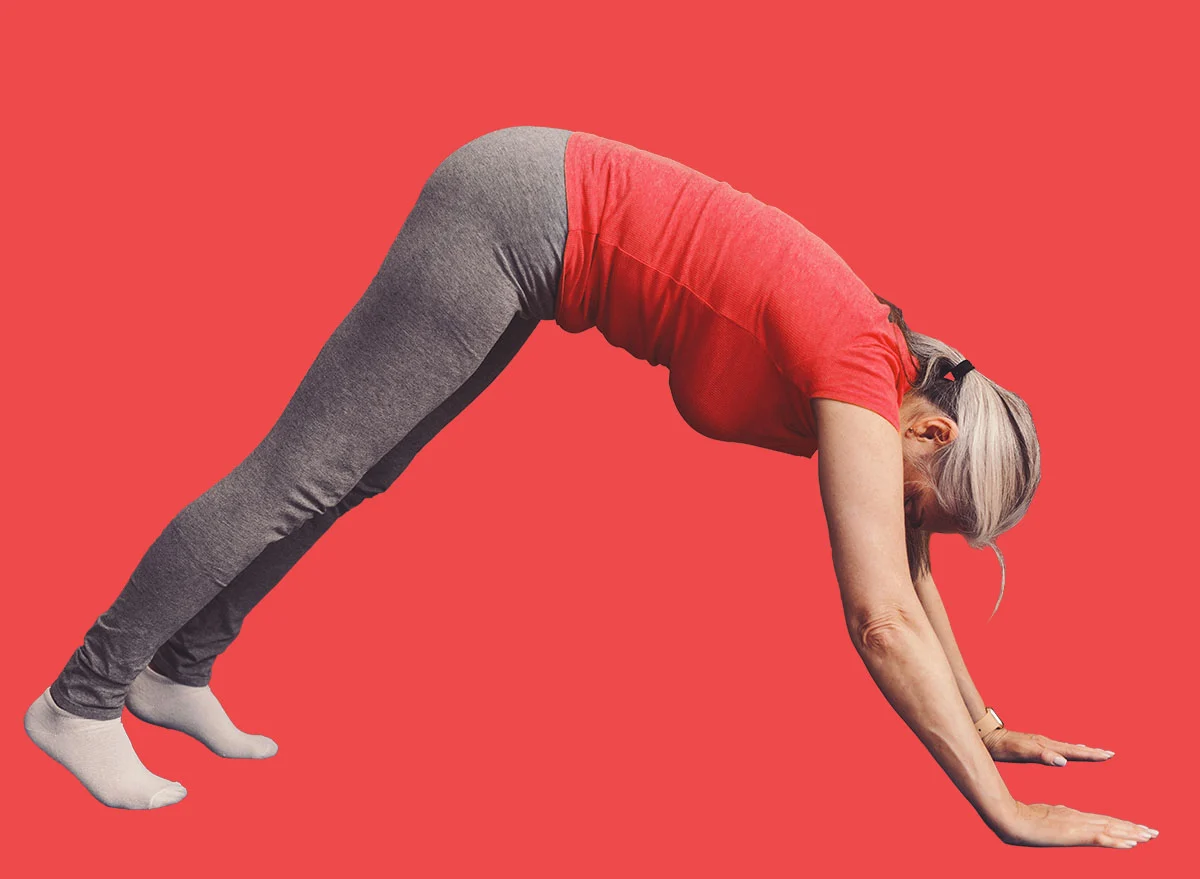
2. Downward Dog to Cobra: Spinal Decompression
This flow serves as a comprehensive "reset" for the entire posterior chain. It addresses the tightness that accumulates in the hamstrings and calves while gently mobilizing the thoracic spine and opening the chest.
- The Mechanics: This transition asks the shoulders to reach overhead—a range that frequently narrows with age—and then shifts the spine from a flexed position into a gentle, controlled extension.
- Muscles Targeted: Shoulders, core, upper back, and the entire back of the leg.
- Execution: Move slowly. Do not force the cobra position; if your lower back feels any pinching, simply shorten the range of the upward movement.
3. The Functional Bodyweight Squat
The squat is the fundamental movement of human existence. It is the action required to stand from a chair, get into a car, or lower yourself to garden.
- The Mechanics: A proper squat forces the ankles, knees, and hips to synchronize. It is a full-body engagement that builds bone density and functional strength.
- Muscles Targeted: Quads, glutes, hamstrings, and core stabilizers.
- Execution: Focus on "depth with control." If you feel unsteady, use a chair as a target; stop the moment your glutes lightly touch the seat, then stand back up.
4. Standing Rotation: Unlocking the Mid-Back
When the thoracic spine (upper back) becomes stiff, the body compensates by putting undue stress on the lumbar spine (lower back). Standing rotations are the antidote to the "slump" that occurs after long periods of sitting.

- The Mechanics: By keeping the feet planted and rotating the torso, you isolate the muscles of the mid-back and obliques, encouraging rotation where it is most needed.
- Muscles Targeted: Obliques, rectus abdominis, and the spinal erectors.
- Execution: Keep your pelvis stable and let the movement initiate from your ribcage. Imagine you are trying to look behind you to see someone standing at your side.
5. Cat-Cow: The Morning Spinal Ritual
For many, the first few minutes of the morning are the stiffest. Cat-Cow is a low-impact, high-reward movement that wakes up the nervous system and lubricates the spinal joints.
- The Mechanics: The alternation between spinal flexion (rounding the back) and extension (arching the back) ensures that no segment of the spine is left "dormant."
- Muscles Targeted: Spinal erectors, shoulder stabilizers, and deep abdominal muscles.
- Execution: Coordinate your breath with your movement. Inhale as you arch (Cow), and exhale as you round your spine toward the ceiling (Cat).
6. The World’s Greatest Stretch: The Master Movement
If you only have five minutes, do this. It is a compound movement that combines a deep lunge with a rotational reach, addressing the three primary areas that tighten with age: the hip flexors, the hamstrings, and the upper back.
- The Mechanics: The deep lunge opens the hip capsule, while the rotational reach clears the path for improved thoracic mobility.
- Muscles Targeted: Hip flexors, hamstrings, glutes, shoulders, and mid-back.
- Execution: If reaching the floor is difficult, perform this with your hands on a stable, elevated surface like a sofa or an ottoman.
Implications for Longevity
The implications of a consistent mobility practice are profound. When joints move freely, the body spends less energy "negotiating" with itself to perform simple tasks. This leads to a reduction in systemic fatigue and a decrease in the frequency of common aches and pains associated with aging.
Furthermore, these exercises serve as a "pre-habilitation" tool. By maintaining a high level of mobility, you are significantly reducing the risk of falls and soft-tissue injuries. The goal is not to train like a professional athlete, but to ensure that your body remains a reliable vessel for the life you want to lead.
Supporting Data and Best Practices
Data from the National Institute on Aging consistently emphasizes that exercise regimens for seniors should be multifaceted. A combination of resistance training (for bone density), cardiovascular activity (for heart health), and mobility work (for joint longevity) provides the most comprehensive protection against age-related decline.
Tips for Success:
- Consistency over Intensity: You do not need to push until you are sweating profusely. The goal is to move through the full, comfortable range of your joints 3–4 times per week.
- Listen to the "Good" Discomfort: There is a difference between the stretch of a muscle and the sharp pain of a joint. If you feel sharp pain, stop immediately and regress to a simpler variation of the movement.
- Frequency: Short, 10-minute "mobility snacks" taken throughout the day are often more effective than one long, grueling session once a week.
Final Thoughts
Aging is a transition, but it does not have to be a decline. By re-engaging with the fundamental patterns of human movement, you are reclaiming your body’s ability to function independently and with ease. These six movements are not just exercises; they are an investment in your future mobility, ensuring that you can continue to reach, turn, squat, and move with confidence for decades to come.
Remember: your body is an adaptive machine. If you stop moving in certain ways, it will eventually stop allowing you to move in those ways. Start today, start small, and prioritize the freedom of your movement above all else.