





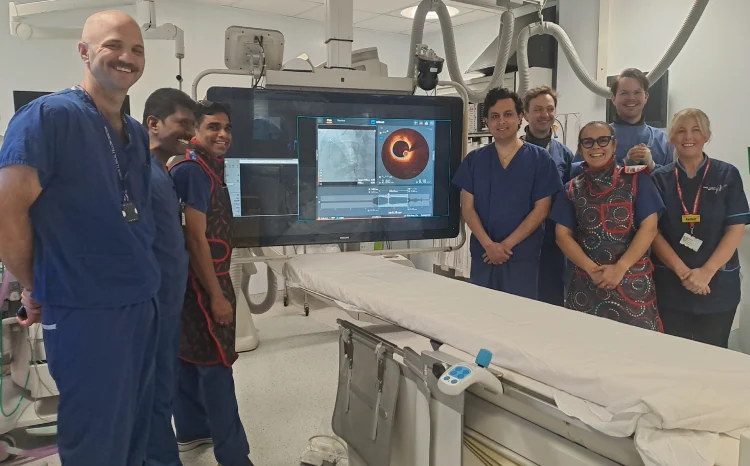
In a significant leap forward for interventional cardiology, King’s College Hospital NHS Foundation Trust has integrated cutting-edge artificial intelligence (AI) software into its surgical suites. The deployment of Abbott Vascular’s Ultreon 3.0 represents a paradigm shift in how clinicians visualize and treat coronary artery disease, promising higher precision, improved clinical outcomes, and a streamlined workflow for one of the most common cardiac interventions performed globally.
As the NHS continues to grapple with the pressures of increasing demand and the need for clinical efficiency, this technology serves as a case study for how high-tech diagnostic tools can augment human expertise to deliver superior patient care.
The Core Innovation: What is Ultreon 3.0?
At its heart, the Ultreon 3.0 system is an advanced imaging platform designed to act as an "intelligent assistant" during coronary angioplasty. A coronary angioplasty is a standard, yet delicate, procedure used to restore blood flow in narrowed or blocked arteries. Typically, this involves the insertion of a coronary stent—a small, expandable wire mesh tube—to keep the vessel open.
While traditional angiography provides a 2D map of the blood vessels, it can sometimes lack the granular detail necessary to assess the complex nature of plaque build-up. Ultreon 3.0 utilizes optical coherence tomography (OCT) enhanced by sophisticated AI algorithms. By providing high-resolution, 3D images from within the vessel, the software allows cardiologists to:
- Identify Vulnerable Plaque: Pinpoint deposits that are highly prone to causing future blood clots.
- Assess Vessel Geometry: Measure the precise diameter and length required for a stent with sub-millimeter accuracy.
- Monitor Stent Deployment: Ensure that the stent is perfectly apposed to the arterial wall, reducing the risk of complications such as stent thrombosis or restenosis.
By providing this data in real-time, the software allows clinicians to move beyond “best-guess” visual estimates, shifting toward a data-driven approach that is tailored to the unique anatomy of each patient.
Chronology of Adoption
The journey toward implementing Ultreon 3.0 at King’s College Hospital reflects a broader trend of digital transformation within the NHS.
- Pre-2026 Preparations: The clinical team at King’s spent months evaluating the efficacy of AI-integrated imaging, benchmarking it against traditional standards of care to ensure the technology met the rigorous safety standards of the NHS.
- April 2026: The Rollout: The technology officially went live at the Trust. The first patients underwent procedures utilizing the AI software, marking a milestone in the hospital’s efforts to integrate "smart" diagnostic tools into daily practice.
- Ongoing Training and Knowledge Exchange: Following the successful pilot, Dr. Nilesh Pareek and his team at King’s were designated as a training hub. They are now actively leading the instruction of cardiologists at other major heart centers across the UK, creating a ripple effect of technological adoption across the national health landscape.
Supporting Data and Clinical Implications
The introduction of Ultreon 3.0 is not merely an aesthetic or diagnostic upgrade; it is an efficiency and safety mandate.
Enhancing Surgical Precision
Coronary artery disease is a leading cause of mortality in the UK. When a stent is placed, the success of the procedure depends heavily on its fit. If a stent is undersized or improperly positioned, the risk of the artery re-narrowing is significantly higher. AI-enabled imaging removes the subjective element of this measurement. By automating the assessment of blood flow and vessel dimensions, the software reduces the potential for human error.
Throughput and Capacity
King’s College Hospital expects that up to 500 patients annually will benefit from procedures enhanced by this technology. By reducing the need for re-intervention and ensuring the "first-time-right" placement of stents, the technology optimizes theater time, potentially reducing the length of stay for patients and freeing up valuable resources for other cardiac cases.
The Broader Digital Ecosystem
This development sits within a wider context of digital health innovation sanctioned by the National Institute for Health and Care Excellence (NICE). In August 2025, NICE issued draft guidance recommending the adoption of six digital platforms specifically for cardiac rehabilitation:
- Activate Your Heart
- D REACH-HF
- Digital Heart Manual
- Gro Health HeartBuddy
- KiActiv
- myHEART
These platforms allow patients to complete their recovery and rehabilitation from home, supported by digital monitoring. When viewed alongside the Ultreon 3.0 deployment, it is clear that the NHS is undergoing a two-pronged digital revolution: one focused on the "acute" surgical intervention (via AI-led angioplasty) and the other focused on "long-term" recovery (via digital rehabilitation tools).
Official Perspectives: Leading the Charge
Dr. Nilesh Pareek, a consultant interventional cardiologist at King’s College Hospital, has been a vocal proponent of this technology. Speaking on the impact of the software, he emphasized that this is part of a larger, necessary evolution in medicine.
"Over recent years, we have seen huge strides in the development of AI technology," Dr. Pareek noted. "It is helping transform cardiac care for patients and improve efficiency, and we’re extremely proud to be leading the way in this field."
His focus remains squarely on the patient experience. By improving the selection of diseased arteries for stenting, the team can ensure that patients receive the most appropriate intervention based on their specific anatomy, rather than a generalized approach. Furthermore, Dr. Pareek highlighted the collaborative spirit of the NHS, noting, "By supporting the training of other sites across the UK in this new technology, we hope to help make sure as many patients as possible can benefit from this latest AI tool."
This sentiment is echoed by administrators within the Trust, who view the project as a successful marriage between medical innovation and clinical scalability.
Implications for the Future of Cardiac Care
The adoption of Ultreon 3.0 at King’s College Hospital suggests several key takeaways for the future of cardiovascular medicine in the UK and globally:
1. The Normalization of AI in Surgery
AI is no longer a futuristic concept discussed in theoretical research papers; it is becoming a standard tool in the operating room. As clinicians become more comfortable with AI-assisted imaging, the barrier to entry for other high-tech interventions will lower, potentially leading to a wave of "intelligent" surgical tools being approved for NHS use.
2. Standardization of Excellence
One of the most significant benefits of AI-assisted technology is the standardization of outcomes. If a cardiac center in London can use the same AI software as a center in a smaller regional hub, the quality of care becomes more uniform across the country. This helps bridge the "postcode lottery" often associated with specialized medical procedures.
3. Data-Driven Decision Making
The long-term impact of using tools like Ultreon 3.0 will be the massive datasets generated. As more hospitals adopt this software, the anonymized data collected during these procedures will provide researchers with unprecedented insights into the morphology of coronary disease. This, in turn, will likely lead to even more refined diagnostic algorithms, creating a virtuous cycle of improvement.
4. Patient-Centric Recovery
The alignment of the Ultreon 3.0 surgical procedure with the home-based rehabilitation platforms recommended by NICE indicates a comprehensive approach to cardiac health. Patients are being treated with the highest level of surgical precision, and then supported with digital tools that empower them to take control of their recovery at home. This holistic strategy is designed to keep the patient at the center of the care model, reducing the burden on hospital infrastructure while improving quality of life.
Conclusion: A New Standard of Care
The integration of Abbott Vascular’s Ultreon 3.0 at King’s College Hospital is more than a technical upgrade; it is a manifestation of the NHS’s commitment to embracing digital health to improve patient outcomes. By marrying human expertise with the analytical speed of AI, the cardiology team at King’s is setting a new benchmark for angioplasty procedures.
As the technology proliferates across the UK, supported by the training initiatives led by Dr. Pareek’s team, the vision of a more precise, efficient, and patient-centered cardiac service becomes a reality. In an era where healthcare systems are constantly tested by aging populations and rising costs, the path forward—as evidenced by King’s—lies in the smart application of digital innovation to solve the most pressing clinical challenges.
The future of cardiac care is not just about doing more; it is about doing it better, faster, and with more clarity than ever before. With AI as a partner in the operating theater, that future is already here.