










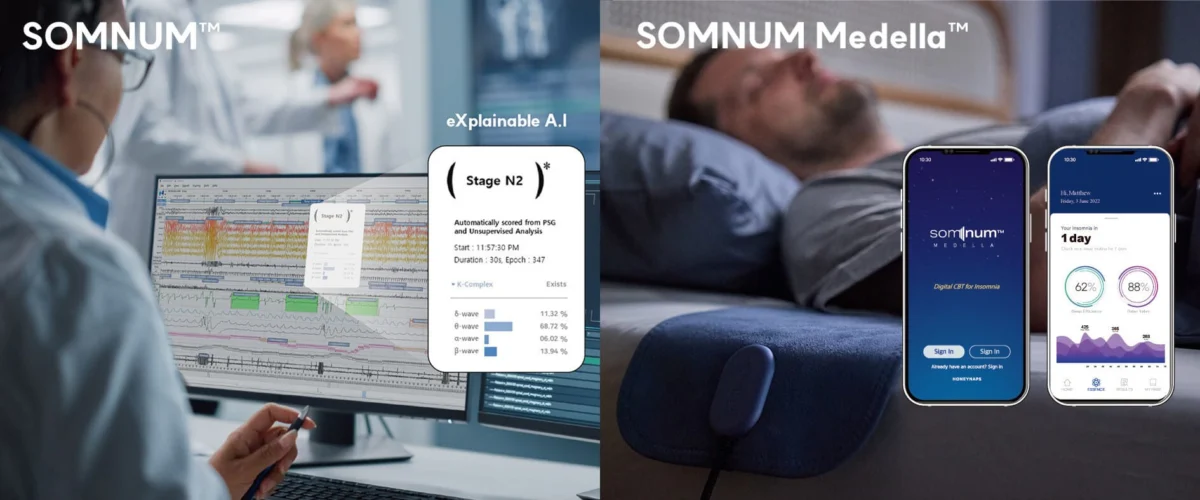
The landscape of sleep medicine is undergoing a profound transformation as artificial intelligence (AI) shifts from a theoretical asset to a clinical necessity. In a significant regulatory milestone, HoneyNaps, a leader in AI-driven sleep diagnostic solutions, has received 510(k) clearance from the US Food and Drug Administration (FDA) for its latest software iteration: SOMNUM V3.0.
This new platform is engineered to automate the complex, time-consuming task of analyzing polysomnography (PSG) data. By providing clinicians with precise, automated detection and classification of respiratory events, SOMNUM V3.0 represents a leap forward in the accuracy and efficiency of diagnosing obstructive, central, and mixed sleep apnea.
The Core Innovation: Automating Complex PSG Analysis
Polysomnography is the gold standard for sleep diagnostics, yet the process of manual scoring is notoriously labor-intensive and susceptible to inter-scorer variability. PSG data involves a multi-channel recording of physiological biosignals—including electroencephalograms (EEG), electrooculograms (EOG), electromyograms (EMG), and respiratory airflow patterns—that a sleep technologist must manually interpret, epoch by epoch.
SOMNUM V3.0 serves as a clinical decision support system designed to augment this process. While previous iterations, such as SOMNUM V1.1.2, established a foothold in automated sleep staging and basic respiratory event detection, V3.0 introduces a deeper level of granular analysis. The software utilizes proprietary AI algorithms to parse subtle physiological patterns within multi-channel biosignals. This allows it to move beyond merely identifying that an apnea event has occurred; it now classifies these events into three distinct categories:
- Obstructive Sleep Apnea (OSA): Identifying physical blockages in the airway.
- Central Sleep Apnea (CSA): Detecting instances where the brain fails to signal the muscles to breathe.
- Mixed Sleep Apnea (MSA): Recognizing complex cases that feature elements of both obstruction and central failure.
By providing event-level classification rather than relying solely on composite indices like the Apnea-Hypopnea Index (AHI), the software offers clinicians a more nuanced view of a patient’s respiratory health.
Chronology of Development and Regulatory Approval
The journey to the V3.0 clearance is the result of years of iterative development and rigorous clinical validation.
Early Foundations and V1.1.2
HoneyNaps first entered the clinical diagnostic market with the launch and subsequent FDA clearance of SOMNUM V1.1.2. This initial success validated the company’s ability to handle the baseline requirements of sleep staging, proving that AI could match or exceed the accuracy of human scorers in identifying sleep stages. This foundational success provided the regulatory pathway and clinical confidence necessary to tackle more complex diagnostic requirements.
The Push for Granularity
Following the initial clearance, the HoneyNaps development team focused on the "respiratory" component of PSG. The primary challenge was the differentiation of apnea types. In traditional manual scoring, clinicians often struggle to distinguish between central and mixed events due to the subtlety of the signal changes. The development of V3.0 was explicitly aimed at solving this diagnostic bottleneck, leveraging deep learning models trained on vast datasets of annotated PSG recordings.
The FDA 510(k) Milestone
The 510(k) process is a rigorous demonstration of "substantial equivalence" to a predicate device. HoneyNaps submitted comprehensive performance data to the FDA, detailing the sensitivity, specificity, and overall percent agreement of the SOMNUM V3.0 algorithms. With the recent announcement of its clearance, the company has officially validated its AI’s clinical performance, clearing the path for widespread integration into sleep clinics and hospitals across the United States.
Supporting Data and Clinical Validation
The efficacy of SOMNUM V3.0 is anchored in its performance data. During the validation phase of the FDA submission, HoneyNaps conducted extensive testing comparing the software’s automated scoring against the consensus scoring of board-certified sleep medicine physicians.
The results were statistically significant, with the algorithms achieving an overall percent agreement of more than 97% across all respiratory event categories. This high level of concordance is critical, as it bridges the "trust gap" that often exists between legacy clinical workflows and AI integration.
The software’s ability to maintain this level of accuracy while analyzing multi-channel biosignals ensures that it does not simply rely on a single metric. Instead, it synthesizes data from multiple inputs to identify the specific physiological signatures of each apnea type. For instance, the AI distinguishes between the persistent respiratory effort observed in OSA and the lack of effort characteristic of CSA, a distinction that is often essential for determining the correct therapeutic intervention, such as CPAP (Continuous Positive Airway Pressure) versus ASV (Adaptive Servo-Ventilation).
Official Responses and Strategic Vision
The leadership at HoneyNaps views this clearance as more than just a regulatory win; it is a validation of their long-term strategy for digital health.
"The FDA 510(k) clearance for SOMNUM V3.0 represents regulatory validation of our AI algorithm’s clinical performance in automatically detecting and differentiating OSA, CSA, and MSA," stated Sean Ha, president of HoneyNaps USA, in a formal release. "We remain focused on advancing AI-driven sleep diagnostics through continued innovation in automated analysis and next-generation digital biomarkers."
This statement underscores the company’s forward-looking approach. While V3.0 provides the current standard for event classification, HoneyNaps is already looking toward the horizon. The company has articulated a roadmap that includes the development of advanced digital biomarkers that go beyond simple apnea detection. By focusing on metrics like "hypoxic burden" (the cumulative impact of low oxygen levels), "arousal burden," and "ventilatory burden," the company aims to provide a more holistic understanding of how sleep disorders impact systemic health and long-term cardiovascular risks.
Implications for the Future of Sleep Medicine
The implications of the SOMNUM V3.0 clearance are far-reaching for three main stakeholders: clinicians, healthcare systems, and patients.
For Clinicians
The most immediate impact is the reduction of "scoring fatigue." Sleep technologists and physicians spend hours reviewing raw PSG data. By automating the classification process, SOMNUM V3.0 allows professionals to shift their focus from the rote task of scoring to the more complex task of clinical decision-making. The software essentially functions as a "first-pass" expert, allowing the physician to review the data, approve the AI’s findings, and dedicate more time to patient consultation and treatment plan development.
For Healthcare Systems
Sleep centers often face significant backlogs in data analysis, leading to delays in patient diagnosis and the initiation of therapy. By standardizing the scoring process through AI, institutions can increase their throughput without compromising accuracy. This leads to faster diagnosis cycles, which is crucial for managing the growing number of patients suffering from undiagnosed sleep-disordered breathing.
For Patients
The primary benefit for the patient is the potential for personalized medicine. When a diagnosis is granular—differentiating accurately between obstructive, central, and mixed events—the treatment plan can be tailored to the specific pathophysiology of the patient. An accurate diagnosis ensures that patients are not prescribed the wrong therapy, thereby improving adherence and overall health outcomes.
Looking Ahead: The Next Generation of Diagnostics
HoneyNaps has signaled that V3.0 is merely a stepping stone. As the healthcare industry moves toward a model of "precision sleep medicine," the integration of more complex biomarkers will become standard. The company’s intent to pursue future FDA clearances for versions incorporating hypoxic and ventilatory burden analysis suggests that they are preparing to provide a deeper diagnostic layer that could eventually predict comorbidities like hypertension, stroke, or heart failure associated with chronic sleep apnea.
As AI continues to mature, the collaboration between human clinical expertise and machine-learning precision is setting a new benchmark for standard-of-care. With the successful clearance of SOMNUM V3.0, HoneyNaps is firmly positioned at the forefront of this evolution, proving that the future of sleep diagnostics lies in the seamless synthesis of big data and clinical intelligence.