



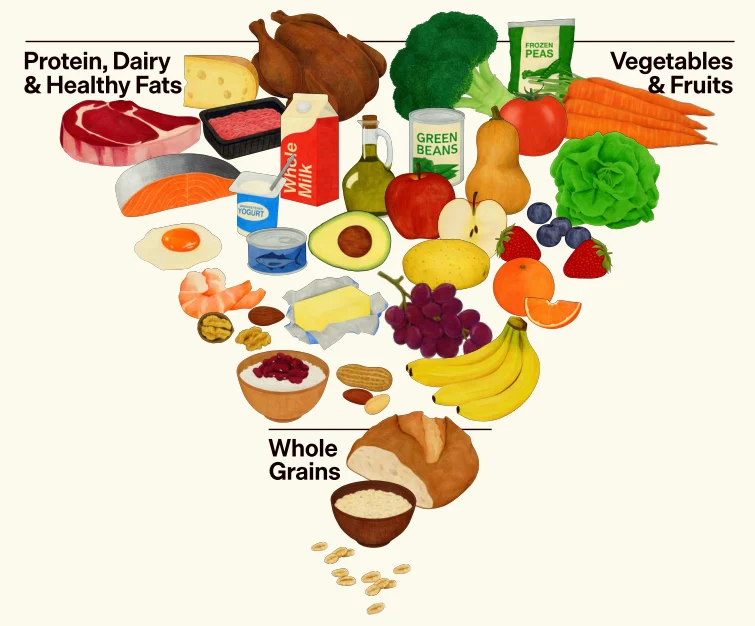
The release of the 2025–2030 Dietary Guidelines for Americans (DGAs) this week was intended to serve as the nation’s definitive compass for nutritional health. With the catchy, consumer-friendly tagline "Eat Real Food," the federal government aimed to simplify complex science into actionable advice for the average American. However, the rollout has been met with a combination of applause for its stance on ultra-processed foods and significant alarm from the scientific community regarding the visual messaging, industry influence, and potential for public health confusion.
While the text of the guidelines maintains a hard line against added sugars and highly processed foods, the accompanying "New Food Pyramid"—a graphic intended to guide daily choices—has drawn sharp criticism. By prominently featuring steak, butter, and full-fat dairy, the new pyramid appears to contradict the very saturated fat limits that the written guidelines continue to endorse.
The Main Facts: What the Guidelines Say
The 2025–2030 DGAs represent a significant, albeit inconsistent, pivot in federal nutrition policy. The primary takeaways from the document include:
- The War on "Highly Processed" Foods: For the first time, the DGAs explicitly target a broad category of "highly processed" items. The guidelines advise against the consumption of sugar-sweetened beverages, ready-to-eat snacks, and refined carbohydrates, favoring whole, fiber-rich grains.
- A Stricter Stance on Added Sugars: The new guidelines take an uncompromising position: no amount of added sugar is considered part of a healthy diet. The recommendations now suggest that children should avoid added sugars entirely until the age of 10—a dramatic increase from the previous threshold of age 2.
- The 10% Saturated Fat Ceiling: Despite the visual prominence of animal fats in the pyramid, the written guidelines retain the long-standing scientific consensus that saturated fat should account for no more than 10% of total daily caloric intake.
- Protein Hype: The guidelines now suggest an intake of 1.2 to 1.6 grams of protein per kilogram of body weight, a jump of 50–100% over previous minimums. However, the document lacks nuance regarding the source of this protein, failing to distinguish between the health profiles of red meat versus plant-based proteins or fish.
A Chronology of the 2025–2030 Process
The journey to this year’s guidelines was marked by a departure from historical norms. Typically, the DGAs are the product of a rigorous, transparent process led by an independent Dietary Guidelines Advisory Committee (DGAC) comprised of top nutrition scientists.
- Evidence Synthesis: The independent 2025–2030 DGAC spent two years reviewing current science, producing a comprehensive report designed to be free from political or industry influence.
- Rejection and Replacement: In an unprecedented move, the current administration rejected the Committee’s initial findings.
- The "Supplemental" Process: Instead of relying on the independent report, the government initiated a "federal contracting process" to conduct a supplemental scientific analysis.
- The Final Release: The resulting 2025–2030 guidelines were published, but the process has been marred by questions regarding the transparency of the authors and the potential for industry bias, particularly given that some reviewers involved in the supplemental analysis disclosed financial ties to the beef and dairy industries.
Supporting Data: The "Saturated Fat Math"
The most glaring disconnect between the guidelines’ text and their visual representation lies in the "Saturated Fat Math." If a consumer follows the pyramid’s emphasis on animal products, they are likely to exceed the 10% limit before their day has even truly begun.
Consider a standard 2,000-calorie diet. A 10% limit for saturated fat equates to roughly 22 grams per day. If an individual adheres to the DGAs’ recommendation of three daily servings of dairy—selecting full-fat options like whole milk, Greek yogurt, and cheddar cheese—they hit 17 grams of saturated fat immediately. Adding a single tablespoon of butter for cooking (7 grams) or a serving of beef tallow (6 grams) pushes the total to 23–24 grams. This leaves zero room for the saturated fat found in other proteins or snacks throughout the rest of the day, effectively making the "healthy" pyramid incompatible with the written limits on fat.
Dr. Frank Hu, chair of the Department of Nutrition at the Harvard T.H. Chan School of Public Health, notes that this creates a dangerous contradiction. "The mixed messages surrounding saturated-fat-rich foods such as red meat, butter, and beef tallow may lead to confusion and potentially higher intake of saturated fat and increased LDL cholesterol and cardiovascular risk," Dr. Hu warns.
Official Responses and Scientific Concerns
The scientific community has been vocal about the potential for these guidelines to do more harm than good. The lack of transparency in the drafting process has been a major point of contention.
Deirdre Tobias, an assistant professor at Harvard and a former member of the 2025-2030 DGAC, has been particularly critical. "As of today, there has not been transparency in who wrote the new DGAs," she stated in a Q&A with Harvard Chan News. She noted that the methodology and rigor used in the supplemental review "deviate significantly" from the established protocols designed to keep the guidelines free from non-scientific influences.
Furthermore, the guidelines remain silent on the environmental impact of food production. While the global scientific community increasingly emphasizes the link between planetary health and human diet, the U.S. government has chosen to omit sustainability as a consideration, effectively ignoring the role of industrial animal agriculture in environmental degradation.
Implications for Public Health
The implications of these conflicting messages are profound. Nutrition guidelines are not merely academic; they inform school lunch programs, hospital menus, and public health policy.
The "Protein Package"
When the government recommends increasing protein intake without emphasizing quality, it ignores the "protein package." Protein is never consumed in isolation; it comes alongside fats, sodium, and fiber. Encouraging high intake of red meat—which is high in saturated fat—without providing clear guidance on the benefits of fish or plant-based proteins like legumes and nuts, is a missed opportunity to address the nation’s cardiovascular health.
The Alcohol Ambiguity
The guidelines’ stance on alcohol—to "consume less for better health"—is criticized for being toothless. Without concrete, measurable limits, the term "less" becomes subjective. In a culture where alcohol consumption is deeply ingrained in social rituals, vague advice rarely results in meaningful behavioral change.
The Risk of Consumer Confusion
Perhaps the greatest danger is that the "New Food Pyramid" will be the only thing consumers remember. Visual aids are notoriously more memorable than the dense, technical text that follows them. If the average American sees a pyramid that prioritizes steak and dairy, they will likely interpret that as a green light for daily consumption, regardless of the 10% saturated fat cap buried in the appendix.
Conclusion: A Call for Clarity
The 2025–2030 Dietary Guidelines for Americans offer a glimmer of progress by calling out the dangers of highly processed foods and added sugars. However, this progress is undermined by a confusing visual strategy and a lack of transparent, science-based authorship.
For those navigating these new recommendations, the best advice remains to look beyond the government’s simplified graphics. Organizations like the Harvard T.H. Chan School of Public Health provide more evidence-based tools, such as the Healthy Eating Plate, which prioritizes plant-based oils, whole grains, and varied protein sources over the saturated-fat-heavy recommendations of the current federal pyramid.
As history has shown, Americans rarely follow the government’s dietary guidelines to the letter. Given the inconsistencies in this latest iteration, it is more important than ever for individuals to consult with registered dietitians and rely on peer-reviewed, independent nutritional science to navigate the complex landscape of their own health.