










In the high-stakes world of modern longevity, billionaire entrepreneur Bryan Johnson has become the face of a radical movement. Featured in the Netflix documentary Don’t Die, Johnson is the architect of a multi-million-dollar annual regimen aimed at a singular goal: reversing his biological clock. From dozens of daily supplements and weekly acid peels to controversial plasma infusions, Johnson’s pursuit of a lower "biological age" has captivated the public imagination. He claims his markers now suggest he is 5.1 years younger than when he began, effectively "aging in reverse."
Yet, the scientific community remains divided. A high-profile New York Times investigation recently challenged these claims, suggesting that, by some metrics, Johnson’s biological age may have actually increased by a decade. Despite this, the "don’t die" crusade is gaining momentum, fueled by a cottage industry of home-testing kits and popularized by health influencers like Peter Attia, Joe Rogan, and Andrew Huberman.
But beneath the headlines and the high-tech marketing lies a fundamental question: Is biological age testing a legitimate medical breakthrough or just the latest expensive wellness trend?
What is Biological Age?
To understand the hype, one must distinguish between two types of time: Chronological Age and Biological Age.
Chronological age is simply the number of years you have been alive—a static figure based on your birth date. Biological age, or "bio age," is a dynamic measure of how your cells and organ systems are functioning. It is the physiological truth of your body, which can be accelerated by chronic stress, poor nutrition, and environmental toxins, or decelerated by consistent, high-impact healthy habits.
Consider two 50-year-old men: "Chang," who maintains a sedentary lifestyle in a polluted urban environment with a poor diet, and "Jabari," who prioritizes strength training, a nutrient-dense diet, and meditative stress management. Despite their identical birth certificates, their internal cellular environments—their bio ages—likely diverge significantly.
The Mechanics of Measurement: How We Track Time
Bio age testing relies on biomarkers—measurable indicators of biological processes. While tech-forward companies focus on sophisticated metrics like DNA methylation (the chemical alteration of DNA) and telomere length (the protective caps on chromosomes), the medical community has tracked "biomarkers of aging" for decades. Blood pressure, cholesterol, and blood glucose are, in essence, the original bio age tests, serving as powerful predictors of cardiovascular health and mortality risk.
The Role of Biomarker Testing
Proactive testing serves three core functions:
- Early Detection: Identifying dysfunction before clinical symptoms manifest.
- Motivation: Tangible data can act as a catalyst for behavioral change. If a test reveals that your bone density is that of a 70-year-old, it provides a powerful, objective "nudge" to begin resistance training.
- Objective Evaluation: Data allows individuals to quantify the efficacy of lifestyle interventions. Does that afternoon energy drink spike your blood glucose? Is your new recovery routine actually lowering your inflammation? Data provides the answers.
The "Zero-Cost" Toolkit: Five Validated Tests
You do not need a billionaire’s budget to track your aging trajectory. Before the era of expensive commercial kits, researchers relied on simple, scientifically validated tests to assess the "pace of aging."
1. The Sitting-Rising Test (SRT)
Strength and balance are non-negotiable pillars of longevity. The SRT requires you to lower yourself to the floor and rise again without using your hands or knees for leverage. This test evaluates mobility, muscle power, and coordination. Research indicates that low scores correlate with a higher risk of cardiovascular mortality.
2. The Grip Strength Test
Grip strength is often a better predictor of longevity than blood pressure. It acts as a proxy for overall muscular strength. If your grip is weak, it often suggests a systemic lack of muscle maintenance, which is linked to increased risks of frailty and chronic disease.
3. The One-Legged Balance Test
Balance requires the seamless integration of your visual, vestibular (inner ear), and muscular systems. An inability to stand on one leg for 10 seconds in middle age has been associated with a doubled risk of mortality over the following seven years.
4. The Pittsburgh Fatigability Scale
Fatigue is a clinical signal. Unlike temporary tiredness, fatigability—the level of exhaustion following a specific activity—is a strong predictor of health outcomes in older adults. Scoring high on this scale can serve as a warning sign for underlying conditions like anemia, metabolic dysfunction, or depression.
5. Body Composition via Tape Measure
Weight is a crude metric. What matters is the ratio of muscle to fat. A simple tape measure can track your body composition, and using a standard calculator, you can monitor your body fat percentage to ensure you are maintaining the muscle mass necessary for healthy aging.
Clinical and Commercial Frontiers
For those willing to look beyond free tests, there are clinical and commercial options, though they come with distinct caveats.
Doctor-Approved Blood Panels
Annual blood work is the gold standard for preventative care. Monitoring markers like ApoB, C-reactive protein (CRP), and Hemoglobin A1C provides a clear window into your metabolic health. Unlike DNA methylation tests, which may be more speculative, these blood markers are directly actionable through diet, exercise, and pharmaceutical intervention.
Bone Density (DEXA)
Strong bones are a hallmark of "super-agers." DEXA scans measure bone mineral density, providing a T-score that helps identify osteopenia or osteoporosis. Because bones act as endocrine organs—secreting hormones like osteocalcin that support muscle and brain health—maintaining density is vital for systemic longevity.
The Commercial Landscape
Commercial tests, such as those measuring DNA methylation (e.g., DunedinPACE) or telomere length, are popular but often misunderstood. These tools were designed for large-scale longitudinal research, not for daily consumer use. Furthermore, biological age can vary by organ; your liver may be aging faster than your brain. Therefore, a single blood-based test is not a comprehensive "age" score, but rather a snapshot of one specific system.
Crucial Warning: Be wary of any test that pairs your results with an aggressive sales pitch for proprietary supplements. Reliable health advice should come from a licensed professional, not a marketing algorithm.
VO2 Max: The Canary in the Coal Mine
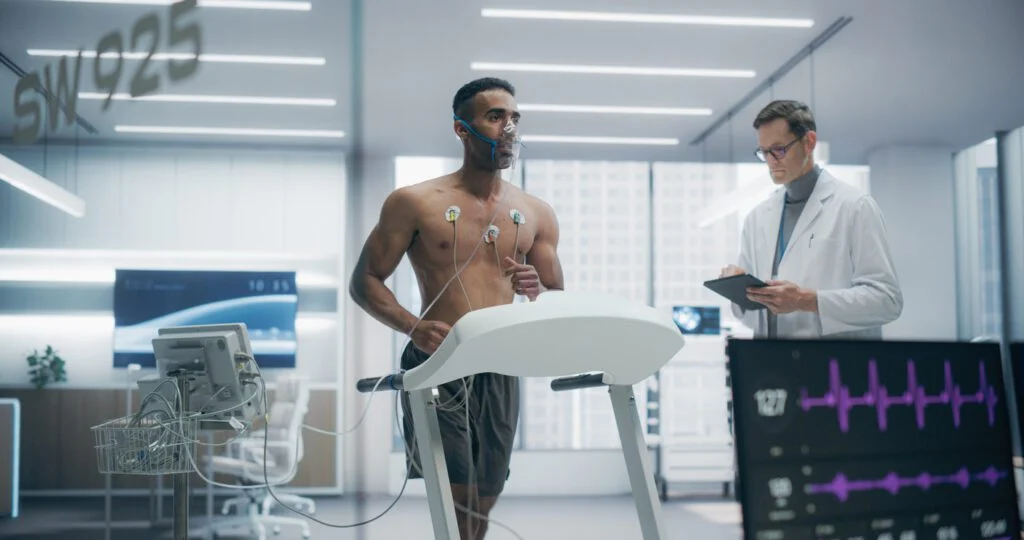
Perhaps the most robust indicator of physiological age is VO2 max—the maximum amount of oxygen your body can utilize during exercise. VO2 max typically declines by 10% per decade after age 30, but this decline can be slowed significantly through consistent cardiovascular training.
High VO2 max is inversely correlated with all-cause mortality. Whether through a professional lab test, a 1-mile walk test, or a 12-minute Cooper run, measuring your VO2 max provides an actionable goal: improve your aerobic capacity, and you improve your life expectancy.
Implications: Turning Data into Action
The most common mistake in the bio-age industry is the "Data-Action Gap." Gathering data without implementing change is a futile exercise. If a test shows you are aging prematurely, the solution is rarely a high-tech supplement; it is almost always the "boring" foundation of health:
- Consistent Sleep: The cornerstone of cellular repair.
- Strength Training: Essential for metabolic health and hormonal balance.
- Nutrient-Dense Nutrition: Fueling the body to minimize systemic inflammation.
- Stress Management: Reducing the cortisol that drives biological aging.
The Bottom Line
Biological age testing should be viewed as a compass, not a destination. It provides a baseline, a way to verify that your lifestyle choices are moving the needle in the right direction. However, these tests do not replace the fundamental requirements of a healthy life.
If you are a professional or an individual looking to optimize your health, remember that the most "anti-aging" intervention available is the consistent application of basic, proven health practices. Do not let the pursuit of a lower number on a test screen distract you from the work of living a better, stronger, and more resilient life.
For those interested in professional guidance, programs like the Level 1 Sleep, Stress Management, and Recovery (SSR) Coaching Certification provide the necessary tools to address the root causes of biological decline, helping individuals and clients move beyond the numbers and into sustainable, long-term health.