









In an era where modern medicine often focuses on the microscopic analysis of isolated symptoms, the ancient system of Ayurveda offers a radically different, holistic framework. Far from being a mere collection of herbal remedies, Ayurveda serves as a comprehensive "science of life" that maps the journey of consciousness into matter. By understanding the body through the lens of the Pancha Maha Bhutas—the five great elements—practitioners claim to reach the root of human health and existential well-being.
The Five Great Elements: The Building Blocks of Reality
To comprehend the Ayurvedic perspective, one must discard the periodic table and adopt a more fluid, experiential definition of matter. In this system, everything in the universe—organic or inorganic—is composed of five elements: Ether, Air, Fire, Water, and Earth.
These elements are not chemical substances, but states of matter defined by their qualities:
- Ether (Akasha): The field in which matter appears; the potential for manifestation. It is the most subtle element, characterized by space and non-resistance.
- Air (Vayu): The state of movement and gaseous transition.
- Fire (Tejas): The transformative energy; that which provides heat and light.
- Water (Jala): The cohesive, liquid factor that allows for fluidity and binding.
- Earth (Prithvi): The most gross and stable state of matter; that which provides structure and solid form.
This elemental hierarchy represents the evolutionary process of the universe. From the expansive, intangible nature of Ether to the dense, solid stability of Earth, these stages dictate how energy condenses into the tangible world.
Chronology: From Primordial Silence to Biological Form
The evolution of creation, according to the Sankhya philosophy—the philosophical foundation of Ayurveda—is a descent from singularity into multiplicity.
The Singularity
Before the onset of time and space, there existed a point of infinite potentiality—dimensionless, qualityless, and incomprehensible. This resonates strikingly with modern physics’ theory of the "Singularity" that preceded the Big Bang. In ancient thought, however, this was not a random event but a "divine play" (Lila), where the singularity desired to perceive itself, thereby fracturing into the individual experiences we call life.
The Primordial Vibration
As this consciousness began its descent, it manifested as sound—the Logos or the primordial "Om." This vibration created the fabric of spacetime, condensing into three primary qualities known as the Gunas:
- Sattva (Transparency/Beingness): The state of clarity and intelligence.
- Rajas (Passion/Movement): The force that drives change and interaction.
- Tamas (Inertia/Density): The stabilizing force that provides the "objective" world of matter.
Through the formation of Ahamkara (the ego or individual identity), consciousness becomes focused, allowing for the diverse array of lifeforms we observe today.
Supporting Data: The Practical Application of Elemental Theory
Ayurveda does not merely theorize; it provides a prescriptive roadmap for health based on the natural law: Like increases like, and opposites balance.
Clinical Case Study: The Cooling Cucumber
Consider the cucumber. Classified by its qualities—cold, liquid, heavy, and dispersing—it is rich in the Water element.
- The Scenario: A patient presents with a "burning" sensation or inflammation during the heat of summer.
- The Prescription: A practitioner would recommend the cooling properties of the cucumber to counteract the excessive Fire (heat) in the patient’s system.
- The Contraindication: Conversely, for a patient suffering from a runny nose or congestion during a damp, cold winter, the cucumber’s water-heavy nature would be considered detrimental, as it would increase the already-dominant Water and Earth qualities within the body, exacerbating the congestion.
The Six Tastes (Rasa)
Ayurvedic medicine classifies all substances—foods, herbs, and even environments—by their six tastes: sweet, sour, salty, pungent, bitter, and astringent. Each taste is a specific combination of the five elements and carries an "energetic potency" (heating or cooling). By matching the qualities of a substance to the needs of the individual, Ayurveda aims to restore homeostatic balance.
The Cognitive Interface: The Five Tanmatras
The bridge between the external world and our internal consciousness is built upon the Tanmatras—the subtle elements that correspond to our five cognitive senses.
- Ether (Sound): Perceived through the ears.
- Air (Touch): Perceived through the skin.
- Fire (Vision): Perceived through the eyes.
- Water (Taste): Perceived through the tongue.
- Earth (Smell): Perceived through the nose.
The sophistication of this system lies in its evolutionary logic: each successive element includes the attributes of the ones preceding it. For instance, while Ether is solely associated with sound, the Earth element encompasses sound, touch, vision, taste, and smell. This makes Earth the most complex and "complete" manifestation of consciousness into matter.
Implications: The Ultimate State of Health
The final objective of Ayurveda is not merely the absence of disease, but Swasthya—a term that translates to "being situated in one’s own true nature."
The Path to Liberation
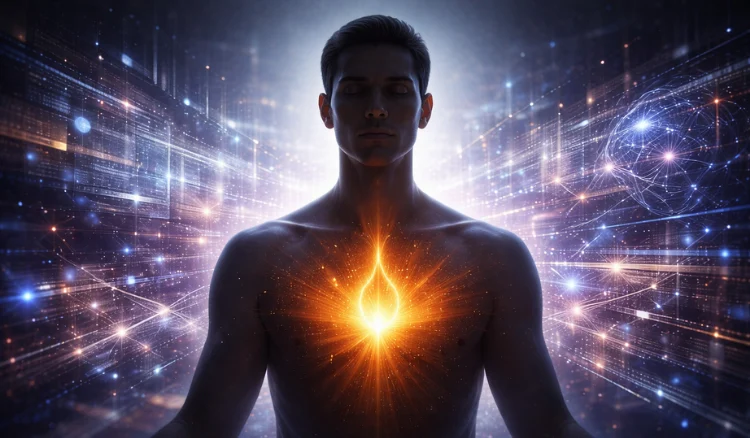
Ayurveda posits that the human mind is an extraordinary tool, but one prone to "fluctuations." When the mind is fully active yet emptied of content—a state of silence—it mirrors the singularity from which it emerged. Just as a droplet of water merges with the ocean to become the ocean, the human consciousness can transcend its limited identity (body, mind, and senses) to perceive the underlying unity of the cosmos.
Scientific and Spiritual Convergence
While modern science views the universe as a complex mechanical system, and ancient Indian philosophy views it as a "divine mirror," both fields agree on the concept of a substratum. Whether it is called the "quantum field" or the "primordial silence," the implication remains: human beings are not separate entities, but localized expressions of a universal field.
Official Perspective and Conclusion
The integration of Ayurvedic principles into contemporary wellness represents a significant shift in how we perceive the human body. By moving away from a "one-size-fits-all" model, practitioners argue that we can honor the unique elemental makeup of every individual.
Critics of traditional systems often demand randomized clinical trials and standardized molecular targets. However, the Ayurvedic tradition counters that because "qualities are relative," a fixed treatment for all people ignores the context of time, space, and individual constitution.
As we continue to navigate the complexities of modern health, the ancient wisdom of the Pancha Maha Bhutas offers a timeless reminder: we are made of the same elements as the stars and the soil. Our health is not a battle against our biology, but a process of aligning our unique, temporary manifestation with the eternal, expansive intelligence that sustains all life. Through this understanding, we find not only physical vitality but a profound connection to the origin of our existence.