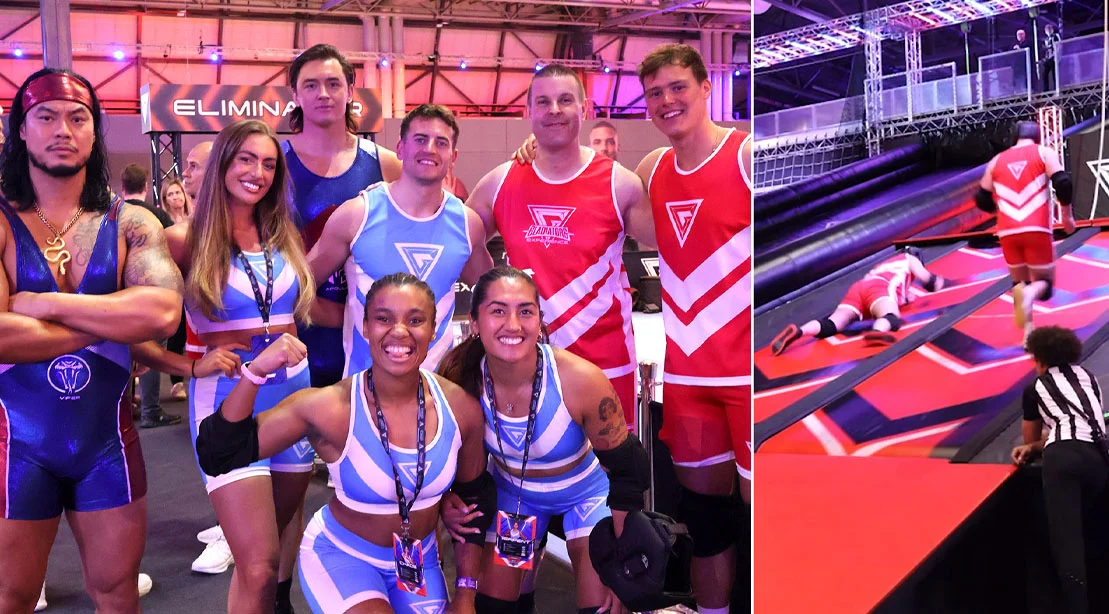
The resurgence of Gladiators is more than just a television revival; it is a global cultural phenomenon. Since the original American Gladiators debuted in 1989, the format has remained a staple of athletic entertainment, but the recent, high-octane reboots in Australia, France, and the United Kingdom have injected a new level of intensity into the brand. For a generation that grew up watching contenders tackle the "Travelator" from the safety of their living rooms, the fantasy of entering the arena has always been a distant, exhilarating dream.
That dream has now materialized in the United Kingdom. At the National Exhibition Centre (NEC) in Birmingham, the world’s first "Gladiators Experience" has officially opened its doors, allowing everyday fitness enthusiasts to test their mettle against the very obstacles that define the show. As a fitness writer for Muscle & Fitness—someone who has survived training sessions with the world’s strongest men, endured the bruising reality of pro wrestling, and felt the raw force of the England Rugby League Team—I have learned that the joy of sport is rarely reserved for the elite. I traveled to Birmingham to see if I, a self-confessed "Gladiators" superfan, could survive the ultimate test of human willpower: The Eliminator.
The Chronology of an Arena Assault
My original mandate for this assignment was straightforward: a journalistic walk-through, documenting the architecture of the course and the logistics of the experience. I intended to keep my sneakers clean and my ego intact. However, the atmosphere at the NEC is designed to dismantle such intentions.
Shortly after my arrival, I was approached by Nathan Bland, a genuine contender from the recent television series and a record-breaking finisher of the course. With a smile that was equal parts welcoming and competitive, he posed a simple question: "Do you want to race?"
In the interest of professional curiosity, I accepted. The whistle blew, and the sterile environment of a exhibition hall vanished, replaced by the thumping bass and high-stakes tension of the televised arena.
The Course: A Physical Breakdown
The Eliminator is an unforgiving gauntlet designed to test explosive power, coordination, and mental grit. Navigating it in real-time is a stark reminder of why the show’s stars are considered elite athletes.
- The Initial Obstacle Beams: These require immediate, high-impact verticality. A "big jump" is the only way to clear the gap, forcing the heart rate to spike within the first five seconds.
- The Balance Beams: After a rope-assisted climb to the raised platform, the challenge shifts from power to poise. Balancing under the fatigue of the initial burst requires significant core stability.
- The Cargo Net: This is the segment that truly separates the contenders from the tourists. Scaling the net into the rafters, I felt the familiar burn of lactic acid flooding my deltoids. As Bland noted while I struggled, this is the "worst part"—the moment where the mind starts to negotiate with the body to quit.
- The Zip Wire and Travelator: The descent from the rafters via zip wire ended with a crash landing that provided a visceral reminder of the impact forces involved in the sport. Recovering from that, I faced the legendary Travelator. Running against a moving belt is an exercise in futility if your technique falters, and I found myself face-down on the mat before scrambling up to swing through the final finish line.
Despite the bruises and the temporary loss of dignity, the experience was profoundly rewarding. I was battered, exhausted, and completely invigorated.
Supporting Data: The Anatomy of a Gladiator
What makes the Gladiators Experience truly unique is not just the ability to run the course, but the opportunity to understand the specific physiological demands placed on the Gladiators themselves. During my visit, I spoke with several of the show’s stars, each of whom brings a unique pedigree to the arena.
The misconception that all Gladiators are inherently good at every event is quickly dispelled when you analyze their backgrounds. For instance, Gladiator Fire (Montell Douglas), a former Olympian and the British record-holder for the 100m sprint (11.05 seconds), admits that speed does not translate to every discipline. "The more you do it, the better you get," Fire explains. "Tackling events like ‘Hang Tough,’ where you have to swing through rings, is an entirely different kind of physical problem-solving than sprinting."
Similarly, Gladiator Electro (Jade Packer), an IFBB Pro Bodybuilder and world-class sprinter, notes that the pressure of one-shot events like "Unleashed" is immense. "You don’t get a second chance to catch your contender," she says. "The pace is set, and if you miss your window, the game is over."
The disparity in physical profiles is telling:
- Athena (Karenjeet Kaur Bains): A powerhouse in strength events, she notes that her low center of gravity is an asset in some areas but a hurdle in high-altitude events.
- Diamond (Livi Sheldon): Favors the structural complexity of "The Wall."
- Cyclone (Lystus Ebsosel): Openly admits that "The Wall" is a struggle, illustrating that even these titans of fitness have a "kryptonite."
Official Perspectives: The Philosophy of Competition
The culture of the Gladiators Experience is intentionally grounded in the "tough love" philosophy of the show. It is not designed to be an easy win for the customer; it is designed to be an honest test.
Gladiator Phantom describes his approach to contenders as one of disciplined mentorship. "To begin with, I am not your friend," he says, with the intensity one would expect from an elite competitor. "I want you to do the job without handouts. I want you to bring your best self. Only then, at the end of it, can we break bread."
This sentiment is echoed by the other performers, who view the NEC installation as a bridge between the screen and the public. "It’s about bringing what we do to life," says Fire. "It’s about showing the fans just how tough, and how incredibly fun, this sport really is."
Implications: Finding the Hero Within
The true value of the Gladiators Experience lies in its accessibility. While the participants are not required to be professional athletes, the environment demands a "contender mindset."
The implications for the average fitness enthusiast are significant. By participating in an environment that simulates elite-level pressure, individuals are forced to step outside their comfort zones. Whether it is the fear of heights on the zip wire or the sheer physical exhaustion of the cargo net, the course provides a mirror for one’s own limitations.
The "Gladiators Experience" is a testament to the fact that fitness is a journey of continuous improvement. The performers themselves are constantly refining their craft, acknowledging their weaknesses, and pushing past their perceived ceilings. If a world-class sprinter like Fire can struggle with the rings, or a powerhouse like Athena can find the high-altitude events taxing, it gives the average person permission to be a work in progress.
In an age of curated social media fitness, where results are often displayed without the struggle, the Gladiators Experience offers something rare: a high-stakes, authentic environment where failure is part of the process. You may not win. You may fall on your face. You will likely be sore the next day. But as I discovered on the floor of the Birmingham NEC, there is a certain, undeniable pride in "leaving it all on the floor."
The Gladiators Experience is more than a theme park attraction; it is a laboratory for human potential. It challenges us to stop watching and start doing, proving that the hero we see on the screen is not a creature from another planet, but a person who simply chose to endure the struggle a little longer than the rest.
The Gladiators Experience continues at the NEC in Birmingham, England, through August 31, 2026. For more information, visit the official website.