





For thousands of years, the ancient Indian medical system of Ayurveda has viewed the human body not merely as a machine of biological processes, but as a dynamic field of energy and consciousness. Central to this holistic philosophy is the practice of Ayurvedic massage—a sophisticated therapeutic modality that transcends the modern concept of "relaxation" to serve as a profound system of palliative (Shamana) and purificatory (Shodhana) care. By utilizing intentional, expert touch, practitioners aim to return the body and mind to a state of equilibrium, tapping into the body’s innate ability to heal itself.
The Foundations of Ayurvedic Bodywork
The methodologies of Ayurvedic massage are rooted in the Brhat Trayi—the "Great Three" texts of Ayurveda, which include the seminal works of Caraka, Sushruta, and Vagbhata. These practices were further refined in historical treatises such as the Bhavaprakasha and the Yogaratnakara.
Historically, these techniques were not reserved for the sedentary; they were vital tools used to support the endurance of warriors, enhance the physical conditioning of athletes, and facilitate reproductive health. Moreover, they played a critical role in specialized clinical applications, such as postpartum recovery and preventative health maintenance, long before the modern wellness industry codified these practices.
The Physics of Wellness: Elements and Doshas
To understand Ayurvedic massage, one must first understand the Pancha Mahabhuta, or the five great elements: Space, Air, Fire, Water, and Earth. In the human physiology, these elements coalesce into the three Doshas, the energetic forces that govern our physical and mental makeup:
- Vata: Composed of Space and Air; it governs movement and communication.
- Pitta: Composed of Fire and Water; it regulates metabolism and transformation.
- Kapha: Composed of Water and Earth; it provides structure and lubrication.
Ayurvedic massage is fundamentally a reactive and corrective therapy. When a Dosha becomes vitiated or imbalanced, the practitioner selects specific techniques, oils, and herbs that possess the "opposite qualities" to neutralize the excess. This adherence to the principle of "like increases like" versus "opposites balance" allows for a highly nuanced approach to treatment.
Individualized Care: The Science of Precision
Unlike contemporary spa massages that often follow a standardized "one-size-fits-all" menu, an authentic Ayurvedic massage is a highly individualized intervention. The practitioner performs a deep assessment of the recipient’s Prakruti (unique birth constitution) and Vikruti (current state of imbalance).
Crucially, the practitioner evaluates Agni (the digestive fire) and the presence of Ama (metabolic toxins). If Ama is high, traditional oil-based massage may be contraindicated, as the heavy, sticky nature of the oil can inadvertently trap toxins. In such cases, the practitioner may opt for Udvartana—a vigorous dry massage using herbal powders to "scrub" away stagnant energies and stimulate lymphatic drainage.
The selection of oil is equally intentional. For the cooling and grounding of a Vata imbalance, heavy, warming oils like sesame are preferred. For Pitta conditions, which often manifest as inflammation or redness, cooling coconut or sunflower oils are utilized. Kapha types, conversely, benefit from lighter, heating oils like mustard to cut through congestion and stagnation.
Vata and the Mind: The Power of Tactile Healing
According to Samkhya philosophy, the air element is inextricably linked to the sense of touch (Sparshendriya). Because Vata is composed of air and space, individuals with a Vata constitution—or those suffering from Vata-related mental health challenges such as anxiety or insomnia—respond profoundly to tactile therapy.
The skin, known as Tvak, is governed by Bhrajaka Pitta, which is responsible for the body’s luster and complexion. Through the regular application of medicated oils, the practitioner "feeds" the skin. This nutrition does not merely stay on the surface; through repeated exposure, the healing properties of the infused herbs penetrate the deeper tissues, including the muscles, nerves, and organs, effectively nourishing the body’s internal Agni through the largest organ we possess.
Categories and Modalities of Ayurvedic Massage
Abhyanga: The Practice of Oleation
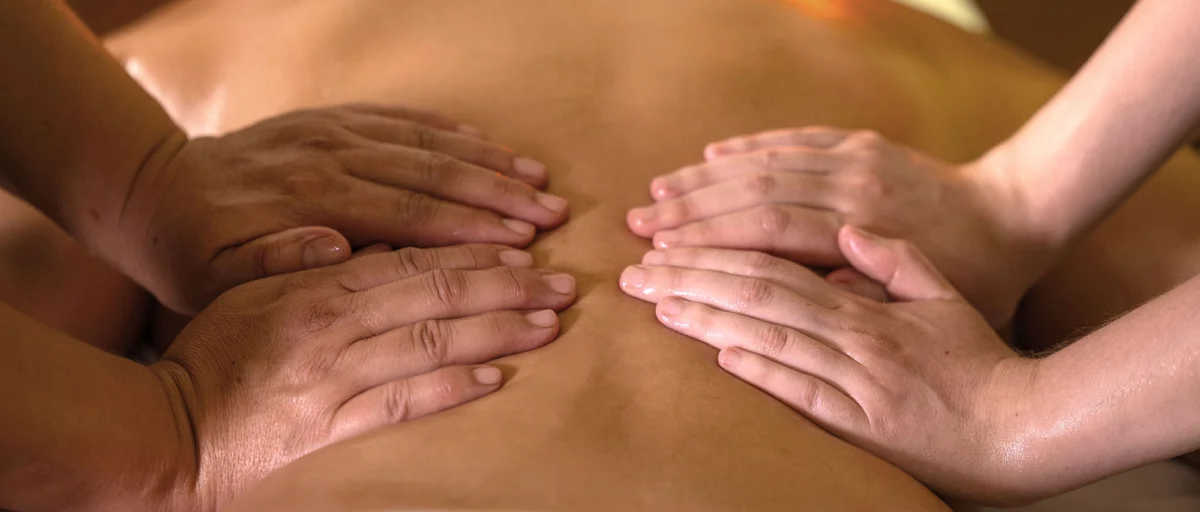
Abhyanga is perhaps the most recognized form of Ayurvedic bodywork. It involves the rhythmic application of warm, herbalized oils. Whether performed as self-massage or administered by one or two therapists (the latter being a four-handed, deeply immersive experience), the goal is Snehan.
In Sanskrit, Snehan translates to both "oil" and "love." The practice is viewed as the physical manifestation of love, aimed at harmonizing the cells of the body. In advanced detoxification protocols like Panchakarma, Abhyanga is used to loosen accumulated toxins, allowing them to move toward the digestive tract for elimination. Specialized formulations like Dhanvantaram Tailam—named after the divine physician Dhanvantari—are specifically engineered for deep Vata pacification and neurological support.
Udvartana and Specialized Techniques
While Abhyanga focuses on oil, Udvartana focuses on friction. This category of treatment includes:
- Udsadana: The use of dry, heated herbal powders for aesthetic and structural refinement.
- Udgarshana: The use of herbal pastes (mixed with water or oil) to treat localized skin conditions.
These are supplemented by directional strokes—Anuloma (away from the heart, grounding) and Pratiloma (toward the heart, stimulating)—and a variety of manual manipulations, including Peedana (kneading), Udvesthana (twisting/wringing), and Sandhi Calana (joint mobilization).
Marma Therapy: The Energetic Gateway
One of the most profound aspects of Ayurvedic bodywork is Marma therapy. Marma points are anatomical junctions where muscles, veins, ligaments, bones, and joints meet. These are not merely physical locations but energetic "gateways" that govern the flow of Prana (life force).
While often compared to Chinese acupuncture, Marma therapy is distinct in its application. The points are generally larger and do not always require needles; instead, they are stimulated through light, precise pressure, often using specialized essential oils to unlock stagnant energy. By stimulating these points, practitioners can trigger the body’s "inner pharmacy," promoting healing at the physical, mental, and emotional levels.
Implications for Modern Healthcare
The enduring relevance of Ayurvedic massage lies in its bridge between the physical and the subtle. As the global medical community shifts toward integrative health, the lessons offered by these ancient traditions become increasingly vital.
The emphasis on individualized treatment, the recognition of the skin as a digestive organ, and the acknowledgment of the mind-body connection through the medium of touch represent a paradigm shift from symptomatic treatment to systemic wellness. By honoring the specific Doshic needs of the individual and recognizing the interconnectedness of our internal and external environments, Ayurvedic massage continues to offer a roadmap for longevity, vitality, and deep, restorative peace.
Conclusion: The Path Forward
For those seeking to deepen their understanding of these ancient modalities, the journey is one of lifelong learning. The mastery of Marma therapy and the nuanced application of herbalized oils require both technical skill and a heart-centered approach. As practitioners like Beatrice Voss, CAP, note, the lineage of these practices is not just a set of instructions, but a sacred tradition of healing that connects us to the wisdom of the past while providing essential support for the complexities of modern living. Whether for physical recovery or the calming of a restless mind, the science of Ayurvedic massage remains a timeless pillar of human health.