









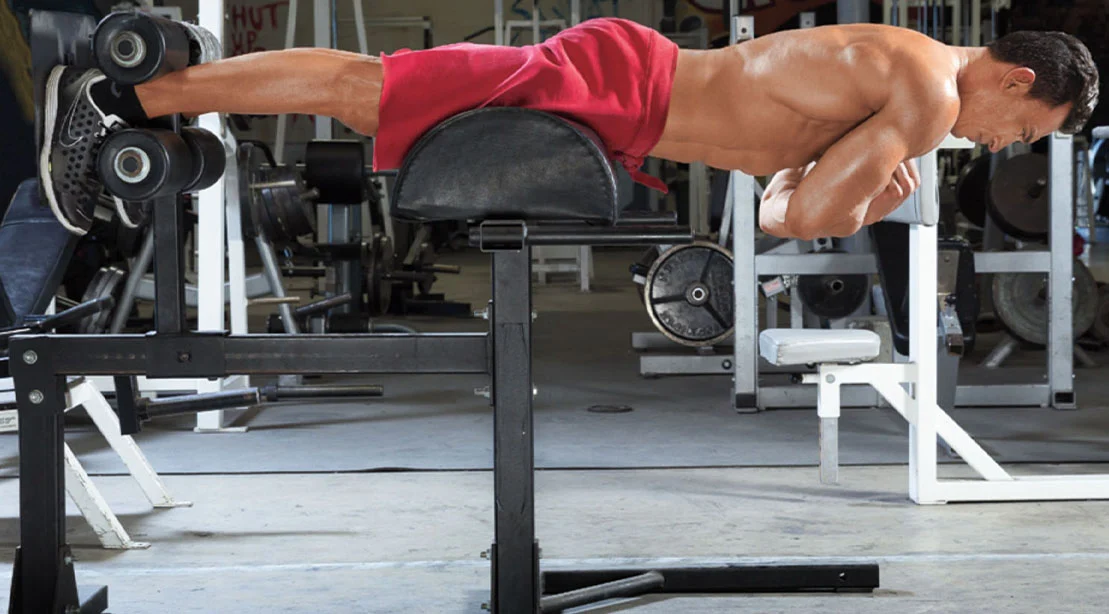
Watching an elite athlete perform a set of Glute-Ham Raises (GHR) can be deceptive. The movement looks fluid, almost effortless, as they hinge at the knees and drive back to vertical with seemingly minimal strain. For the uninitiated, the GHR is often viewed as a simple leg-curling variation. However, those who have actually stepped onto the machine know the truth: the GHR is a brutal, high-tension exercise that exposes every weakness in your posterior chain.
When a lifter fails on the GHR, it is rarely a lack of raw muscle mass that is the culprit. More often, it is a catastrophic breakdown in setup and structural tension. If you aren’t positioned correctly before the first repetition, you aren’t training your hamstrings—you are merely fighting gravity in an unstable, inefficient posture.
This guide serves as the definitive protocol for mastering the GHR, moving beyond the basics to ensure that every rep is a high-quality stimulus for your glutes and hamstrings.
The Anatomy of Success: Why Setup Determines Performance
The Glute-Ham Raise is technically complex because it requires simultaneous knee flexion and hip stabilization. Unlike a machine leg curl, where the pad supports your femur and the machine handles the path of motion, the GHR requires you to stabilize your own torso against the force of gravity.
The Core Principles of the GHR
To unlock the benefits of the GHR—hypertrophy, injury prevention, and improved athletic output—you must adhere to four immutable pillars:
- Strategic Knee Placement: Proper alignment ensures the hamstrings can operate through their full functional range of motion without impingement.
- Stable Foot Anchorage: Your feet serve as the pivot point. Any slippage here results in a dissipation of force.
- The "Lever" Concept: Your body from knees to head must act as a single, rigid, unbending steel rod.
- Pre-Repetition Tension: You cannot "turn on" your hamstrings halfway through the movement. You must establish tension before you ever begin the descent.
The Chronology of a Perfect Repetition
Many lifters make the mistake of rushing the setup, viewing it as "dead time" before the real work begins. In reality, the setup is the work. Following a systematic, chronological approach to your setup is the only way to ensure consistent performance.
Step 1: Precision Engineering of the Footplate and Pad
Before you even think about bracing, the machine must be tailored to your anthropometry. Because limb lengths vary wildly, a "one-size-fits-all" approach to machine settings is a recipe for failure.
The Metric: Your knees should be positioned just behind the crest of the pad. If they are too far forward, you will feel trapped; if they are too far back, you will lose the leverage needed to drive the movement.
- Internal Cue: Think "Knees supported, not pinned."
- External Cue: Position the knee joint slightly behind the pad’s apex.
- Coach’s Pro-Tip: Perform a "Dry Run." Before loading your effort, lean forward three inches. If you feel a shearing force in your knees or a lack of balance, adjust the footplate distance.
Step 2: Ankle Integrity and Force Transfer
Your feet are the foundation. If your feet are loose, your hamstrings will be firing into a vacuum. You need to drive your toes and the balls of your feet firmly into the plate, treating the footplate as if you are trying to push it through the wall behind you. This creates a "stiffness" that travels up the kinetic chain.
Step 3: Establishing the Rigid Lever
The most common error in GHR performance is the "break" in the body line. If your hips sag or your lower back arches, you have effectively neutralized the mechanical disadvantage the GHR is designed to provide.
- The Goal: A perfectly straight line from the crown of your head to your knees.
- The Visualization: Imagine your body is a stiff wooden plank hinged only at the knee. If you bend at the waist, you have failed the structural requirement of the lift.
Step 4: The Art of Pre-Tensioning
Just as you pull the "slack" out of a barbell before a heavy deadlift, you must pull the slack out of your posterior chain. Before you lower your torso, actively squeeze your glutes and pull your heels into the pad. This co-contraction of the hamstrings and glutes creates a localized stability that protects the lumbar spine and maximizes fiber recruitment.
Supporting Data: Why the GHR Outperforms Other Exercises
The Glute-Ham Raise is arguably the "king" of the posterior chain because it creates a unique training stimulus. Unlike the seated leg curl, which is an isolation movement, the GHR forces the entire posterior chain—including the spinal erectors—to work isometrically while the hamstrings perform dynamic knee flexion.
Biomechanical Implications
- Functional Hypertrophy: Research indicates that the GHR places a high demand on the long head of the biceps femoris, a muscle critical for sprint speed and knee stability.
- Lumbar Resilience: Because the core must remain braced throughout the movement, the GHR acts as an advanced anti-extension exercise, strengthening the muscles that support the spine under load.
- Athletic Transfer: Athletes who prioritize the GHR see improvements in explosive jumping and sprinting mechanics, as the exercise reinforces the ability to maintain a rigid torso while moving the lower limbs.
Expert Commentary: The "Green Light" Checklist
To standardize your training, we spoke with several strength coaches who emphasize a "Green Light" protocol. Before every single rep, regardless of whether you are in your first or final set, you must mentally tick these boxes:
- Footplate Check: Are my toes driven in?
- Knee Alignment: Are my knees just behind the pad?
- Pelvic Position: Are my ribs "down" and my glutes squeezed?
- Tension Check: Is my core braced as if expecting a punch?
If these four criteria are not met, the "Green Light" is off. Resetting takes five seconds; recovering from a lower-back strain caused by poor form takes weeks.
Addressing Common Failures
The "Back Extension" Trap
Many lifters turn the GHR into a back extension by allowing their torso to drop and then using their lower back to "yank" the body back to center. This is not only ineffective for the hamstrings; it is dangerous for the lumbar discs.
- The Fix: Think about driving your heels into the pad to pull your body up, rather than using your upper back to lift. Keep your chin tucked to avoid hyperextending the cervical spine.
The "Hip Hinge" Hybrid
If you feel your butt pushing back or your hips folding, you are essentially performing a poor imitation of a good morning.
- The Fix: Visualize a steel rod running from your head to your knees. If you feel your hips moving independently of your shoulders, stop. Re-engage your glutes immediately.
Implications for Long-Term Programming
Integrating the GHR into your program requires a respect for its intensity. Because of the high eccentric load, the GHR can leave you significantly sore.
Programming Recommendations:
- Frequency: 1–2 times per week.
- Volume: Focus on quality over quantity. 3 sets of 8–10 controlled reps are infinitely better than 5 sets of 15 "sloppy" reps.
- Assisted Progression: If you cannot complete a full rep, use a band or a PVC pipe for balance. There is no shame in assisted GHRs; the shame lies in performing an exercise incorrectly just to satisfy an ego-driven rep count.
Final Reflections
The Glute-Ham Raise is a litmus test for the serious lifter. It demands patience, precision, and an almost obsessive attention to detail. By mastering the setup, you transform the machine from a piece of equipment into a precision tool for building a world-class posterior chain.
The secret is simple: stop trying to "crank out" reps and start trying to "master" them. Once you view the GHR as a skill-based movement rather than a strength test, your gains will move from stagnant to significant. Keep your knees aligned, your core braced, and your body rigid—and prepare for the posterior development you’ve been chasing.